Analisi esperta di Still Life di Endre Balint
Stile: Expressionism · Genere: still life
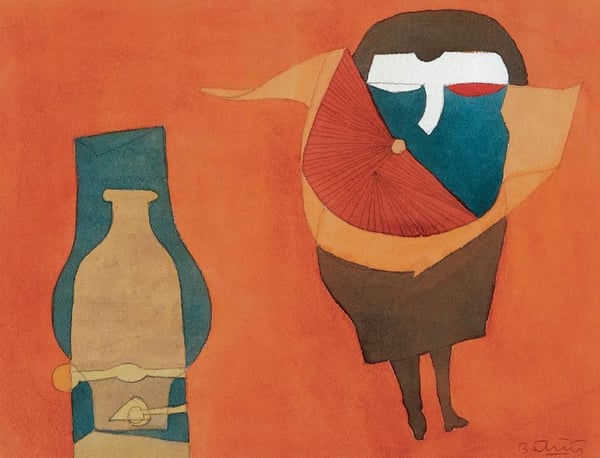
Expert Art Historical Analysis: "Still Life" by Endre Bálint
Style & Period Context
Endre Bálint (1914–1986) was a pivotal figure in Hungarian modernism, closely associated with the post-war European School of Budapest. While his mature work often fused Expressionist intensity with Surrealist fragmentation, Still Life exemplifies his early-to-mid-career engagement with Expressionism—a movement that prioritized emotional truth over objective representation. In this painting, Bálint pushes the conventions of still life (ordinarily a genre of quiet order) into a realm of psychological tension and subjective distortion.
Formal Analysis
Typical of Expressionist still lifes, Bálint’s composition likely abandons naturalistic perspective in favor of flattened, tilted planes that press objects toward the picture surface. Tables, bowls, and fruits become almost abstract symbols—their contours exaggerated, their colors heightened beyond nature. The palette is probably dominated by unsettling contrasts (e.g., acidic greens against deep reds or muddy browns), creating a sense of disquiet rather than harmony. Brushwork would be vigorous, often impastoed, leaving visible traces of the artist’s emotional urgency.
Significance within Expressionism
What makes Bálint’s Still Life notable is its transformation of a domestic motif into a vehicle for existential unease. Unlike the decorative still lifes of Impressionism or the analytical arrangements of Cubism, Bálint’s version uses the genre to channel personal and collective anxiety—a hallmark of post-World War II Central European Expressionism. The ordinary objects (fruit, bottles, cloth) appear charged with symbolic weight: their distorted forms may suggest fragility, decay, or the dislocation of everyday life under political turmoil.
Legacy
Bálint’s Still Life bridges the raw emotionalism of early 20th-century German Expressionism with the poetic surrealism that later defined his oeuvre. It demonstrates how the still life genre could be reimagined as a psychological landscape, where the artist’s inner world shapes the seen world. This work is therefore significant for showing that even the most traditional subjects could be revitalized by Expressionism’s commitment to subjective truth—a lesson that influenced subsequent generations of Hungarian avant-garde painters.
Genere
Stile
Visivamente simili
20 opere con composizione e palette affini
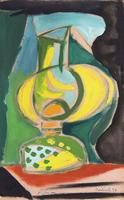
Bálint Endre, Csendélet 1947
Endre Balint
Breakfast
Fernand Leger
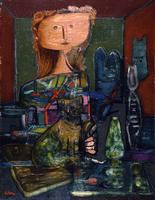
Woman with a Cat
Jankel Adler
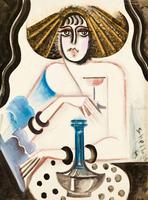
Scheiber Hugó Éjszakai Bárban
Scheiber Hugó
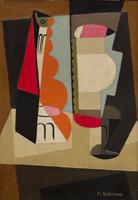
Cubist Composition
Maria Blanchard
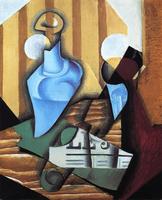
Still Life with Bottle and Glass
Juan Gris
Bust of a woman
Pablo Picasso
Lampade
Gustavo Foppiani
Composition with Paraffine Lamp, Vase and Book
Sandor Bortnyik
Untitled
Albert Gleizes
Bild
Pablo Picasso
Angel Still Feminine
Paul Klee
Bortnyik Sándor, Kompozició Lámpával.
Sandor Bortnyik
La bouteille
Henri Laurens
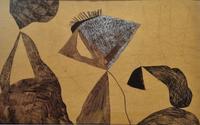
Vajda Lajos Composition, 1939, Pencil and Indian Ink on Paper, 62,8x89.5cm
Vajda Lajos
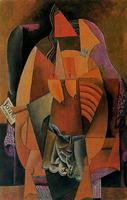
Woman with a shirt sitting in a chair
Pablo Picasso
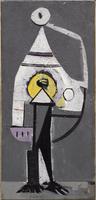
The Barber (Composition No. 5)
Arshile Gorky
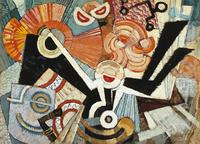
Syncopated Accompaniment (staccato)
Frantisek Kupka
Bodegón Cubista
Maria Blanchard
Portrait (Head)
Arshile Gorky