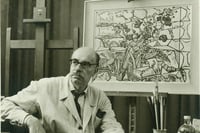
Expert analysis of Nikos Hadjikyriakos-Ghikas’s Paris Roofs II
Style: Cubism · Genre: cityscape
Expert Analysis: "Paris Roofs II" by Nikos Hadjikyriakos-Ghikas
Nikos Hadjikyriakos-Ghikas (1906–1994) was a pivotal figure in the Greek modernist movement, known for synthesizing the revolutionary visual language of European Cubism with the luminous, planar geometries of his native Aegean landscape. "Paris Roofs II"—a cityscape executed in the Cubist style—stands as a significant work not only for its technical mastery but for its role in bridging the Parisian avant-garde and the emerging modernist identity of Greek art.
What makes this work significant within Cubism and its period:
-
Cubist Dissection of the Urban Landscape
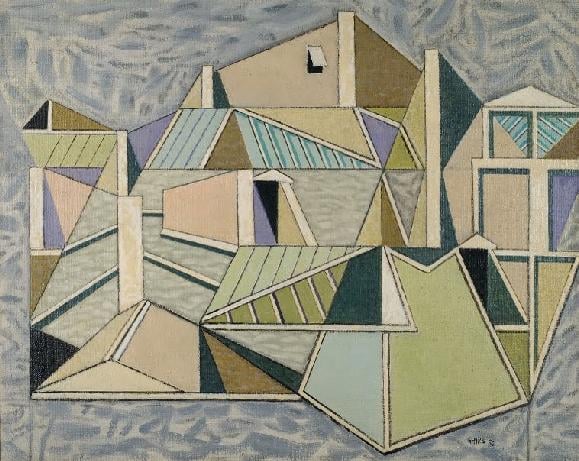
True to Cubist principles, Ghikas fractures the traditional roofscape into a mosaic of interlocking planes and faceted geometric shards. Instead of depicting a single, fixed viewpoint, he presents multiple perspectives simultaneously: rooftops tilt upward, chimneys slide sideways, and sky is collapsed into angular fields. This systematic deconstruction of a familiar subject—the Parisian skyline—echoes the analytical phase of Cubism pioneered by Picasso and Braque, yet Ghikas retains a distinctive sense of rhythm and a slightly more lyrical, decorative order. -
Dynamic Composition and Chromatic Restraint
The palette is characteristically Cubist early-modern: muted ochres, grays, blues, and muted greens, with perhaps an accent of warm terra-cotta or pale sky. This restricted color scheme allows the viewer to focus on the structural interplay of line and plane. The composition pulses with diagonal energy, leading the eye over tilted roof tiles and through negative spaces that feel both architectural and abstract. -
Signature Greek Modernist Tendencies
While firmly rooted in Parisian Cubism, "Paris Roofs II" reveals Ghikas’s enduring preoccupation with clarity and light. The facetted surfaces often flatten into near-geometric blocky forms—a stylistic foreshadowing of the more abstract, “light-dissecting” works he later created back in Greece. This painting is a crucial transitional piece, demonstrating how Ghikas adapted rigorous European modernism into a visual language that could later articulate the stark, sun-drenched architecture of the Cyclades. -
Cultural Bridge: Paris and Athens
Ghikas spent a formative period in Paris in the 1920s and 1930s, where he exhibited alongside Chagall, Miró, and other École de Paris figures. "Paris Roofs II" exemplifies his ability to absorb the principles of Cubism and make them his own—infusing the analytical geometry of Paris with a Mediterranean sense of decorative pattern and poise. The painting thus represents both an homage to the Cubist cityscape tradition and a declaration of artistic independence, as Ghikas would later become the foremost exponent of Greek modernist painting.
In summary, "Paris Roofs II" is significant for its refined Cubist language, its role in Ghikas’s development as a national modernist, and its testament to the international reach of Cubist ideas. It is a work that transforms a quotidian Parisian view into a vibrant, multidimensional structure—affirming Ghikas’s place as a vital interpreter of early 20th-century abstraction.
Visually similar
20 works with related composition and palette
L’intérieur D’une Maison
Jacqueline Lamba
Pious northern landscape
Paul Klee
With the Egg
Paul Klee
Dream City
Paul Klee
Red and Yellow with Bird
Jagdish Swaminathan
Composition
Alexandre Istrati
Composition
Alexander Rodchenko
The Window
Hans Hofmann
Night Subway
Jimmy Ernst
Modok Mária. Szentendrei Háztetők 1940
Modok Mária
In the Garden
Kenneth Noland
Modok Mária, Szentendrei Tetők 1940
Modok Mária
Crystalline Landscape
Paul Klee
Cin-Zin
Karl Knaths
Cargo suédois au Radoub
Gustave Singier
Le village
Georges Valmier
Vers le port
Albert Gleizes
Play of Planes
Karl Knaths
Costruzione spaziale - paesaggio
Enrico Prampolini
Sur fond gris n. 10
Alberto Magnelli