Analisi esperta di The Cross di Ivan Milev
Stile: Art Nouveau (Modern), Symbolism · Genere: genre painting
Expert Analysis: "The Cross" by Ivan Milev
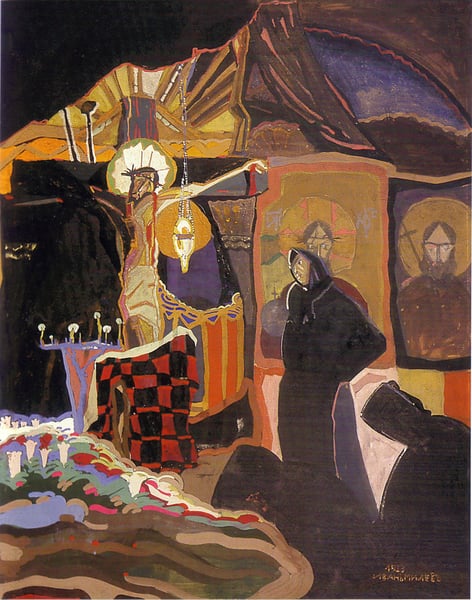
Ivan Milev’s “The Cross” stands as a masterful synthesis of Art Nouveau’s decorative fluidity and Symbolism’s spiritual depth, refracted through a distinctly Bulgarian lens. As a genre painting, it depicts an everyday scene—perhaps a rural ritual or personal devotion—elevated to a transcendent plane. Milev’s significance lies in his role as a bridge between Western European modernism and the national artistic awakening of early 20th-century Bulgaria.
Composition and Style: The work likely employs Art Nouveau’s signature sinuous lines and organic motifs—curving vine-like forms, stylized foliage, and a flattened picture plane—to frame the central cross. The cross itself may be rendered not as a rigid symbol but as a living, almost botanical structure, intertwining with human figures or a landscape. This treatment reflects Symbolism’s preference for evocative, ambiguous imagery over literal narrative.
Color and Mood: Milev’s palette often juxtaposes deep, earthy tones (umber, ochre, olive) with luminous accents (gold, crimson, or blue), creating an atmosphere of solemn mysticism. The cross becomes a focal point of light or shadow, suggesting both suffering and redemption—a duality central to Symbolist thought.
Cultural Significance: What makes “The Cross” truly remarkable is how Milev infuses Art Nouveau’s international aesthetic with Bulgarian folk traditions. The cross, a ubiquitous Christian symbol in Orthodox culture, is reimagined through local embroidery patterns, ceramic glazes, or iconographic conventions. This fusion challenges the purely ornamental nature of Art Nouveau, giving it a nationalistic and spiritual charge.
Thematic Depth: The painting transcends its genre roots by using a mundane rural scene to explore universal themes: faith, mortality, and the intersection of the divine with human labor. Milev’s cross is not merely a religious object but a cipher for the Bulgarian soul—rooted in the soil, yet reaching toward modernity.
In essence, “The Cross” exemplifies Milev’s unique contribution to modernism: a project that honors the symbolic richness of his heritage while engaging fully with the formal innovations of his time. It is a quiet, powerful testament to how art can negotiate tradition and progress.
Genere
Visivamente simili
20 opere con composizione e palette affini
Kondor Béla, Krisztus 2
Kondor Béla
Virgin with Divine Infant - Crucifixion
Konstantinos Parthenis
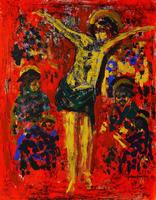
Jesus
George Stefanescu
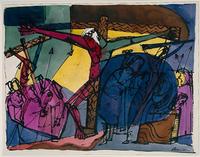
Golgotha
Romare Bearden
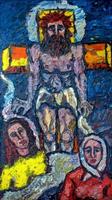
Modern Christ
Endre Bartos
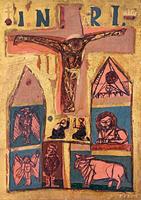
Kondor Béla, Szerb Krisztus
Kondor Béla
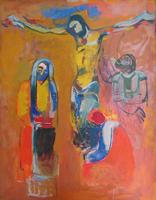
Crucification
Minas Avetisyan
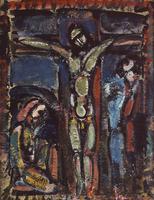
Crucifixion
Georges Rouault
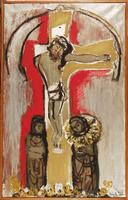
Hungarian Christ
Piroska Szanto
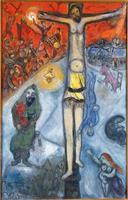
Resurrection
Marc Chagall
Exodus
Marc Chagall
The Crucifixion
Odilon Redon
Jesus
George Stefanescu
Kondor Béla, Pléhkrisztus
Kondor Béla
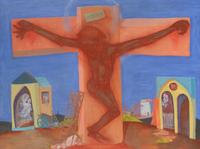
Kondor Béla, Pléhkrisztus
Kondor Béla
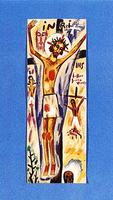
Jesús Crucifio
Xul Solar
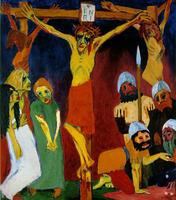
Crucifixion
Emil Nolde
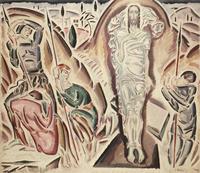
The Resurrection
Konstantinos Parthenis
Crucifixion (Golgotha)
Oskar Kokoschka
The Deposition
Graham Sutherland