Niko Pirosmani sanatçısının Celebration in Bolnisi-Khachini eseri hakkında uzman analizi
Tarz: Naïve Art (Primitivism) · Tür: genre painting
Expert Analysis of "Celebration in Bolnisi-Khachini" by Niko Pirosmani
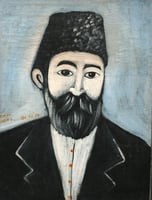
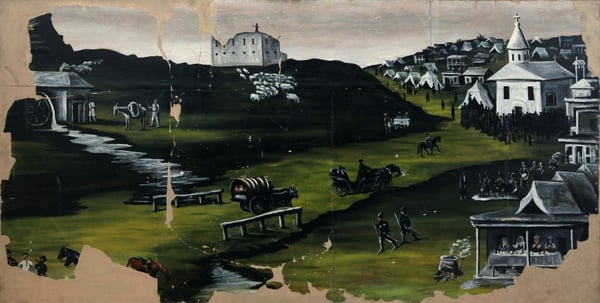
Niko Pirosmani’s “Celebration in Bolnisi-Khachini” stands as a quintessential example of Naïve Art (Primitivism) and genre painting, encapsulating the raw vitality and cultural authenticity that define the artist’s most significant contributions to early 20th‑century art. The work’s importance lies in how it synthesizes the hallmarks of its style and period—unaffected simplicity, direct observation of communal life, and a deeply personal visual language—to elevate a humble festivity into a timeless, emotionally resonant tableau.
Significance within Naïve Art (Primitivism)
As a leading figure of Naïve Art, Pirosmani rejected academic conventions and instead embraced a self‑taught, intuitive approach. In “Celebration in Bolnisi-Khachini,” this manifests in the deliberate flattening of space, the bold, unmodulated use of color, and the disregard for linear perspective—all characteristic of Primitivism. The figures are arranged in a frieze-like manner, their poses stiff and frontal, yet charged with a sense of ritualistic joy. This formal simplicity is not a lack of skill but a conscious choice to prioritize direct expression over illusionism. The painting’s significance within Naïve Art lies in its ability to convey authentic human emotion—here, communal celebration—through a visual language that feels both raw and refined, spontaneous yet composed.
Significance as Genre Painting
As a genre painting, this work documents a specific social occasion—likely a wedding, harvest feast, or religious holiday in the Georgian village of Bolnisi-Khachini. Genre painting traditionally aims to capture slices of everyday life, but Pirosmani transcends mere documentation. The scene is populated by musicians, dancers, and seated guests, all drawn with a childlike economy of line yet imbued with distinct personalities. The table laden with food and drink becomes a symbol of generosity and social cohesion. Pirosmani’s focus on the celebratory aspect—the shared meal, the music, the animated postures—elevates a local custom into a universal statement about human connection. Its significance as genre painting is intensified by the artist’s own background; a self‑taught painter who worked as a laborer and innkeeper, Pirosmani painted the life he knew intimately, lending the work an authenticity that academic genre painting often lacked.
Cultural and Stylistic Resonances
The painting’s period significance is amplified by Pirosmani’s role as a distinctly Georgian voice within the broader Primitivist movement. While contemporaries in Paris (like Rousseau) explored urban fantasies, Pirosmani rooted his work in the earthy, robust traditions of the Caucasus. The bold black outlines, flat planes of deep green, red, and ochre, and the stark white of the tablecloth create a visual rhythm that mirrors the music implied in the scene. The compositional balance—a dense cluster of figures around a central axis—reflects the ordered chaos of a real celebration. At the same time, the lack of shading or atmospheric depth gives the painting a timeless, almost icon‑like quality, connecting the contemporary genre scene to ancient religious and folk art traditions.
Conclusion
“Celebration in Bolnisi-Khachini” is significant because it exemplifies how Naïve Art can transform everyday experience into a powerful, unaffected testimony. Pirosmani’s work resists the artifice of academic painting, offering instead a vision of celebration that is at once specific (Georgian village life) and universal (human revelry). In its merging of Primitivist style with the genre painting tradition, the artwork stands as a landmark of early modern art—a reminder that artistic sophistication can emerge not from technical mastery alone, but from the unvarnished sincerity of vision.
Görsel olarak benzer
İlişkili kompozisyon ve renk paletine sahip 20 eser
Saint George’s Day in Bolnisi
Niko Pirosmani
Signboard: "Beer-House Zakatala"
Niko Pirosmani
Tapestry in six paintings
Niko Pirosmani
Vintage
Niko Pirosmani
Phaeton and the night feast
Niko Pirosmani
Country Fair
Grandma Moses
Party by the River Tskheniszkali
Niko Pirosmani
Shiraki (part of Tapestry in six paintings)
Niko Pirosmani
Eagle Bridge Hotel
Grandma Moses
Saint Anthony (part of Tapestry in six paintings)
Niko Pirosmani
Shenandoah Valley (1861 News of the Battle)
Grandma Moses
Belakani (part of Tapestry in six paintings)
Niko Pirosmani
Moving Day on the Farm
Grandma Moses
Park with Figures
Henri Rousseau
Winter festivities on the river
Boris Kustodiev
Residence of Thomas Hilborn
Edward Hicks
Sugaring Off
Grandma Moses
Country Road with Halt of a Convoy
Jan Brueghel the Elder
The Residence of David Twining in 1785
Edward Hicks
The Rainbow
Grandma Moses