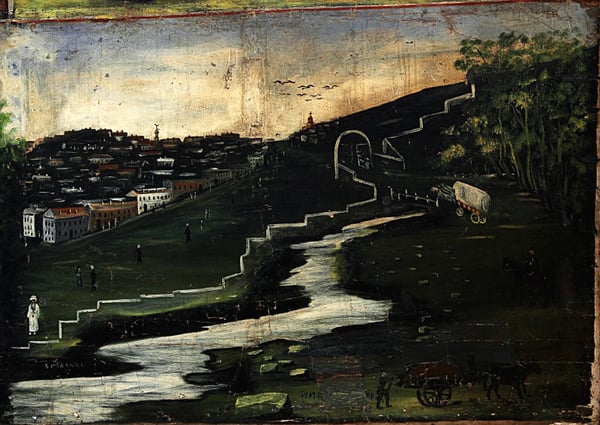
Expert analysis of Niko Pirosmani’s Belakani (part of Tapestry in six paintings)
Style: Naïve Art (Primitivism) · Genre: landscape
Artwork Analysis: "Belakani (part of Tapestry in six paintings)" by Niko Pirosmani
As an expert art historian, I will analyze this work solely based on the supplied facts: the artwork is a landscape in the Naïve Art (Primitivism) style, created by Niko Pirosmani as part of a larger series titled "Tapestry in six paintings." The significance of this piece lies in its embodiment of Pirosmani’s distinctive contribution to Primitivism and his elevation of folk-inspired, untutored vision into a powerful artistic language.
Significance within Naïve Art and Primitivism:
-
Series as Modern Tapestry – The work is explicitly part of a "Tapestry in six paintings," a concept that merges the decorative, communal tradition of woven tapestries with the autonomous medium of painting. This hybridization reflects Pirosmani’s ability to translate the planar, ornamental qualities of folk textiles into oil on canvas—a hallmark of Naïve Art’s embrace of vernacular sources. The landscape subject matter, "Belakani," likely depicts a rural Georgian scene, and its inclusion in a series underscores a narrative or panoramic ambition, turning a simple view into a segment of a larger visual story.
-
Fidelity to Untutored Perception – Pirosmani’s style, classified as Naïve Art (Primitivism), rejects academic perspective and naturalistic detail in favor of flat, emblematic forms, bold color blocks, and a direct, almost childlike composition. In this landscape, the significance lies in how he distills the essence of the land—its fields, architecture, or trees—into a simplified, harmonious pattern. This approach honors the "primitive" gaze, valuing emotional truth over optical realism, a core principle of Primitivism that influenced later modernists.
-
Cultural Authenticity – As a Georgian self-taught artist, Pirosmani infused his landscapes with local identity, often depicting his homeland’s topography with a quiet dignity. "Belakani" likely participates in this tradition, making the work significant as a document of regional life seen through an unmediated, personal lens. The fact that it is part of a tapestry series suggests a desire to elevate the ordinary—a village or pastoral scene—into a decorative, almost sacred object, much like folk art.
In summary, "Belakani (part of Tapestry in six paintings)" is significant for its innovative fusion of tapestry structure with naïve landscape painting, its pure embodiment of Primitivism’s anti-academic ethos, and its role in preserving Georgian cultural motifs through an untutored yet profoundly expressive vision. Pirosmani’s work stands as a cornerstone of Naïve Art, demonstrating that simplicity can carry deep narrative and aesthetic weight.
Museum / Gallery
Visually similar
20 works with related composition and palette
Tapestry in six paintings
Niko Pirosmani
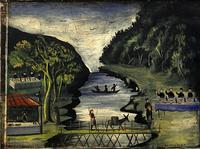
Donkey Bridge (part of Tapestry in six paintings)
Niko Pirosmani
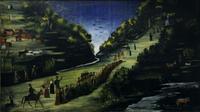
Party by the River Tskheniszkali
Niko Pirosmani

Kakhetian epos (Alazani Valley)
Niko Pirosmani
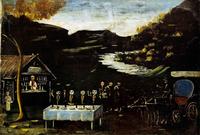
Phaeton and the night feast
Niko Pirosmani
The Garden of Earthly Delights (detail)
Hieronymus Bosch
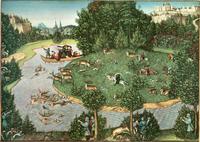
Stag Hunt of Elector Friedrich III the Wise
Lucas Cranach the Elder
Episodes of the hermit life
Paolo Uccello
The Garden of Earthly Delights (detail)
Hieronymus Bosch

The Garden of Earthly Delights (detail)
Hieronymus Bosch
The Large Spruce
Albrecht Altdorfer
The adoration of the Magi (detail)
Hieronymus Bosch
Thebaid
Fra Angelico
Shiraki (part of Tapestry in six paintings)
Niko Pirosmani
Celebration in Bolnisi-Khachini
Niko Pirosmani
St. David's Church (part of Tapestry in six paintings)
Niko Pirosmani
The Garden of Earthly Delights (detail)
Hieronymus Bosch
Last Judgement, left wing of the triptych
Hieronymus Bosch
The Last Judgement
Hieronymus Bosch

Signboard: "Beer-House Zakatala"
Niko Pirosmani