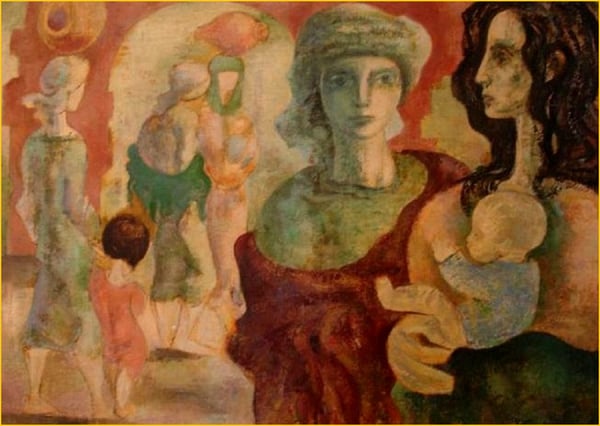
Subúrbio
Analisi esperta di Subúrbio di Julio Pomar
Stile: Expressionism · Genere: genre painting
Expert Analysis of Subúrbio by Julio Pomar
Julio Pomar’s Subúrbio is a compelling example of mid-20th‑century Portuguese Expressionism, a movement that channeled raw emotional intensity into keen social observation. The painting belongs to the genre of genre painting—scenes of everyday life—but Pomar elevates the ordinary into a charged commentary on urban marginality.
Stylistic and Period Significance
Pomar’s work emerged from the crosscurrents of European Expressionism and Portuguese Neorealism. In Subúrbio, the influence is unmistakable: distorted figures, a compressed spatial depth, and a palette dominated by murky browns, grays, and muted ochres. The brushwork is deliberately coarse and gestural, stripping the scene of any idealized prettiness. This harsh, unflinching technique reflects the Expressionist goal of conveying inner psychological truth rather than external reality. At the same time, Pomar anchors that truth in a specific sociopolitical context—the precarious life of Lisbon’s industrial outskirts in the 1940s–50s.
Genre Painting as Social Critique
While genre painting traditionally depicted domestic or rustic harmony, Pomar subverts it. The title Subúrbio (Suburb) hints at a liminal space—neither fully country nor city, trapped between poverty and aspiration. The figures are compressed into a claustrophobic frontality; their faces are masks of weariness or defiance. By choosing an everyday suburban scene (a street corner, perhaps a gathering of workers or laundry lines), Pomar refuses to exoticize poverty. Instead, he makes the viewer confront the dehumanizing toll of industrialization and dictatorship-era austerity.
What Makes It Significant
Subúrbio is significant because it bridges Portuguese Neorealism’s documentary impulse with Expressionism’s formal radicalism. Pomar does not merely record the suburbs; he distorts them to echo the emotional weight of life on the margins. The painting stands as a pivotal work in Pomar’s career—one that helped define a generation of artists who used expressive means to bear witness to social injustice, long before political upheaval finally erupted in the Carnation Revolution. In this sense, Subúrbio is both an aesthetic radical and a quiet historical document, reminding us that Expressionism can be as potent a tool for social critique as for personal anguish.
Genere
Stile
Visivamente simili
20 opere con composizione e palette affini
Blue Village
Marc Chagall
Maternidade
Lasar Segall
Fisherman's Family
Marc Chagall
Czóbel Béla Half Nude
Bela Czobel
The Artist's Wife and Baby
David Bomberg
Berény Róbert, Annácska
Berény Róbert
The Expulsion
Alexander Bogen
Mother and Child
Victor Palmov
Untitled (Mother and Child)
Frances Hodgkins
Mother with baby at her breast, and child in landscape
Paula Modersohn-Becker
Nekyia
Chronis Botsoglou
Rose Nudes in a Landscape
Harry Phelan Gibb
Cikáni
Josef Capek
Phaedra
Rosemarie Beck
Madonna of the Slums
Vicente Manansala
Mother with Child
Nikola Martinoski
Holy Family
Marc Chagall
In the Street
Honore Daumier
Woman and Child against a Stained Glass Background
Odilon Redon
Modok Mária, Család 1937
Modok Mária