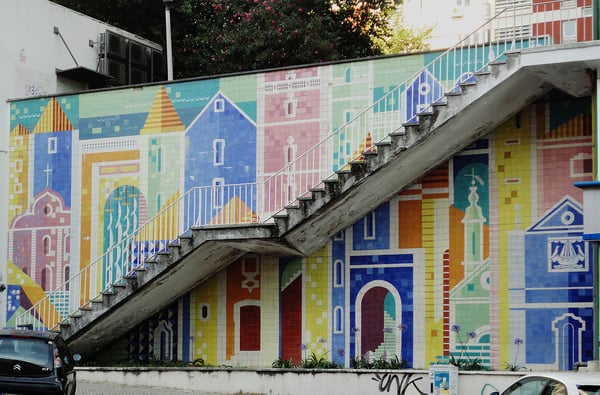
Analisi esperta di Azulejos (ceramic tiles) panel, Av. Infante Santo, Lisbon di Carlos Botelho
Stile: Expressionism · Genere: mosaic
Expert Analysis: Azulejos (ceramic tiles) panel, Av. Infante Santo, Lisbon by Carlos Botelho
This work is a striking synthesis of Portugal’s most cherished decorative tradition—the hand-painted azulejo—with the emotive, subjective force of Expressionism. As a mosaic composed of glazed ceramic tiles, the panel is not merely a painting transferred to a wall; it is a permanent, architectural intervention that transforms everyday urban space into a vehicle for heightened emotional expression.
Significance within Style and Period
-
Integration of Folk Craft and Avant-Garde
Botelho elevates the humble azulejo—historically used for architectural ornament, religious scenes, or utilitarian surfaces—into a bold Expressionist statement. While traditional azulejos often adhere to strict folk motifs or narrative panels, Botelho fractures form and distorts perspective, using the tile grid to create a jagged, syncopated rhythm. This marriage of vernacular craft and modernist painting broke new ground in mid-20th-century Portuguese public art, asserting that a deeply rooted local medium could carry the psychological intensity of Expressionism. -
Urban Expressionism in Lisbon
The location on Avenida Infante Santo—a major Lisbon artery—is deliberate. Botelho depicts the city not as a postcard but as a living, dissonant organism. Buildings lean, perspectives skew, and colors (typically vivid blues, greens, and ochres) are pushed beyond naturalism to convey movement, heat, and the pulse of daily life. The tile grid imposes a geometric order onto this chaos, creating a tension between the structured medium and the brush-like energy of the painted imagery. -
Technical and Tactile Innovation
Unlike a canvas-bound painting, a tile mosaic demands that the viewer experience it in situ, under changing light, and in dialogue with the surrounding architecture. Botelho exploits the reflective quality and hard edges of glazed tiles: the gloss adds a vibrant, almost wet appearance to his expressionist strokes, while the grout lines act as a graphic skeleton. This interplay of shiny, color-saturated surfaces and disrupted outlines distances the work from the softer blending of oil on canvas, giving it a raw, permanent immediacy. -
Cultural Significance
By making an Expressionist work out of azulejos, Botelho asserted that Portuguese identity could be both modern and deeply traditional. At a time when many European artists looked to “primitive” or non-Western sources for expressive power, Botelho turned to his own country’s decorative past. The panel stands as a landmark of Portuguese modernist public art, demonstrating that azulejaria is not a relic but a living language capable of expressing the anxieties and energies of contemporary urban life.
Conclusion
This piece is significant because it elevates a decorative craft to the level of avant-garde painting while remaining rooted in local material culture. It transforms a street-facing wall into a vibrant, emotional narrative of Lisbon, proving that Expressionism can thrive not only in a gallery but on the very surfaces people walk past every day. Botelho’s Azulejos panel is a triumphant example of how tradition and rebellion can coexist, giving the city a voice that is both ancient and fiercely modern.
Visivamente simili
20 opere con composizione e palette affini
Way Home
Enkhjargal Tsagaandari
Relativity lattice
M.C. Escher
Dreams of the Past
Nina Tokhtaman Valetova
The Red Stairway
Ben Shahn
Bird Phoenix Rebirth
Nina Tokhtaman Valetova
Untitled
Leopold Survage
Operetta
Aleksandra Ekster
Sketch of mural with the Buddhist theme for Nicholas Roerich Museum in New York
Nicholas Roerich
Portrait of digestive system
Carloluigi Colombo
Work No. 330
Martin Creed
Convex and Concave
M.C. Escher
Architecture au clair de lune
Rene Magritte
Portrait of UFO
Carloluigi Colombo
Azulejo
Sa Nogueira
House of Stairs
M.C. Escher
Stairs, Provincetown
Charles Demuth
Sol Doirado
Carlos Botelho
Section as above; start of scale
Giovanni Battista Piranesi
High and Low
M.C. Escher
Over the Flaminia
Jeffrey Smart