Analisi esperta di Ensayo de color di Carlos Orozco Romero
Stile: Magic Realism, Surrealism · Genere: symbolic painting
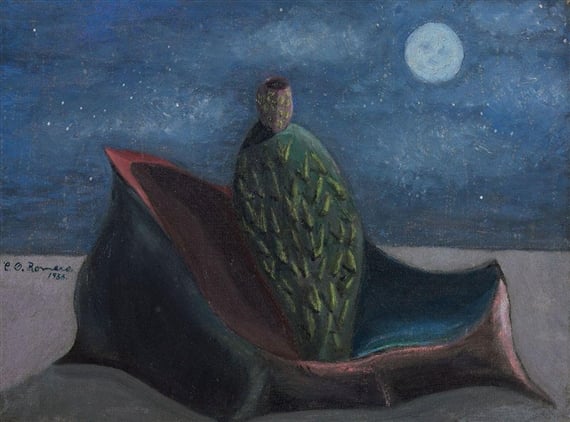
Carlos Orozco Romero’s “Ensayo de color” (Color Test) is a seminal work that bridges the artist’s roots in Mexican muralism with the more introspective, dreamlike currents of Magic Realism and Surrealism. Executed as a symbolic painting, the piece epitomizes Orozco Romero’s departure from overt social narrative toward a personal, psychologically charged visual language.
Significance within Magic Realism & Surrealism:
- As a Magic Realist work, “Ensayo de color” presents ordinary objects or scenes with an uncanny, hyper-real clarity that makes the familiar feel strange—a hallmark that distinguishes it from pure fantasy. The artist uses precise, almost academic draftsmanship to render a seemingly mundane subject (a “color test”) that transforms into a metaphysical inquiry.
- Its Surrealist dimension emerges through the displacement of logic: the painting operates as a self-referential meditation on the act of painting itself. The “test” becomes a symbolic ritual, where color is not merely a formal element but a conduit for subconscious expression. Orozco Romero aligns with Surrealism’s interest in automatism and the irrational, yet he tempers it with a disciplined compositional structure.
Symbolic and Thematic Depth:
- The title “Ensayo de color” invites multiple readings. On one level, it is a literal studio exercise—a palette or canvas being tested—but symbolically, it represents the artist’s struggle to reconcile visual perception with inner vision. The painting likely juxtaposes vibrant, contrasting hues with muted tones, creating a tension that mirrors the conflict between objective reality and subjective fantasy.
- Within the context of Mexican art of the mid-20th century, Orozco Romero’s symbolic approach offers an alternative to the dominant muralist school. While his contemporaries focused on public, didactic imagery, “Ensayo de color” turns inward, exploring the artist’s private mythology and the alchemy of creation.
Stylistic Legacy:
- This work is significant for how it synthesizes two seemingly divergent movements: Magic Realism’s grounded, often melancholy observation of reality and Surrealism’s liberation of the unconscious. Orozco Romero achieves this fusion through a meticulous handling of light and texture, lending an eerie palpability to symbolic elements (e.g., a palette, a draped cloth, a figure’s gesture).
- “Ensayo de color” stands as a precursor to later Latin American Magic Realist painters, demonstrating that the movement could engage with purely aesthetic and conceptual questions—like color theory and artistic identity—rather than only with folklore or political allegory.
In essence, Orozco Romero’s “Ensayo de color” is a pivotal work that redefines symbolic painting as a space for both technical experimentation and poetic introspection. Its importance lies in its quiet subversion of realism, using the very tools of representation to question the boundaries between art, reality, and the dream.
Visivamente simili
20 opere con composizione e palette affini
Untitled (cactus plants in background)
Stanley Pinker
Manacá
Tarsila do Amaral
Still Life With Shell
Clovis Trouille
Marine Relics
Eleonora Brigalda Barbas
Natureza morta com três vasos de cactos
Lasar Segall
Still Life With Seashell and Fruit
Ion Pacea
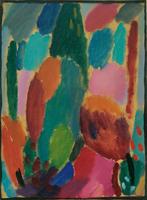
Variation: Zärtlichkeiten
Alexej von Jawlensky
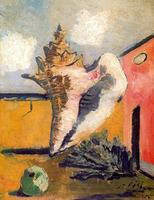
La Grande Conchiglia
Filippo De Pisis
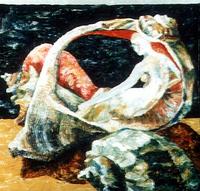
At Sunset
Eleonora Brigalda Barbas
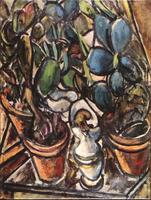
Galimberti Sándor, Csendélet Kaktusszal 1910
Galimberti Sándor
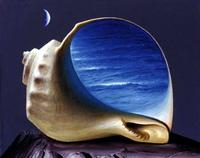
Sound of the Sea
Sabin Balasa
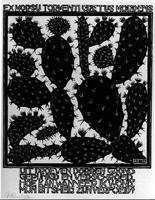
Emblemata - Cactus
M.C. Escher
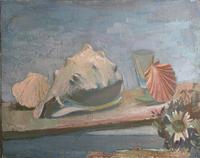
Natura Morta
Mario Tozzi
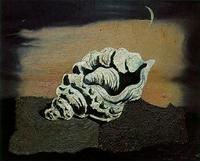
Shell
Salvador Dali
Solitude
Sven Jonson
Still Life With Seashell
Henri Catargi
#27: El Nopal (Nopal)
Marina Pallares
The shell 'Conus Marmoreus'
Rembrandt
Sleeping Child
Henri Manguin
Still Life With Tazza and Seashell
Ion Pacea