Expert analysis of Louis Cane’s Papier découpé et collé
Style: Color Field Painting · Genre: abstract
Expert Analysis: "Papier découpé et collé" by Louis Cane
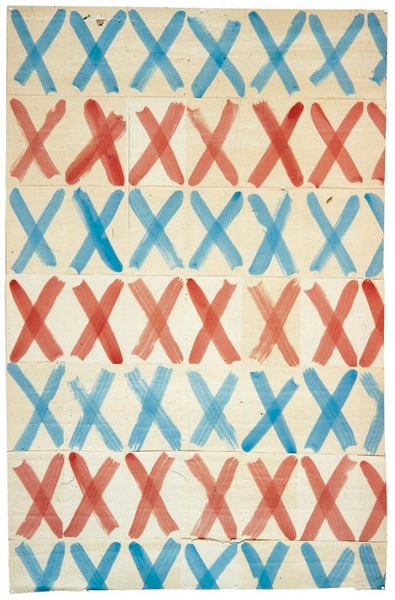
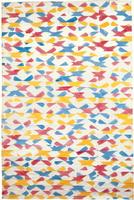
The artwork Papier découpé et collé (French for "cut and glued paper") by Louis Cane represents a compelling synthesis of two distinct artistic traditions: the chromatic purity of Color Field Painting and the tactile, process-driven language of collage. While Color Field Painting—championed by figures like Mark Rothko, Helen Frankenthaler, and Morris Louis—typically privileges large expanses of stained or thinly painted color on unprimed canvas, Cane translates that vocabulary into a medium defined by physical cut-outs and adhesive layering.
Significance within the Style and Period:
-
European Reinterpretation of American Abstraction: Cane was a leading member of the French Supports/Surfaces movement (active from the late 1960s through the 1970s), which reacted against the formalism of abstract painting and instead emphasized the materiality of the canvas, frame, and artistic process. By adopting the Color Field aesthetic—broad, saturated fields of color—and executing it through papier découpé, Cane challenges the primacy of gestural brushwork and underscores the objecthood of the artwork. The sharp edges of the cut paper replace the soft, atmospheric boundaries of traditional Color Field painting, introducing a crisp, almost architectural geometry.
-
Materiality as Meaning: The title itself announces the method: the work is not painted but assembled. This aligns with Supports/Surfaces’ critique of institutionalized painting. The use of paper—a humble, everyday material—democratizes the high-art Color Field palette. Where a painter like Frankenthaler might let thinned pigment soak into raw canvas, Cane’s collaged segments create actual, physical separations between hues, making the act of cutting and arranging as crucial as the color itself. The result is a paradox: a static, flat composition that nevertheless possesses a literal third dimension (the thickness of the paper and the slight shadows from layering).
-
Dialogue with Abstraction and Decoration: The work’s abstract genre is evident, but its precise, geometric cuts evoke a post-Cubist interplay of positive and negative space. By removing compositional elements (the "découpé" process) and reattaching them, Cane draws attention to the blank ground of the support—often left exposed in his works—as an active compositional force. This mirrors Color Field painting’s attention to the entire picture plane, yet introduces a handmade, almost playful quality that prefigures later Postmodern critiques of pure abstraction.
Conclusion:
Papier découpé et collé is significant because it expands the Color Field tradition from a purely painterly endeavor into a tactile, conceptual dialogue about how abstract art is made. By using cut paper, Cane questions the boundary between painting and object, between American Color Field formalism and European materialist theory. The work embodies Supports/Surfaces’ desire to deconstruct the conventions of painting while retaining the emotional resonance of pure color—a unique and historically important contribution to 1970s abstraction.
Visually similar
20 works with related composition and palette
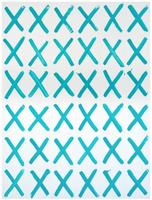
Papier découpé
Louis Cane
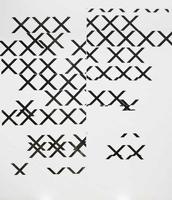
Painting
Wade Guyton
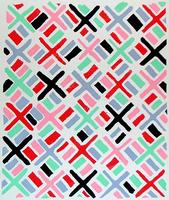
Composition 34
Sonia Delaunay
People
Se-Ok Suh
Papier découpé
Louis Cane
Pittura R
Pino Pinelli
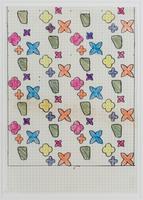
Untitled (Muster Auf Kästchenpapier)
Konrad Lueg
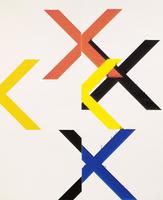
Untitled
Wade Guyton
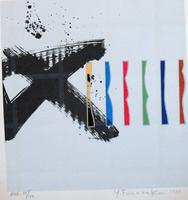
646
Funasaka Yoshisuke
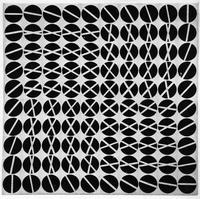
Untitled
Horacio Garcia-Rossi
Louis Vuitton Monogram Multicolore (White)
Takashi Murakami
Problemi di stratificazione
Mario Ballocco
Papier découpé
Louis Cane
Systole And Diastole
Alfred Jensen
Untitled IV
Daniel Dezeuze
IMG 6136
Katsuhito Nishikawa
9-Soles
Omar Rayo
Pochoir
Andre-Pierre Arnal
Untitled
Heimo Zobernig
Papier découpé et collé
Louis Cane