Expert analysis of Takashi Murakami’s Louis Vuitton Monogram Multicolore (White)
Style: Neo-Pop Art, Superflat · Genre: figurative
Expert Art Historical Analysis: "Louis Vuitton Monogram Multicolore (White)" by Takashi Murakami
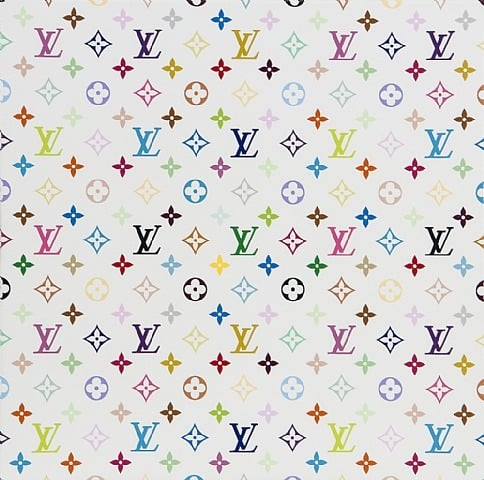
Takashi Murakami’s Louis Vuitton Monogram Multicolore (White) stands as a defining work of early 21st-century Neo-Pop art and a landmark of the Superflat movement. Executed in the figurative tradition, the piece reimagines the iconic Louis Vuitton monogram—originally a symbol of bourgeois luxury—through a vibrant, cartoonish lens that collapses hierarchies between high art, commercial branding, and popular culture.
Significance within Neo-Pop Art
As a leading figure of Neo-Pop, Murakami extends the legacy of Andy Warhol by directly engaging with consumer goods and mass production. However, instead of mere reproduction, Murakami transforms the luxury logo into a playful, accessible visual language. The white ground and multicolored logo disrupt the monogram’s traditional brown-on-gold exclusivity, democratizing the brand and commenting on the commodification of desire. This work exemplifies Neo-Pop’s central strategy: using the visual economy of advertising and fashion to critique, celebrate, and blur the boundaries between art and commerce.
Significance within Superflat
The painting is a quintessential Superflat statement. Murakami’s term describes a flattened pictorial space—influenced by Japanese anime, manga, and the lack of perspective in traditional nihonga—that rejects Western illusionism. Here, the repeated monogram letters become a decorative, almost pattern-like surface, devoid of depth. The cheerful, candy-colored palette and crisp outlines evoke a “kawaii” (cute) aesthetic, masking a critique of consumerist superficiality. Superflat also collapses distinctions between fine art and lowbrow visual culture; by placing a luxury logo on canvas, Murakami insists that art, fashion, and commerce are equal players in contemporary visual experience.
Genre and Figurative Approach
Though figurative, the “figure” is not a human but a brand icon—the Louis Vuitton monogram is treated as a character or meme. This anthropomorphization of a logo aligns with Murakami’s broader project of creating a “character-based” art world (e.g., Mr. DOB). The multicolored variation infuses the mark with energy, making it hyper-visible and shifting its symbolic weight from status to spectacle.
Overall Significance
Louis Vuitton Monogram Multicolore (White) is significant because it operationalizes Superflat’s core thesis: in a world saturated with images, the line between art, brand, and product is not just blurred but irrelevant. Its commercial success (as both an artwork and a design for handbags) exemplifies Murakami’s ambition to collapse the gallery space into the marketplace, challenging traditional art-world hierarchies. The piece remains a touchstone for understanding how contemporary art absorbs and reflects global consumer culture with both irony and earnest delight.
Visually similar
20 works with related composition and palette
Untitled (Muster Auf Kästchenpapier)
Konrad Lueg

Papier découpé
Louis Cane
Untitled (Verticals and Horizontals)
Francois Morellet

Eye Love Superflat (Black)
Takashi Murakami
Optical Painting
Wen-Ying Tsai
Grid #8
Thomas Downing
Papier découpé et collé
Louis Cane
Composition 34
Sonia Delaunay

Appearance of Crosses 89-6
Ding Yi
Systole And Diastole
Alfred Jensen
Problemi di stratificazione
Mario Ballocco
Untitled
Soledad Sevilla
Egyptian no. 7
Owen Jones
Studie H.H.305
Hans Hinterreiter

Painting
Wade Guyton
Beholders
Mihnea Cernat
Bush Medicine
Abie Loy Kemarre
Papier découpé
Louis Cane
Drawing of ground plan for the office of Jean Zay
Fernand Leger
Is It Still High Art?
Joyce Kozloff