Expert analysis of William James Glackens’s City Scene
Style: New Realism · Genre: genre painting
Expert Analysis of City Scene by William James Glackens
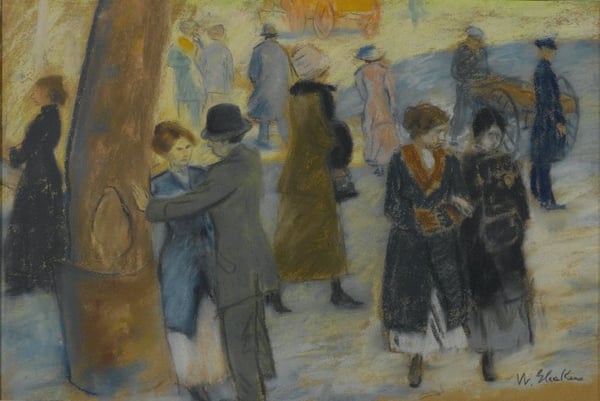
William James Glackens’ City Scene exemplifies the spirit of New Realism—the American offshoot of the Ashcan School that emerged in the early twentieth century. As a genre painting, it captures an unidealized slice of urban life, but Glackens elevates the everyday through a distinctive blend of reportorial directness and painterly verve.
Significance within New Realism
Unlike the more dour social documentation of some Ashcan colleagues, Glackens infuses his city views with a buoyant, almost Impressionist delight in light and color. City Scene is significant for its refusal to sentimentalize or moralize; instead, it presents the city as a vibrant, democratic stage. The painting’s loose, rapid brushwork and high-keyed palette—influenced by Renoir and French modernism—bring a sense of fleeting pleasure to the mundane: pedestrians, carriages, and storefronts become animated by dappled sunlight and shadow.
Place in Glackens’ Oeuvre
Glackens was a founding member of “The Eight,” the group that broke from academic convention to champion modern urban subjects. City Scene encapsulates his talent for balancing social observation with formal innovation. The composition is deliberately casual, with figures cropped at the edges, suggesting a snapshot stolen from the flow of city life. This approach rejects the posed, theatrical narratives of traditional genre painting in favor of an authentic, kinetic realism.
Cultural and Artistic Context
Painted during a period of massive immigration and urban growth, City Scene speaks to the era’s fascination with the modern metropolis. Glackens avoids the gritty, tenement-focused pathos of a Jacob Riis photograph or a George Bellows prizefight; instead, he celebrates the city’s public, commercial vitality. The work’s significance lies in its synthesis of American subject matter with European painterly techniques—a hallmark of New Realism that helped pave the way for later urban modernists.
In sum, City Scene is not merely a record of a place and time, but a demonstration of how Glackens transformed the ordinary into a luminous, participatory experience, solidifying his role as a key figure in the evolution of early American modernism.
Genre
Style
Visually similar
20 works with related composition and palette
The Nannys
Giuseppe De Nittis
Place Clichy
Pierre-Auguste Renoir
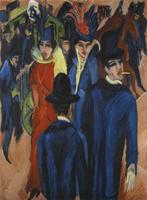
Berlin Street Scene
Ernst Ludwig Kirchner
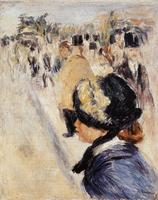
Le Place Clichy
Pierre-Auguste Renoir
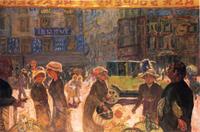
La Place Clichy
Pierre Bonnard
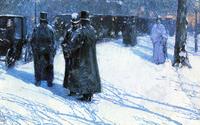
Cab Stand at Night, Madison Square, New York
Childe Hassam
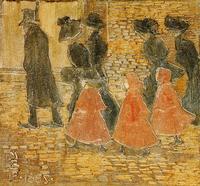
Three Little Girls in Red
Maurice Prendergast
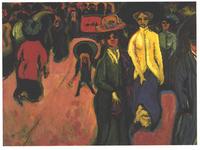
Street, Dresden
Ernst Ludwig Kirchner
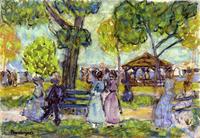
The Pavilion
Maurice Prendergast
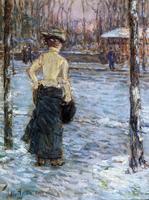
Winter, Central Park
Childe Hassam
Evening in Paris
Pierre Bonnard
Road to the Shore
Maurice Prendergast
People Strolling on the Beach
Vincent van Gogh
Fruit Stand, Coney Island
William James Glackens
Morning in Paris
Pierre Bonnard
New York Street Scene
Childe Hassam
The Drive, Central Park
William James Glackens
Sunday Morning, Paris
Maurice Prendergast
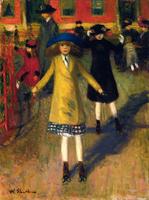
Girl Roller-Skating, Washington Square
William James Glackens
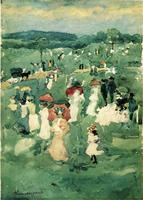
Strolling in the Park (also known as In the Park)
Maurice Prendergast