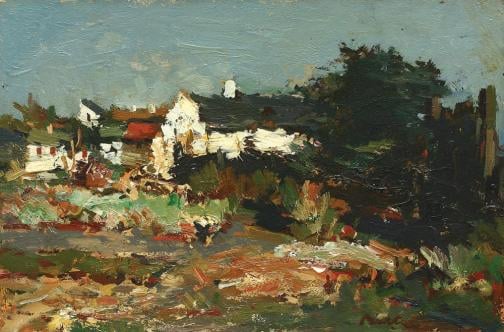
Village Boundary
Analisi esperta di Village Boundary di Adam Baltatu
Stile: Impressionism · Genere: landscape
Expert Analysis: "Village Boundary" by Adam Baltatu
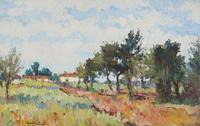
Adam Baltatu (1861–1926) was a pivotal figure in the introduction and development of Impressionism in Romania, and Village Boundary stands as a compelling example of his contribution to the movement. Painted in the late 19th or early 20th century, this landscape embodies the core Impressionist concerns—capturing fleeting light, atmospheric conditions, and the sensory experience of a specific moment—while grounding them in a distinctly Romanian rural setting.
Significance within Impressionism
Baltatu trained in Paris and was directly influenced by the Barbizon school and French Impressionists such as Corot and Monet. However, his significance lies in how he adapted Impressionist techniques to the local landscape and light of Romania. Village Boundary likely depicts a scene on the outskirts of a rural settlement, where the boundary between cultivated land and wild nature is marked by a dirt path, a fence, or a line of trees. Here, Baltatu does not simply mimic the soft, hazy light of the French countryside; instead, he captures the brighter, more contrasting sunlight of the Romanian plain, with its sharp shadows and vivid greens and ochres.
The work demonstrates Baltatu’s mastery of broken brushwork and plein-air observation. Patches of color are applied side by side to suggest the shimmer of leaves, the texture of grass, and the play of light on a dusty path. Unlike the more structured compositions of academic landscape painting, Baltatu’s scene appears spontaneous and immediate—a snapshot of rural life rather than a staged pastoral ideal. This aligns with the Impressionist emphasis on the "impression" of a moment, rather than detailed naturalism.
Genre and Cultural Context
As a landscape, Village Boundary is also significant for its nationalist undertones. In the late 19th century, Romanian artists were seeking to define a national identity through art. Baltatu, along with colleagues like Nicolae Grigorescu and Ștefan Luchian, used Impressionism to celebrate the everyday beauty of the Romanian countryside—the villages, the haystacks, the peasants—elevating them to subjects worthy of high art. Village Boundary may depict a liminal space between the human and the natural, a theme that resonated with a nation undergoing modernization while preserving its agrarian roots.
What Makes It Significant
- Pioneering Hybridity: It merges French Impressionist technique with a distinctly Eastern European sensibility, proving that Impressionism was not a monolithic style but a flexible language for expressing diverse landscapes and lights.
- Atmospheric Truth: Baltatu’s handling of light and shadow—often warmer and more golden than in Northern French Impressionism—captures the unique luminosity of the Romanian countryside.
- Quiet Narrative: The "boundary" in the title suggests a threshold: between village and field, order and wilderness, tradition and change. This gives the painting a subtle, reflective quality beyond mere visual delight.
In sum, Village Boundary is significant as a key work of Romanian Impressionism, demonstrating how local artists assimilated and transformed a global movement to articulate a national identity, while remaining faithful to the Impressionist project of recording the transient beauty of the natural world.
Genere
Stile
Visivamente simili
20 opere con composizione e palette affini
District Six
Gregoire Boonzaier
Czóbel Béla , Szentendre Törökvölgy
Bela Czobel
Houses
Gregoire Boonzaier
Houses in Mangalia
Stefan Dimitrescu
The Sea at Tuzla
Lucian Grigorescu
Straussart 20 May 2013 43 25000 a
Conrad Theys
Summer Landscape
Henri Catargi
Landscape
Henri Matisse
Maisons À Kervilahouen, Belle Ile
Henri Matisse
Houses in the Trees
Pierre-Auguste Renoir
Berény Róbert , Tájkép,
Berény Róbert
Landscape, Corsica
Henri Matisse
Monterey, California
William Merritt Chase
Autumn in Cagnes
Henri Matisse
Farms in Brittany, Belle Ile
Henri Matisse
Landscape with trees and houses
Gregoire Boonzaier
Landscape from Bærum
Harriet Backer
Dans Le Jardin
Michel Kikoine
Berény Róbert, Kilátáts a Kertre
Berény Róbert
Summer Sky
Adam Baltatu