Analisi esperta di Landscape with trees and houses di Gregoire Boonzaier
Stile: Impressionism · Genere: landscape
Expert Analysis: "Landscape with trees and houses" by Gregoire Boonzaier
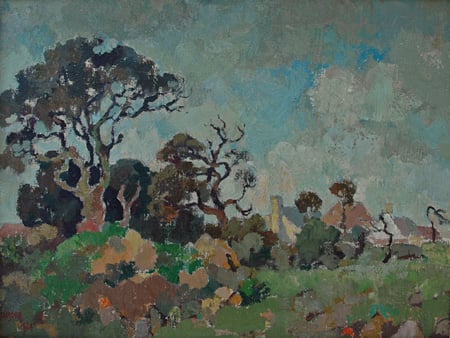
Gregoire Boonzaier’s Landscape with trees and houses stands as a compelling example of the artist’s role in transplanting European Impressionism onto South African soil. While the painting’s subject—a bucolic scene of trees and modest dwellings—may appear conventional within the Impressionist canon, its true significance lies in Boonzaier’s adaptation of the style to capture the distinct luminosity, warmth, and geography of the Cape region.
Stylistic Significance Boonzaier, a leading figure in the so-called “Cape Impressionist” movement, synthesizes the classic Impressionist preoccupation with light and atmosphere with a uniquely local sensibility. In this work, the hallmark broken brushwork and pure, unmixed colors are evident: dappled patches of green, ochre, and blue evoke the shimmer of leaves and the haze of a sunlit day. However, unlike the muted, overcast palette often favored by the French Impressionists, Boonzaier emphasizes the high-key, crystalline light of the South African landscape. The shadows in the foreground are not grey or black but rendered in deep violet and cool blue, following Impressionist color theory to convey the warmth of the sun.
Composition and Genre As a landscape, the painting prioritizes mood over topographical accuracy. The trees are arranged as framing devices, their canopies creating a natural arch that leads the eye toward the houses nestled in the middle distance. This composition is deliberately informal, suggesting a casual glimpse—a snapshot of rural life—rather than a staged vista. The houses themselves are simplified forms, almost abstracted into blocks of light and shadow, a nod to the Impressionist belief that the fleeting moment is more important than architectural detail.
Cultural and Historical Context Boonzaier’s significance emerges from his position as a pioneer of modern South African art. Working in the early-to-mid-20th century, he defied the conservative academic traditions of his time by embracing Impressionism at a moment when it was still considered avant-garde in his homeland. His landscapes, including this one, helped shift South African painting away from romanticized, documentary realism toward a more subjective, sensory experience of the environment. The “trees and houses” are not just local color—they are vehicles for exploring the very nature of perception under the brilliant African sun.
Conclusion Landscape with trees and houses is significant not because it breaks new formal ground within Impressionism, but because it successfully applies the movement’s core principles—light, atmosphere, and immediacy—to a new context. Boonzaier proves that Impressionism is not bound to the fields of Giverny or the boulevards of Paris; it can sing just as vividly among the trees and houses of the Cape.
Visivamente simili
20 opere con composizione e palette affini
Summer New Abbey
Samuel Peploe
Landskap met kronkelende pad, Kenilworth
Gregoire Boonzaier
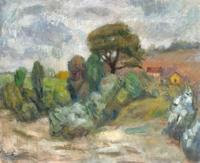
Berény Róbert, Bozótos
Berény Róbert
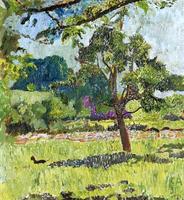
Summer
Cuno Amiet
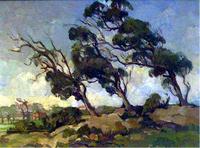
Windswept Trees
Gregoire Boonzaier
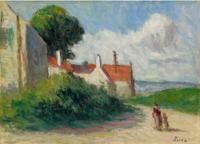
Landscape In Asquin-sous-Vézelay
Maximilien Luce
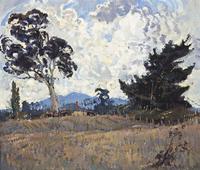
Woodside Pastoral
Horace Trenerry
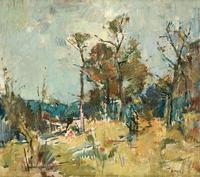
Landscape
Teodor Harșia
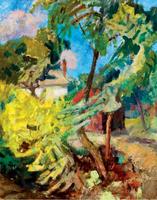
Berény Róbert, Kilátáts a Kertre
Berény Róbert
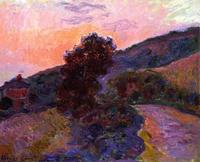
Sunset at Giverny
Claude Monet
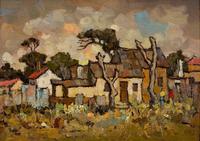
Straussart 20 May 2013 43 25000 a
Conrad Theys
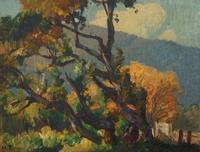
Beginning of Autumn
Stefan Popescu
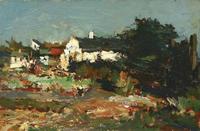
Village Boundary
Adam Baltatu
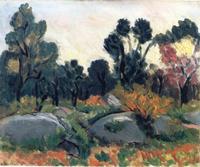
Landscape
Henri Matisse
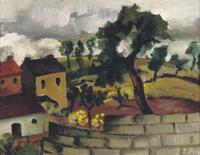
Landscape in Limburg
Else Berg
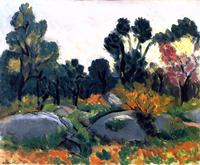
Rocks in the Vallée Du Loup
Henri Matisse
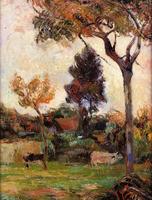
Two cows in the meadow
Paul Gauguin
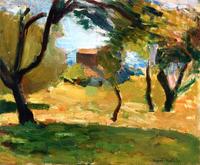
Corsican Landscape
Henri Matisse
Landscape of Cote d Azur
Pierre Bonnard
Texas Dry Country
Robert Julian Onderdonk