Expertenanalyse zu Tsuguharu Foujitas Cosmetics
Stil: Magic Realism · Genre: genre painting
Expert Analysis: "Cosmetics" by Tsuguharu Foujita
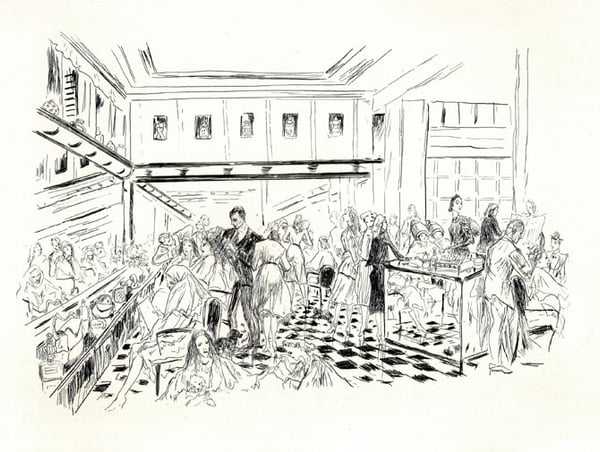
As a work of Magic Realism executed in the genre painting tradition, Cosmetics by Tsuguharu Foujita occupies a significant intersection of cultural hybridity and technical mastery. Foujita, a Japanese-born artist who thrived in early 20th-century Paris, brings to this piece a distinctive fusion of Eastern ink-wash precision and Western oil painting’s luminous texture—a hallmark of his Magic Realist approach.
Significance within Magic Realism:
Magic Realism seeks to render the ordinary with an uncanny clarity, often blurring the boundary between the mundane and the dreamlike. In Cosmetics, Foujita elevates the everyday ritual of applying makeup into a suspended, almost ritualistic moment. The subject—likely a woman at her vanity—is depicted with hyper-realistic detail (the sheen of a mirror, the softness of fabric, the tactile delicacy of cosmetics) while the composition remains eerily still, as if time itself has paused. This creates a sense of quiet enchantment, a core trait of Magic Realism. Foujita’s characteristic use of a milky, opalescent ground (often achieved with a mixture of lead white and egg tempera) further imbues the scene with an otherworldly glow, transforming a private, domestic act into a universal contemplation of artifice and identity.
Significance within Genre Painting:
Genre painting traditionally depicts scenes of everyday life, but Foujita redefines the category by infusing it with psychological weight. While predecessors like the Dutch Golden Age painters focused on moralizing or anecdotal narratives, Cosmetics offers no explicit story—only a charged, introspective atmosphere. The figure’s absorbed expression and the precise arrangement of objects (mirror, brush, powder) suggest a meditation on self-presentation, a theme that resonates with modernity’s preoccupation with constructed identity. Foujita’s fusion of Japanese ukiyo-e compositional flatness with Western chiaroscuro creates a unique visual language, making Cosmetics a pivotal work that bridges Eastern and Western sensibilities within the Magic Realist and genre painting canons.
Why It Matters:
Foujita’s Cosmetics demonstrates how Magic Realism can elevate genre painting beyond mere documentation into a poetic inquiry. Its significance lies in its flawless synthesis of technique and meaning: the seemingly “magic” quality emerges not from fantastical elements, but from the artist’s ability to make the familiar strange and profound. This work stands as a testament to Foujita’s role as a transcultural pioneer, whose vision expanded the boundaries of both style and subject matter.
Visuell ähnlich
20 Werke mit ähnlicher Komposition und Farbpalette
Maxim
Tsuguharu Foujita
At Dominic's
Ilya Repin
Scheiber Hugó, Eszpresszóban
Scheiber Hugó
Bistro
Periklis Vyzantios
Caffe Greco
Renato Guttuso
Ball
Arturo Souto
Dance-hall
Vincent van Gogh
Drawing for the vicarage
Marià Fortuny
Quin Drawings 1984 The Salisbury West End
MAUREEN QUIN
Charpentier
Tsuguharu Foujita
SAINT-GERMAIN NIGHTCLUB
Gerard Sekoto
Restaurant rougeot I
Jean Dubuffet
Alexander Murashko at work on a collective picture of the Model statement in the studio of Ilya Repin
Boris Kustodiev
The Railway
Ernst Ludwig Kirchner
Figures in a Room (Figuren im Raum)
Oskar Schlemmer
Nightlife
Archibald Motley
Side Show
Maurice Prendergast
Men in Front of the Counter in a Cafe
Vincent van Gogh
School of Beauty, School of Culture
Kerry James Marshall
Scheiber Hugó, Kávéház
Scheiber Hugó