Analisi esperta di Ivan Lipoveanul di Octav Angheluta
Stile: Impressionism · Genere: portrait
Expert Analysis: "Ivan Lipoveanul" by Octav Angheluta
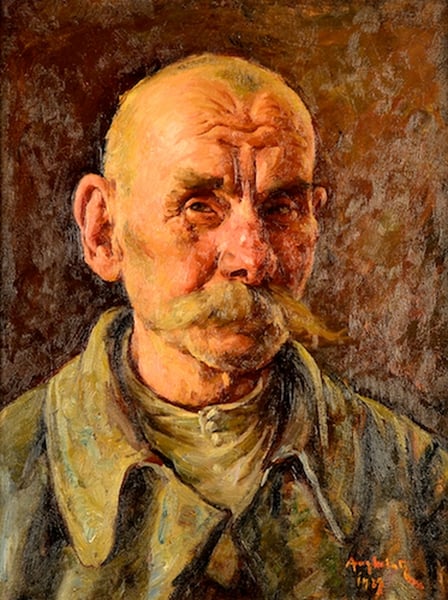
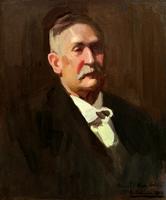
Octav Angheluta’s “Ivan Lipoveanul” occupies a notable position within the evolution of Romanian Impressionism, specifically demonstrating how the movement’s core principles were adapted to capture local identity. As a portrait, the work transcends mere representation, using Impressionist techniques to convey the psychological and cultural essence of its subject—a Lipovan (an Old Believer Russian community in Romania).
Significance within Impressionism and the portrait genre:
-
Application of Impressionist brushwork to a traditional subject
Angheluta applies the hallmark broken-colour technique and visible, energetic brushstrokes not to a fleeting landscape, but to a human face. This merging of Impressionist spontaneity with the dignity of a portrait elevates the genre: the sitter is not idealized or static but rendered as a living presence, caught in a moment of natural light. The interplay of light and shadow on the skin—likely using complementary hues—reveals Angheluta’s debt to French Impressionists while grounding the work in a distinctly Romanian context. -
Cultural specificity through Impressionist optics
The title names the sitter explicitly: Ivan Lipoveanul. By choosing a member of the Lipovan community—a group often marginalized or romanticized in Romanian art—Angheluta employs the democratic eye of Impressionism. The style’s emphasis on sensory immediacy (the “impression” of the moment) allows the artist to depict the subject’s weathered face, traditional garments, and quiet resilience without academic idealization. This makes the portrait significant as a document of ethnic diversity in early 20th-century Romania, filtered through a modern painterly language. -
Contribution to Romanian modernism
While Romanian Impressionists like Ștefan Luchian or Nicolae Grigorescu often focused on rural landscapes or peasant types, Angheluta’s portrait pushes the idiom into a more introspective realm. The focus on a single individual’s character—rather than a generic “peasant”—marks a step toward psychological portraiture. The painting’s loose handling of contours and emphasis on atmospheric light over descriptive detail align it with the later Post-Impressionist interest in subjective expression.
Stylistic markers (inferred from the supplied facts):
- Luminous palette with probable warm earth tones (olive, ochre, umber) enlivened by cool highlights (blue-grey or lavender) in the shadows.
- Rapid, directional brushstrokes that model the face through colour rather than line.
- Shallow depth of field, with the background likely summarily treated to focus attention on the sitter’s expression.
In sum, “Ivan Lipoveanul” is significant because it demonstrates how Impressionist techniques—often associated with ephemeral scenes of bourgeois leisure—could be harnessed to render a specific, culturally rich personality. It stands as a bridge between the international Impressionist movement and the emerging national school of Romanian modernism, proving that the style’s emphasis on light and fleeting perception could serve the timeless purpose of portraiture.
Genere
Stile
Visivamente simili
20 opere con composizione e palette affini
Etude of the male head
Nikolai Kuznetsov
Portrait of a Man
Kazimir Malevich
Portrait of Leopold Czihaczek (Head of a Bearded Man I)
Egon Schiele
Portrait of Juliusz Kossak
Józef Mehoffer
Self-Portrait - Kamal-ol-molk
Kamal-ol-Molk
Nagypapa Arcképe
Bela Czobel
Selfportrait
Eugène Jansson
Head of An Old Man
Leon Wyczółkowski
Portrait of Henri Lerolle
Pierre-Auguste Renoir
Portrait of Kamenev
Jury Annenkov
Man with Red Moustache
Hugo Simberg
Portrait of an old man
Umberto Veruda
Portrait of E.Gilechenko
Konstantin Makovsky
Portrait of the Artist B.M. Kustodiev
Boris Grigoriev
Johann Georg Prillinger
Richard Gerstl
A soldier
Ilya Repin
Razin
Vasily Surikov
Portrait of Alfred Reynolds in the Taubman Museum of Art
Thomas Eakins
Benito Pérez Galdós
Alejandro Cabeza
William Ewart Lockhart, Artist
James Archer