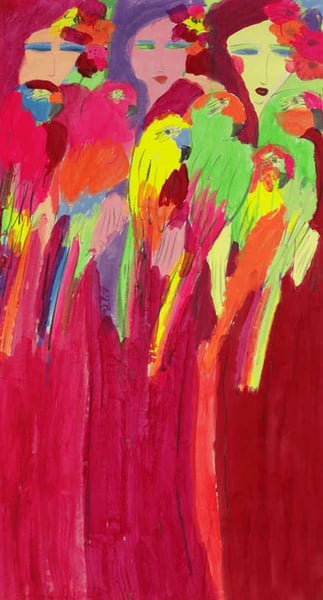
Three Ladies and Parrots
Expertenanalyse zu Walasse Tings Three Ladies and Parrots
Stil: Naïve Art (Primitivism), Pop Art · Genre: figurative
Expert Analysis: "Three Ladies and Parrots" by Walasse Ting
Walasse Ting’s Three Ladies and Parrots is a striking synthesis of two seemingly divergent movements—Naïve Art (or Primitivism) and Pop Art—while remaining firmly rooted in figurative representation. The work’s significance lies in how Ting bridges Eastern and Western visual languages, infusing Pop Art’s bold, commercial imagery with the spontaneous, untutored charm of naïve painting.
Naïve Art & Primitivism:
Ting deliberately adopts a childlike, unrefined approach: flat planes of high-key color, simplified forms, and a disregard for naturalistic perspective. The three ladies are rendered with round, schematic faces and doll-like features, echoing the directness of folk art. Parrots, a recurring motif in his work, are depicted with exaggerated, almost cartoonish plumage. This primitivism is not merely decorative—it challenges academic conventions and privileges emotional immediacy over technical precision, a hallmark of the naïve tradition.
Pop Art Influence:
Ting’s palette is unmistakably Pop: electric pinks, acidic greens, and vivid yellows recall the consumerist vibrancy of Warhol or Lichtenstein. Yet his subject matter diverges from American Pop’s fixation on mass media. Instead, he applies Pop’s graphic clarity to intimate, erotic themes. The parrots—often symbols of exoticism and mimicry—become stand-ins for the commodified female gaze, a subtle critique of sexual objectification wrapped in playful, decorative surface.
Figurative Fusion:
The painting is unabashedly figurative, but Ting departs from traditional portraiture. The ladies are not individualized; they are archetypes, interchangeable with the parrots in their decorative flatness. This flattening aligns with both naïve art’s disregard for depth and Pop’s use of repetition and pattern. The resulting tension—between decorative innocence and provocative content—is where the work’s power lies.
Significance in Art History:
Three Ladies and Parrots exemplifies how Ting carved a unique niche: he was a Chinese-born artist working in New York and Paris, absorbing Pop art’s boldness while retaining the poetic, calligraphic looseness of Chinese ink painting (though not explicitly stated, this biographical context informs the work’s hybridity). The painting stands as a precursor to later cross-cultural pop movements and remains a testament to art’s ability to fuse high and low, East and West, the playful and the provocative.
Visuell ähnlich
20 Werke mit ähnlicher Komposition und Farbpalette
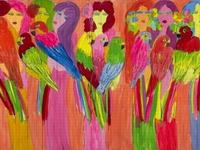
Ladies with Parrots
Walasse Ting
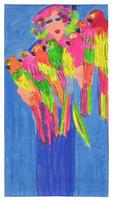
Blue Lady with Parrots
Walasse Ting
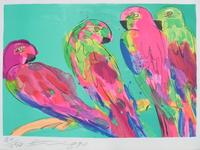
Parrots
Walasse Ting
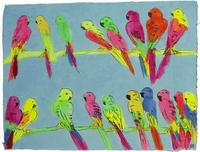
Many Parrots
Walasse Ting
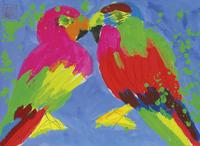
Two Parrots
Walasse Ting
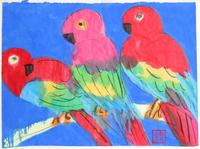
Three Parrots
Walasse Ting
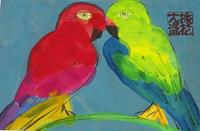
Red Parrot, Green Parrot
Walasse Ting
Kelly V
Sidney Nolan
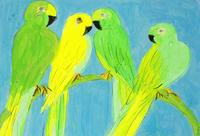
Green and Yellow Parrots
Walasse Ting
Parrot Haven
Wu Guanzhong
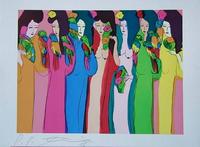
Ladies in a Row
Walasse Ting
Blue Parrots
August Macke
Study for 'Polly'
Robert Lewis Reid
Chagrins D'Amour. Kusaie, Est Carolines
Paul Jacoulet
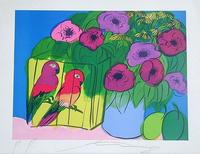
Parrots with Flowers
Walasse Ting
Laissez les jacasser
Bernard Buffet
Red dead parrot
Kinder Album
Cedric Morris
Frances Hodgkins
Papagallos
José Garnelo
Red and Blue Macaw
Henry Stacy-Marks