Expert analysis of Jean Helion’s Figure rose
Style: Abstract Art, Cubism · Genre: figurative
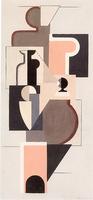
Expert Analysis: "Figure Rose" by Jean Hélion
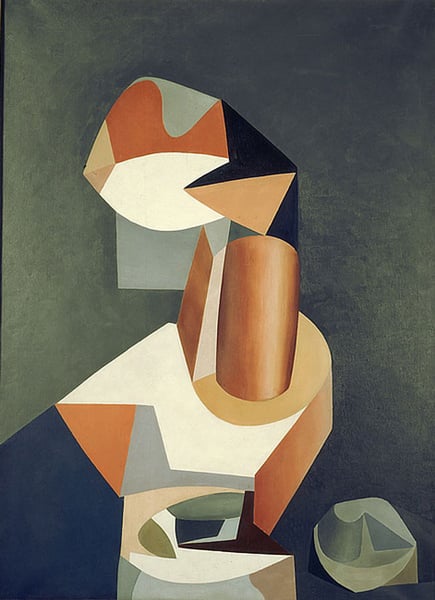
Jean Hélion’s "Figure Rose" occupies a pivotal position in the artist’s trajectory and in the broader narrative of 20th-century art. Though the work is categorized under Abstract Art and Cubism, its genre is explicitly figurative—a deliberate fusion that reveals Hélion’s mature synthesis of two seemingly opposing impulses.
The Cubist Underpinning
Hélion, who began his career as a committed abstractionist and member of the Abstraction-Création group, never abandoned the structural logic of Cubism. In "Figure Rose," the human form is dismantled into geometric facets and intersecting planes, echoing the analytical approach of Picasso and Braque. However, Hélion softens the rigid tectonic geometry of early Cubism with a more fluid, organic handling of space. The “rose” of the title likely refers to a warm, fleshy hue that both anchors the figure and dissolves its boundaries, allowing the abstract scaffolding to breathe.
The Figurative Turn
What makes "Figure Rose" significant is its date and context. By the mid-1930s, Hélion had begun to reintroduce recognizable subjects—figures, objects, and everyday scenes—into his previously non-objective compositions. This was not a retreat from modernism but a radical expansion. Unlike the Surrealists, who distorted the figure for psychological effect, Hélion sought to preserve the figure’s physical presence while subjecting it to the same formal pressures he had applied to pure abstraction. The result is a figure that is both a concrete body and a constellation of abstract relationships—a “figurative abstract” that defies easy categorization.
Significance Within the Style
- Bridging Two Eras: "Figure Rose" exemplifies Hélion’s unique position as a link between the geometric abstraction of the 1930s (e.g., Mondrian, van Doesburg) and the resurgent figuration of postwar art (e.g., Bacon, de Kooning).
- Cubism Reimagined: While Cubism originally fractured the figure to represent multiple viewpoints simultaneously, Hélion uses similar fragmentation to explore the figure’s volume and sensory weight—almost as if the abstract planes are re-coalescing into a living form.
- Color as Structure: The pink/rose palette is not merely decorative; it functions as a structural element, modulating between warm flesh tones and cooler abstract zones. This chromatic tension reinforces the painting’s central drama: the struggle and harmony between representation and abstraction.
In summary, "Figure Rose" is a key work in Hélion’s oeuvre and in the history of modernism. It demonstrates that abstraction and figuration need not be mutually exclusive—rather, they can be cohabitants in a single canvas, each enriching the other. This piece stands as a testament to Hélion’s bold belief that the human figure, even when disassembled, remains a potent vehicle for formal and expressive innovation.
Genre
Style
Visually similar
20 works with related composition and palette
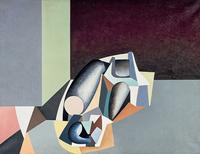
Fallen Figure
Jean Helion
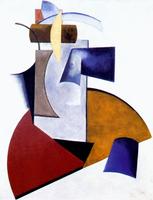
The disc and lid
Alexander Rodchenko
Naturaleza Muerta
Maria Blanchard
Cubist Still Life
Maria Blanchard
Composición Cubista Con Botella
Maria Blanchard
Cubist Composition
Maria Blanchard
Abstraction d'une Statuette
Marthe Donas
Abstract Composition No. 6
Marthe Donas
Cubist Composition
Maria Blanchard
Ile de France
Jean Helion
Bodegón Cubista
Maria Blanchard
Lutte as Ciel
John Ferren
Study for Aviation. Evolution of Forms Under Aerodynamic Limitations (Newark Airport Mural)
Arshile Gorky
Bodegón
Maria Blanchard
1934-6 (painting - still life)
Ben Nicholson
Lamp
Juan Gris
Les Goudes
Maurice Esteve
Les Goudes
Maurice Esteve
Picture T 21
Willi Baumeister
Still Life with Instruments
Lyubov Popova