Analisi esperta di L'Abstraction, Le Peintre et le Modele di Jean Helion
Stile: Expressionism · Genere: self-portrait
Expert Analysis: Jean Hélion’s L’Abstraction, Le Peintre et le Modele (Abstraction, The Painter and the Model)
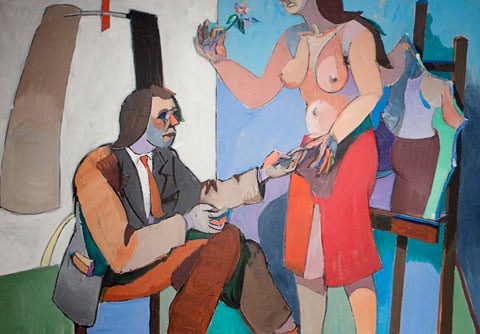
This self-portrait by Jean Hélion occupies a pivotal position in the artist’s career and in the broader trajectory of Expressionism. Created during Hélion’s transition from pure geometric abstraction toward a more figurative, human-centered vocabulary, the work is a meta-painting that literally stages the tension between abstract form and representational reality.
Significance within Expressionism and Hélion’s Oeuvre
-
A Self-Portrait as a Manifesto
As a self-portrait, the painting is not merely a likeness but a philosophical statement. Hélion places himself (the painter) alongside a model, directly engaging with the act of creation. The title—Abstraction, The Painter and the Model—declares that the subject is the very process of negotiating between abstract visual language and the concrete presence of the human figure. This makes the work a landmark in Expressionist self-reflexivity, where the artist’s identity is inseparable from his artistic choices. -
Expressionism’s Internal Dialogue
While Hélion began as a key figure in abstract Constructivism, his later work embraced the emotional intensity and distorted forms typical of Expressionism. In this piece, the “Expressionist” label is earned through the visible brushwork, heightened color contrasts, and the psychological drama of the scene. Yet the title explicitly names “Abstraction,” suggesting that Hélion refuses to abandon the lessons of geometry and simplification. The painting thus becomes a crucible where two competing modernist impulses—pure form and raw emotion—clash and coexist. -
Genre Innovation: The Self-Portrait as Allegory
Traditionally, self-portraits focus on the artist’s face or studio setting. Hélion expands the genre by making the painting’s own conceptual foundation the central character. The model likely functions as both a literal figure and a symbol of representation itself, while the painter (Hélion) stands for the abstracting eye. By placing them together, he literalizes the creative dialectic that defines his mature work. -
Historical Context
Painted as Hélion moved away from the rigid geometry of his earlier abstractions, L’Abstraction, Le Peintre et le Modele signals his return to the human figure—a shift that profoundly influenced later post-war European figuration. The work’s significance lies in its courage to hold abstraction and representation in unresolved tension, making it a cornerstone example of how Expressionism could absorb and transform modernist formal experimentation without losing emotional urgency.
In sum, this self-portrait is not just a picture of the artist; it is a painted theory of painting itself. Hélion’s dialogue between the two polarities of his title makes the work a singular document of Expressionism’s capacity for self-examination and synthesis.
Genere
Stile
Visivamente simili
20 opere con composizione e palette affini
Painter and reclining model
Rafael Zabaleta
The Painter and His Model
Georges Braque
Painter with Model
Istvan Ilosvai Varga
The Three O'Clock Sitting
Henri Matisse
Le Rayon de Soleil
Theophile Steinlen
Interior with nude
Rafael Zabaleta
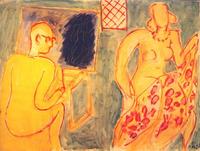
The Painting Session
Henri Matisse
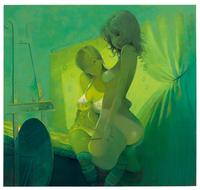
Studio
Lisa Yuskavage
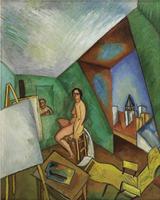
The studio on Seguier street
Raoul Dufy
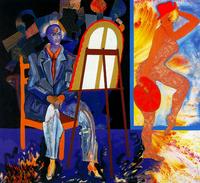
Shrine. Homage to Cézanne
Miriam Schapiro
The Workshop
Carlos Quizpez Asín
The painter Diego Rivera
Arturo Souto
Drawing nude seated in armchair
Pablo Picasso
Attempting the Impossible
Rene Magritte
The Three O'Clock Sitting
Henri Matisse
Lo schiaffo
Mario Comensoli
The Painter
Grégoire Michonze
The three graces
Rafael Zabaleta
Untitled
Gerda Wegener
Students. In the sculpture studio
Dmitri Zhilinsky