Analisi esperta di Orange, Black Painting with Blue Edge, and Burgundy di Robert Irwin
Stile: Light and Space · Genere: installation
Expert Analysis: "Orange, Black Painting with Blue Edge, and Burgundy" by Robert Irwin
Robert Irwin’s Orange, Black Painting with Blue Edge, and Burgundy is a landmark work within the Light and Space movement, a Southern California–born sensibility that emerged in the 1960s and ’70s. Rather than treating the artwork as a discrete object, Irwin—who began as an Abstract Expressionist painter—shifted his focus to the phenomenology of perception, using color, light, and architectural context to create an installation that blurs the boundary between painting, sculpture, and environment.
Significance within Light and Space
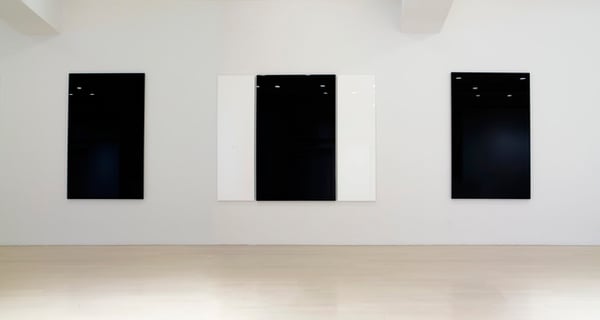
The title itself functions as a precise perceptual instruction: it names three chromatic zones—orange, black, and burgundy—and a fourth element (a blue edge) that operates as a boundary or threshold. These are not merely colors applied to a canvas; they are situated, embodied experiences. Irwin often worked with translucent scrims, painted acrylic panels, or carefully lit walls to produce fields of color that seem to float, advance, or recede depending on the viewer’s position and the ambient light. In this work, the “blue edge” likely acts as a disruptive framing device, preventing the eye from settling into a conventional figure-ground relationship. The black section may absorb light, creating a void, while the orange and burgundy generate optical vibration.
Genre as Installation
Categorizing this piece as an installation is crucial. Irwin’s work redefines the gallery itself as part of the artwork. The piece does not exist solely on a wall; it interacts with the room’s lighting, the floor, and the movement of the viewer. As you walk around it, the relationships among the color fields shift—orange may appear to glow, burgundy recede, and the blue edge might seem to cut into space. This site-responsive quality makes the installation an event rather than an object.
Why It Matters
-
Dematerialization of the Art Object: Irwin, like his Light and Space peers (James Turrell, Larry Bell), helped dismantle the traditional painting/sculpture binary. Here, “painting” becomes a perceptual field that includes the viewer’s body and the architecture.
-
Phenomenological Engagement: The work demands slow, attentive looking. It is not about representation or symbolism but about pure visual sensation—how color behaves under real light, how edges become ambiguous, how the brain constructs form from tonal contrast.
-
Transitional Moment: This piece sits at the cusp of Irwin’s move from studio-based painting to large-scale environmental interventions (like his Central Garden at the Getty). It retains a painterly vocabulary—canvas-like planar surfaces—but recontextualizes them into a spatial dialogue.
In essence, Orange, Black Painting with Blue Edge, and Burgundy is significant because it inverts the traditional role of the viewer: instead of decoding a fixed image, you become an active participant in generating the artwork’s appearance with every shift in light, movement, or focus. It is a masterclass in the poetics of perception that defines the Light and Space movement at its most radical.
Visivamente simili
20 opere con composizione e palette affini
Monochrome Painting: A Posteriori Prototype: Average Size
Stephen Prina
The Seasons
Brice Marden
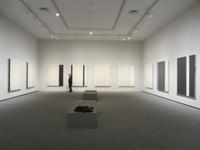
Stations of the Cross
Barnett Newman
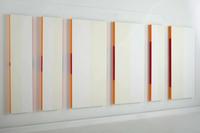
Crescendo Diminuendo
Cesar Paternosto
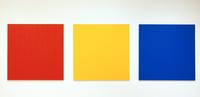
Red Yellow Blue III
Ellsworth Kelly
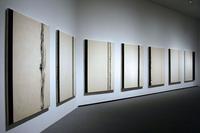
Stations of the Cross 1958 1966
Barnett Newman
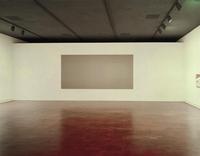
Cumo
James Turrell
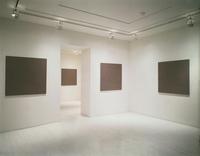
Installation view
Gaylen Gerber
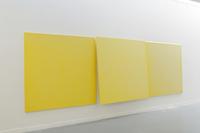
Stanza, Giallo Oro
Ettore Spalletti
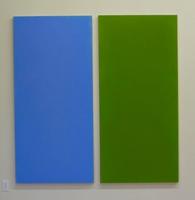
Mother E
Anne Appleby
Toiles à l’unité/Légendes
Claude Rutault
Spectrum V
Ellsworth Kelly
Quartetto indivisibile
Ettore Spalletti
static balance
Carsten Nicolai
Untitled/Exquisite Corpse: The Complete Paintings of Manet 227 of 556 Baigneuses en Seine (Bathers in the Seine) 1874?
Stephen Prina
Morning Chapter 30 (installation view)
R.H. Quaytman
Work No. 373
Martin Creed
dé-finition/méthode #496: exposition-suicide 1
Claude Rutault
The White Room (About T. S. Eliot)
Pedro Cabrita Reis
"On the threshold of infinity" Individual exhibition
Andrzej Nowacki