Expertenanalyse zu Jose Malhoas Dying the clothes
Stil: Impressionism, Realism · Genre: genre painting
Expert Analysis of "Dying the clothes" by José Malhoa
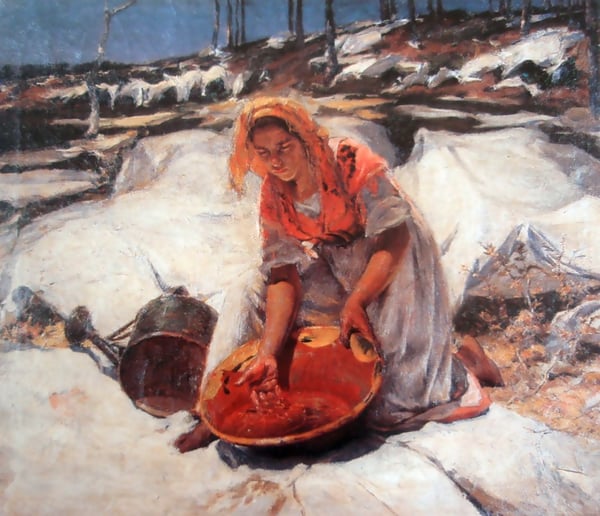
José Malhoa’s Dying the clothes stands as a compelling synthesis of two pivotal 19th-century movements—Impressionism and Realism—applied to the intimate, everyday subject matter of genre painting. The work is significant for how it bridges the documentary fidelity of Realism with the ephemeral optical effects of Impressionism, capturing a moment of domestic labor with both social honesty and sensory vibrancy.
Realist Foundation:
As a genre painting, the work grounds itself in the Realist tradition by depicting an unglamorous, quotidian task: the manual dyeing of textiles. Malhoa avoids idealized or historical themes, instead turning his eye to the lived experience of ordinary people—likely rural or working-class Portuguese women. The careful rendering of textures (rough cloth, steaming dye vats, weathered hands) and the unposed authenticity of the figures align with Realism’s commitment to truthfully representing contemporary life. This choice elevates the dignity of manual work, a hallmark of the movement’s social consciousness.
Impressionist Innovation:
Simultaneously, Malhoa employs Impressionist techniques to dissolve the scene into vibrant, transient light and color. The handling of the dye bath’s reflections, the play of sunlight across wet fabric, and the dappled shadows cast on the ground betray a fascination with atmospheric conditions typical of Impressionism. Rapid, visible brushstrokes suggest the fleeting moment—a splash of water, a shift in sunlight—rather than a frozen tableau. The palette, likely dominated by deep blues, warm ochres, and whites, captures the optical interplay between artificial pigments and natural illumination, making the very process of dyeing a metaphor for painting itself.
Significance within Style and Period:
What makes Dying the clothes especially notable is its role in Portuguese art history. Malhoa was a central figure in introducing Impressionist sensibilities to Portugal while retaining the narrative clarity and social observation of Realism. This work exemplifies his ability to merge two often-opposed approaches: the Realist insistence on subject matter and the Impressionist emphasis on perception. In doing so, he creates a painting that is both a faithful record of a disappearing craft and a shimmering meditation on light and color. It stands as a testament to how genre painting could evolve beyond mere anecdote into a nuanced exploration of modern visual experience—making Malhoa a crucial bridge between academic tradition and avant-garde experimentation in late 19th-century Europe.
Genre
Visuell ähnlich
20 Werke mit ähnlicher Komposition und Farbpalette
Clara
Jose Malhoa
Washing Day
Augustus John
Washerwoman
Noè Bordignon
Gathering Plums
Henry Herbert La Thangue
At the Market
Nicolae Vermont
Milk For The Calves
Frederick Morgan
Souvenir de dour Amenez
Jules Breton
Peasant Woman with pots
Zinaida Serebriakova
At the fountain
Léon Augustin Lhermitte
The Laundry Woman
Camille Pissarro
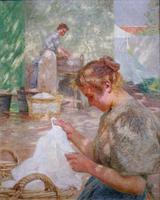
Sunny Day
Emile Claus
Gypsy girl is changing a baby in a wooden tub
August von Pettenkofen
Laundresses on Lake Garda
Ettore Tito
The drinking jug
Joaquín Sorolla
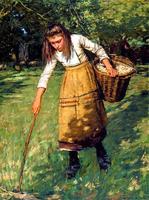
Gathering Wool
Henry Herbert La Thangue
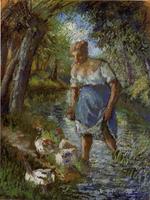
Peasant Crossing a Stream
Camille Pissarro
At the tap
Ivan Mrkviсka
The little girl with a special nanny
Aurelio Tiratelli
Shadow and Sunlight
Julien Dupré
Untitled
Daniel F. Gerhartz