Analisi esperta di Portrait of the Pianist Conrad Ansorge di Lovis Corinth
Stile: Impressionism · Genere: portrait
This analysis focuses on the significance of Lovis Corinth’s "Portrait of the Pianist Conrad Ansorge" within the context of Impressionism and the artist’s own stylistic evolution.
Expert Analysis
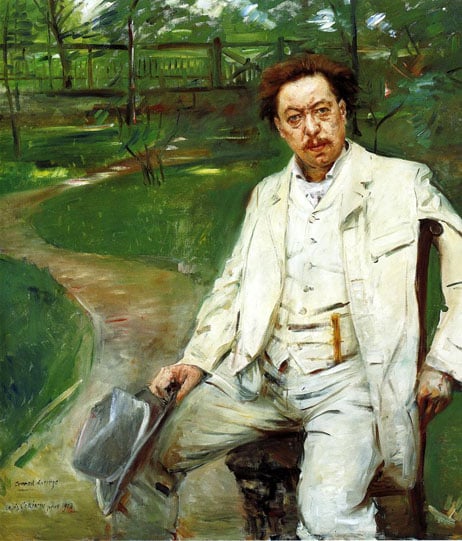
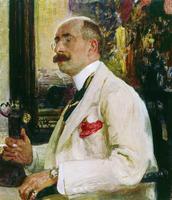
"Portrait of the Pianist Conrad Ansorge" (1903) by Lovis Corinth is a masterful example of late German Impressionism, but it also points toward the artist’s later, more expressive tendencies. The work is significant not only as a portrait of a prominent musician but also as a demonstration of how Corinth adapted Impressionist principles—specifically the emphasis on light, color, and loose brushwork—to explore psychological depth and the energy of performance.
Stylistic Significance within Impressionism:
- Dynamic Brushwork: Corinth employs visible, energetic brushstrokes that build the form of the pianist without rigid outlines. The face and hands are rendered with more controlled strokes, while the background and clothing dissolve into a flurry of dabs and swashes. This technique captures the fleeting, “impressionistic” moment of the sitter at the piano, implying movement and the transient nature of music itself.
- Subordinated Detail for Atmosphere: Rather than focusing on literal likeness or precise detail, Corinth prioritizes the overall mood. The dark, warm tones of the background and the pianist’s suit are punctuated by the pale face and hands, drawing the viewer’s eye to the subject’s intense expression. This use of tonal contrast and limited palette is a hallmark of Corinth’s mature Impressionist style, which often favored chiaroscuro over the bright pastels of French Impressionism.
- Capturing the Sitter’s Vocation: The portrait goes beyond static representation. Conrad Ansorge was a renowned pianist and composer, and Corinth implies his profession through gesture and posture. The slightly tilted head, the positioning of the hands (even if unfinished or blurred), and the concentrated gaze suggest a man caught in the act of making music. For Corinth, Impressionism was a tool to convey sensation, and here that sensation is the experience of listening to (or seeing) a performance.
Why This Work Is Significant within the Period:
-
Bridge to Expressionism: While firmly rooted in Impressionist technique—especially in its brushwork and interest in light—this portrait foreshadows Corinth’s later turn toward Expressionism. The intensity of Ansorge’s facial expression, the psychological weight of the sitter’s stare, and the almost violent energy of the paint application anticipate the more distorted, emotional style Corinth would adopt after 1910. The portrait is thus a crucial transitional piece, showing how German Impressionism could absorb and redirect the movement’s core concerns toward inner life and drama.
-
Portraiture as Character Study: Corinth was renowned for his penetrating portraits of cultural figures. In this work, he elevates the genre beyond mere likeness by using the Impressionist vocabulary to explore the subject’s mental state. The loose, unfinished areas (like the hands) are not a sign of carelessness but a deliberate choice to focus the viewer on the face—the locus of thought and spirit. This psychological emphasis distinguishes Corinth from his French Impressionist contemporaries, who often treated the sitter as part of a light-and-color study.
-
Technical Virtuosity: The painting demonstrates Corinth’s command of oil paint. The impasto highlights on the forehead and cheekbones, the thin washes of the background, and the vigorous strokes that define the pianist’s lapel all show a painter in complete control of his medium. This technical freedom—born from Impressionism’s rejection of academic finish—allows the portrait to feel both spontaneous and deeply considered.
In summary, "Portrait of the Pianist Conrad Ansorge" is significant as an exemplar of how German Impressionism adapted the style’s core tenets (loose brushwork, atmospheric color, and a focus on the fleeting moment) to serve a more introspective, psychological vision. It is a work that captures not only the likeness of a musician but also the energy of his art, while simultaneously marking a pivotal step in Corinth’s journey from Impressionism to his later, more Expressionist style.
Genere
Stile
Visivamente simili
20 opere con composizione e palette affini
Portrait of I. E. Tsvetkov
Vladimir Makovsky
Charles le Coeur
Pierre-Auguste Renoir
Portrait of Monsieur Brun
Edouard Manet
Raimundo de Madrazo in his Paris garden
Joaquín Sorolla
Breakfast In The Green
Anders Zorn
Portrait of Sergei Witte, Minister of Finance
Ilya Repin
Portrait of Charles and Georges Durand Ruel
Pierre-Auguste Renoir
Edward Onslow Ford
Arthur Hacker
Portrait of a man sitting on a park bench
Vladimir Makovsky
Ludvig Karsten
Edvard Munch
Seated Man
Paul Cezanne
Portrait of K. A. Somov
Filipp Malyavin
Portrait of I. F. Tyumenev
Andrei Ryabushkin
Holger Drachman
Peder Severin Kroyer

Portrait of M. Paul
Émile Friant
Portrait of Octave Maus as Dandy
Theo van Rysselberghe
Francisco Bernareggi
John Singer Sargent
Sir William Alison Russell
George Washington Lambert
Portrait of Chaliapin
Konstantin Korovin
Portrait of N.D. Ermakov
Ilya Repin