Deskundige analyse van Bauernmädchen mit weißem Kopftuch van Wilhelm Leibl
Stijl: Realism · Genre: portrait
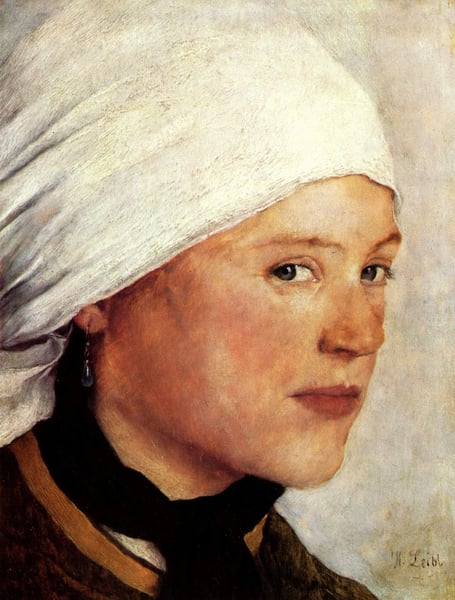
Expert Art Historical Analysis: "Bauernmädchen mit weißem Kopftuch" (Peasant Girl with White Headscarf) by Wilhelm Leibl
Context and Significance
Wilhelm Leibl (1844–1900) was a leading figure of German Realism, deeply influenced by the unsentimental naturalism of Gustave Courbet. This portrait, executed with meticulous precision, exemplifies Leibl’s commitment to portraying rural life without idealization or romanticism—a core tenet of the Realist movement. Alongside artists like Wilhelm Trübner and Carl Schuch, Leibl formed the "Leibl-Kreis" (Leibl Circle), which championed direct observation, restrained palettes, and painstaking draftsmanship.
Visual and Technical Analysis
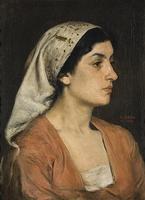
The work centers on a young peasant woman, her face framed by a crisp white headscarf—a humble, everyday garment that becomes the composition’s luminous focal point. Leibl’s brushwork is almost miniaturist in its detail: the texture of the fabric, the subtle shifts in skin tone, and the soft shadows beneath the jawline are rendered with exacting control. The background is kept dark and neutral, forcing the viewer’s attention squarely onto the sitter’s expression and the simple geometry of her headgear.
Realist Authenticity
Unlike earlier genre paintings that often sentimentalized peasant life (e.g., the work of the Düsseldorf School), Leibl presents his subject with unflinching directness. The girl’s gaze is neither coquettish nor downtrodden; it is calm, reserved, and self-contained. There is no overt narrative—only the quiet dignity of a specific individual. This refusal to impose symbolic or moral meaning is a hallmark of Leibl’s mature Realism.
Significance within the Movement
"Bauernmädchen mit weißem Kopftuch" is significant because it transforms a portrait of an anonymous rural figure into a study of pure visual truth. Leibl’s emphasis on materiality—the sheen of linen, the warmth of flesh, the weight of cloth—aligns with the Realist goal of capturing “things as they are.” The painting also demonstrates how German Realism, while sharing French Realism’s social conscience, often leaned toward a more austere, almost photographic objectivity. This piece stands as a testament to Leibl’s belief that the humblest subject, painted with uncompromising honesty, can achieve profound artistic power.
Visueel vergelijkbaar
20 werken met verwante compositie en kleurenpalet
Jeanne Calvet
Jules Breton
Portrait of a Peasant Girl
Ion Andreescu
Peasant Woman from Muscel
Nicolae Grigorescu
Head of a Farm Girl
Wilhelm Leibl
Self-portrait
Zinaida Serebriakova
The Red Scarf
Nicolae Vermont
Young Girl with a Large Cap on Her Head
Camille Corot
Portrait Study
Charles Sillem Lidderdale
Portrait of an Italian Woman
Wenzel Tornøe
Peasant woman from Gabbro
Silvestro Lega
A Girl in a Scarf
Anna Bilińska

Magus
John Currin
Head of a Young Farmer
Nicolae Grigorescu
Self Portrait in Ukrainian Costume
Tetyana Yablonska
Girl in red scarf (worker)
Kuzma Petrov-Vodkin
Grandma
Victor Zaretsky
Celestina
Robert Henri
Portrait of Ingeborg Anderdatter Gulsvig
Adolph Tidemand
Ukrainian
Hryhorii Havrylenko
ortrait de femme au foulard
Johann Victor Kramer