Analisi esperta di Der Spargroschen di Wilhelm Leibl
Stile: Realism · Genere: genre painting
Analysis of "Der Spargroschen" by Wilhelm Leibl
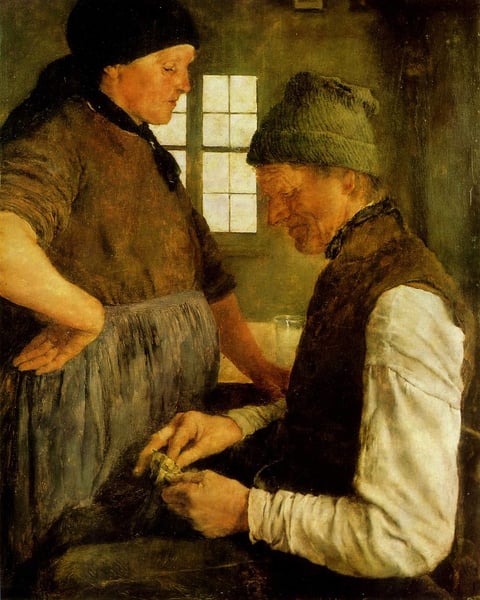
Wilhelm Leibl’s Der Spargroschen (The Penny Saved) stands as a masterful exemplar of German Realism, a movement that sought to depict everyday life with uncompromising honesty. As a genre painting, it focuses on a single, intimate moment—a peasant figure, likely a woman or child, carefully examining or setting aside a small coin—that becomes a profound meditation on thrift, dignity, and the quiet struggles of rural existence.
Significance within Realism and Leibl’s Oeuvre
Leibl’s contribution to 19th-century Realism lies in his rejection of both romantic idealization and academic artifice. In Der Spargroschen, he achieves this through:
- Unflinching observation of the mundane: The subject—a person saving a penny—is deliberately modest. Leibl elevates this everyday act to monumental status, mirroring the Realist insistence that truth resides in the lives of ordinary people.
- Meticulous, almost photographic detail: Leibl’s brushwork is precise and dense, rendering textures of worn clothing, rough hands, and weathered skin with a tactile immediacy. This precision was informed by his study of Hans Holbein the Elder and his engagement with French Realists like Courbet, yet Leibl’s style remains distinctly German in its sober restraint.
- Psychological depth without sentimentality: The figure’s expression is neutral, introspective—neither sentimentalized nor mocked. The act of saving a small coin becomes a symbol of resilience and self-respect, reflecting the harsh economic realities of 19th-century peasant life without moralizing.
- Compositional clarity: The close cropping focuses attention on hands and face, eliminating narrative distraction. The sparse background reinforces the theme of frugality, while the soft, natural light models form with a Caravaggesque intensity, lending solemnity to the scene.
Context and Legacy
Painted during Leibl’s mature period (c. 1877) while he worked in the Bavarian countryside, Der Spargroschen exemplifies his commitment to portraying rural figures with dignity and truth. It forms part of a group of works—such as Die Dorfschönheit and Drei Frauen in der Kirche—that secure Leibl’s reputation as a chronicler of the unsung. Today, the painting is valued not only for its technical brilliance but also for its quiet resistance to the industrialization and urbanization that were reshaping Germany. Leibl’s realism here prefigures the social consciousness of later artists like Käthe Kollwitz, while remaining a timeless record of human perseverance.
Genere
Stile
Visivamente simili
20 opere con composizione e palette affini
Young woman knitting
Vincent van Gogh
Interior with genre scene
Émile Friant
Strickende Mädchen auf der Ofenbank
Wilhelm Leibl
The frugal meal
Émile Friant
Die Tiroler Kellnerin
Albin Egger-Lienz
Dag ungleiche Pahr
Wilhelm Leibl
An Accident
Pascal Dagnan-Bouveret
In der Bauernstube
Wilhelm Leibl
Laundry Girls Ironing
Edgar Degas
A Day Dream
Eastman Johnson
Grandfather and grandchildren
Ludwig Knaus
Spring
Edvard Munch
A feathered friend
Felix Schlesinger
Mädchenportrait
Josef Kinzel
The new material
Jules Trayer
A scene of two ladies in an interior
Harry Brooker
Hope
Frank Holl
Reprimand
Vladimir Makovsky
Scheveningen Woman Knitting
Vincent van Gogh
In the Store During a Pause from Fishing
Peder Severin Kroyer