Expertenanalyse zu Frederic Remingtons A Misdeal
Stil: Impressionism · Genre: genre painting
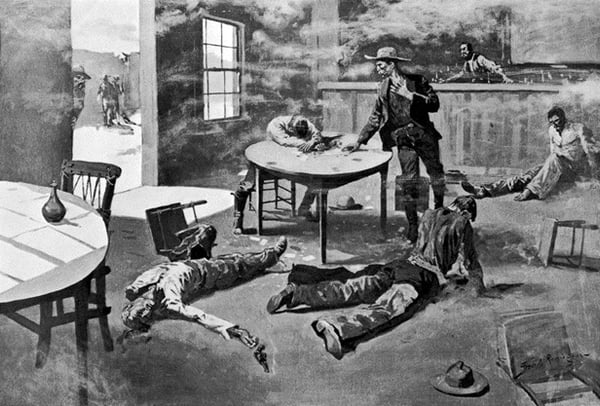
Expert Analysis of "A Misdeal" by Frederic Remington
Frederic Remington is primarily celebrated for his vivid, action-packed depictions of the American West, often rendered in a detailed, realist style. However, "A Misdeal" marks a significant departure and a bold experimentation with Impressionism, a movement more commonly associated with French and American urban or pastoral scenes. This artwork’s significance lies in how it synthesizes Remington’s signature Western subject matter with the atmospheric, light-driven techniques of Impressionism, revealing a lesser-known but crucial phase of his artistic evolution.
Significance within Impressionism and Remington’s Oeuvre
-
Genre Painting in an Unexpected Context: As a genre painting, "A Misdeal" captures a moment of everyday life—here, a tense poker game in a Western saloon. Impressions of the period often focused on modern leisure (cafés, theaters, boating) or rural landscapes. Remington adapts this focus to the frontier, elevating a rough-and-tumble card game to a subject worthy of Impressionist treatment. This expands the movement’s scope, proving that its principles could illuminate the grit and social ritual of the American West with equal vitality.
-
Experimentation with Light and Atmosphere: Unlike Remington’s earlier, more linear and documentary works, "A Misdeal" employs the hallmark Impressionist concern with light and its transient effects. The painting likely uses broken brushwork, soft edges, and a muted yet warm palette to convey the smoky, lamplit interior of a saloon. The figures are rendered not as precise portraits but as shapes of color and shadow, dissolving into the ambient glow. This prioritization of atmospheric mood over narrative detail was radical for Remington and demonstrates his willingness to absorb European avant-garde techniques.
-
A Bridge Between Two Modes: In his later career (c. 1900–1909), Remington increasingly moved toward Impressionism, producing nocturnes and scenes where light—not action—became the protagonist. "A Misdeal" exemplifies this shift: the card players’ tense expressions are suggested rather than described, and the true drama lies in the flickering lamplight modeling their faces. The work thus stands as a crucial transition piece, connecting his early realist chronicles of the West to his final, luminous, post-Impressionist-inspired masterpieces like "The Stampede" or "The Night Herder."
-
Challenging the Stereotype of Western Art: By adopting Impressionism, Remington contested the notion that Western American subjects could only be rendered in a gritty, documentary style. "A Misdeal" imbues a mundane frontier occurrence with painterly sophistication and emotional depth—the tension of a misdeal becomes as visually compelling as a thunderstorm or a cavalry charge. It also reveals the artist’s broader ambition: to not merely record the West, but to interpret it through the lens of modern art, thereby elevating it to the level of high culture.
In summary, "A Misdeal" is significant because it represents Remington’s cross-pollination of American Western genre painting with European Impressionist technique. It demonstrates that the ephemeral, subjective qualities of light and atmosphere—central to Impressionism—can find powerful expression in the unlikely setting of a frontier saloon, thereby expanding the boundaries of both movements.
Visuell ähnlich
20 Werke mit ähnlicher Komposition und Farbpalette
Peaceful Valley Saloon
Charles M. Russell
Le tripot
Gustave Bourgain
Austeria rzymska
Aleksander Gierymski
Strike
Mihaly Munkacsy
Visits a Ration Board
Norman Rockwell
The Spy
Nicolae Vermont
Claude Bernard and Pupils
Léon Augustin Lhermitte
Questioning in the committee of poor
Ivan Vladimirov
The Village Tavern
John Lewis Krimmel
Police raid
George Pemba
Prayer Before the Meal
Vincent van Gogh
A young boy is sitting on the table where another is doing his homework
Jules Trayer
Batone recounts
Niccolo Cannicci
Alphonse de Neuville
Alphonse-Marie-Adolphe de Neuville
A party
Vladimir Makovsky
The brigades of dawn
Carlos Saenz de Tejada
Registering Fellaheen for the Conscription
Elizabeth Thompson
The last news
Nicolas Toussaint Charlet
Interior of an Inn
Adriaen van Ostade
Untitled
Everett Shinn