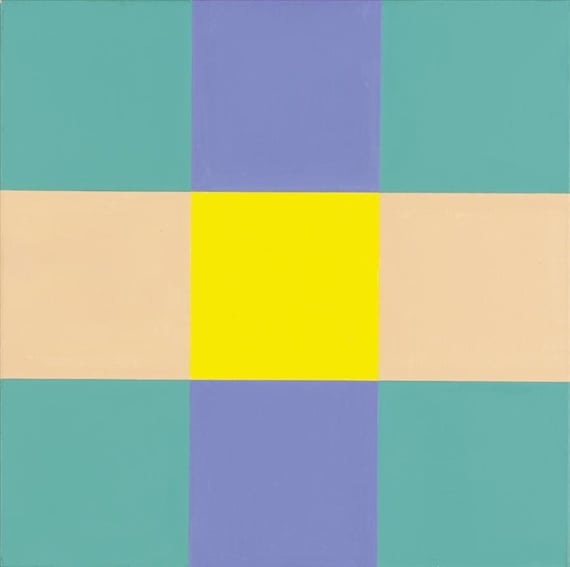
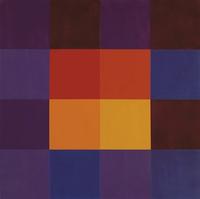
Drei Horizontal Gruppen mit gelben Zentrum Variation E
Analisi esperta di Drei Horizontal Gruppen mit gelben Zentrum Variation E di Richard Paul Lohse
Stile: Concretism · Genere: abstract
Expert Analysis: Drei Horizontal Gruppen mit gelben Zentrum Variation E (1951) by Richard Paul Lohse
Richard Paul Lohse (1902–1988) was a central figure in Swiss Concretism, a movement that broke with expressive abstraction to pursue a purely rational, mathematical visual language. This painting—whose title translates to Three Horizontal Groups with Yellow Center Variation E—exemplifies the core tenets of Concretism: systematic order, optical dynamism, and the elimination of all subjective gesture.
Composition and Structure
The work is built from three distinct horizontal bands (the “three horizontal groups”), each further subdivided into a precise arrangement of color fields. A vibrant yellow zone anchors the center, creating a focal point that balances the cooler, more neutral hues flanking it. This central yellow does not simply sit as a static block; it interacts with the adjacent strips through measured contrasts of value and saturation. Lohse’s method is serial: each horizontal group is a variation on a theme, shifting the proportions and color sequences slightly to generate a rhythm that appears both systematic and optically alive.
Significance within Concretism and Beyond
What makes this painting pivotal is its radical commitment to structure as content. Lohse rejected symbolic or narrative meaning; instead, he treated color and form as autonomous elements that could be organized by pre-established rules—often using grids, arithmetic progressions, or modular repeats. Here, the variation “E” suggests a sequence of permutations, prefiguring the serialist strategies later adopted by Minimalist and Conceptual artists in the 1960s. The work achieves a paradoxical stillness and motion: the horizontal bands press against one another, creating a subtle tension that feels both controlled and dynamic.
Influence and Legacy
This piece stands as a key example of how Concretism bridged Bauhaus principles and postwar systematic art. Lohse’s exploration of color intervals and symmetrical variation directly influenced Op Art (e.g., Bridget Riley) and the grid-based abstractions of artists like Sol LeWitt. By reducing painting to its elemental components—line, plane, hue, and repetition—Drei Horizontal Gruppen mit gelben Zentrum Variation E redefines abstraction not as improvisation, but as a form of visual logic, making it a landmark in the history of geometric abstraction.
Visivamente simili
20 opere con composizione e palette affini
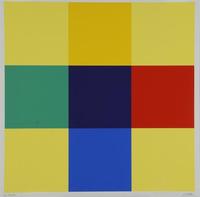
Kreuz aus Gleichung und Kontrast
Richard Paul Lohse
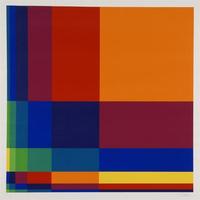
Sechs vertikale systematische Farbreihen mit orangem Quadrat rechts oben
Richard Paul Lohse
Stabilisierter kern
Max Bill
Cross
Edna Andrade
Untitled
Richard Paul Lohse
Structure
Guido Molinari
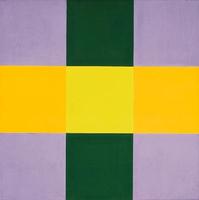
Drei Gruppen mit grnem Zentrum
Richard Paul Lohse
Geometric Composition
Ivan Serpa
Big Blue Pink
Judy Chicago
Modular/Seriell
Richard Paul Lohse
Untitled, 703, 7ft x 7ft
Robert Swain
Untitled (from the Portfolio "Ten Works X Ten Painters")
Ad Reinhardt
EC20-E1
Thiago Boecan
Echiquier
Aurelie Nemours
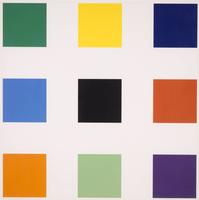
Nine Squares
Ellsworth Kelly
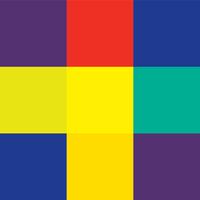
Diagonal from bright equality and contrast
Richard Paul Lohse
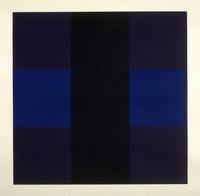
Untitled #6
Ad Reinhardt
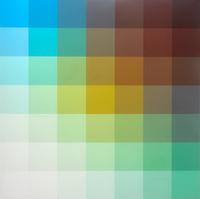
Untitled, 712, 7ft x 7ft
Robert Swain
The Fourth of the Three
Richard Anuszkiewicz
Neun systematische Farbreihen mit horizontaler und vertikaler Verdichtung
Richard Paul Lohse