Expertenanalyse zu Richard Paul Lohses Modular/Seriell
Stil: Concretism · Genre: abstract
Artwork: Modular/Seriell
Artist: Richard Paul Lohse
Style: Concretism
Genre: Abstract
Expert Analysis
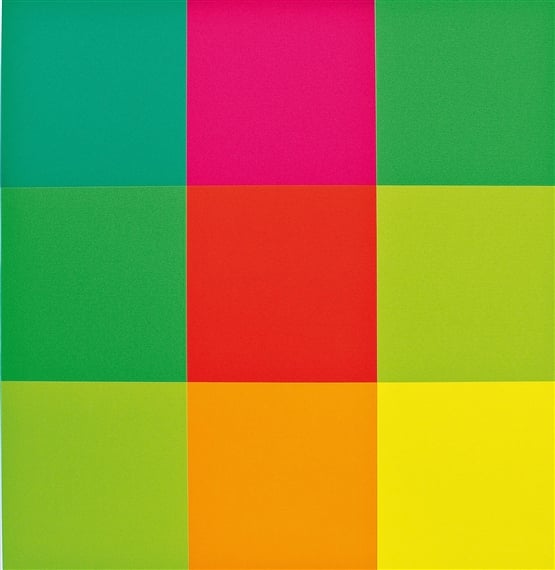
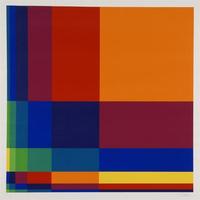
Richard Paul Lohse’s Modular/Seriell is a masterwork of European Concretism—a movement that pushed abstract art toward rigorous, systematic structures. This painting exemplifies Lohse’s lifelong commitment to serial order and modular composition, where color and form are generated not by intuition but by predetermined, repeatable rules.
What makes it significant:
-
Systematic Color Progression – Unlike purely geometric abstraction, Lohse’s grids are built from color series that follow mathematical or permutational logic. In Modular/Seriell, hues shift in a predictable sequence (e.g., by saturation, hue, or value), transforming the canvas into a visual score where each square is both unique and part of a larger, logical whole. This pre-established system eliminates subjective gesture, aligning with Concretism’s goal of “concrete” (non-symbolic, self-referential) art.
-
Modularity as Structure – The painting’s grid is strictly modular: repeated, identical units (squares or rectangles) contain color variations. This modular approach reflects postwar utopian ideals of industrial precision and democratic seriality—each element is equal, replaceable, and part of an open-ended system. Lohse’s work anticipates later Minimalism and Conceptual Art, but his focus remains on optical experience rather than pure concept.
-
Union of Order and Perception – Despite its rigid system, Modular/Seriell creates dynamic perceptual effects. Neighboring colors interact optically, producing illusory shadows, vibrations, or spatial depth. The viewer experiences both the rational blueprint (the modular grid) and an organic, shifting visual field—a dialectic between logic and sensation that defines Concretism’s highest achievements.
-
Historical Context – Lohse was a key member of the Swiss Concretist group Allianz and a collaborator with Max Bill. Modular/Seriell embodies the movement’s rejection of both Expressionism and Surrealism, championing instead a universal, mathematically grounded visual language accessible to all. It stands as a landmark in non-figurative, non-narrative art that privileges structure over subject.
In essence, Modular/Seriell is not merely a pretty grid—it is a manifesto in paint, demonstrating how abstraction can become a tool for exploring order, perception, and the limits of systematic creation. Its significance lies in its radical proposal: that art can be both utterly rational and deeply perceptual, serial yet singular.
Visuell ähnlich
20 Werke mit ähnlicher Komposition und Farbpalette
Stabilisierter kern
Max Bill
Farbfelder
Richard Paul Lohse
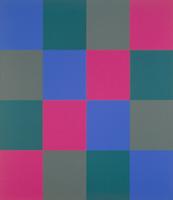
Structure
Guido Molinari
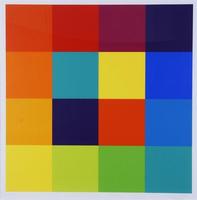
Gestufte Quadratreihe um ein Komplementärzentrum
Richard Paul Lohse
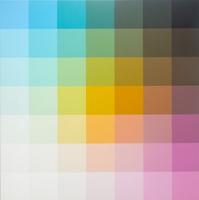
Untitled, 703, 7ft x 7ft
Robert Swain
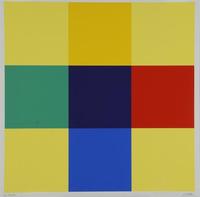
Kreuz aus Gleichung und Kontrast
Richard Paul Lohse
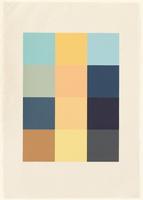
After Duchamp
Sherrie Levine
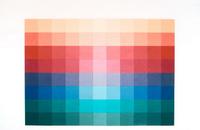
Untitled, 80”x110”
Robert Swain
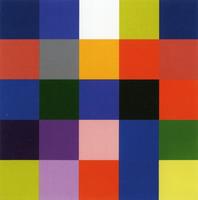
25 Colours
Gerhard Richter
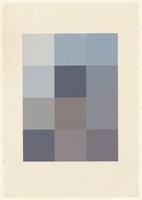
After Monet
Sherrie Levine
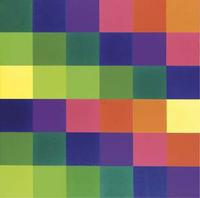
Six systematical colour rows from bright to bright
Richard Paul Lohse
Untitled, 712, 7ft x 7ft
Robert Swain
Johnson and Johnson Model
Robert Swain
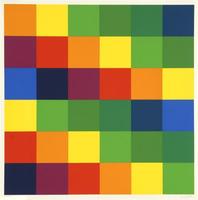
Sechs systematische Farbreihen mit blaugrünen und violetten Akzenten
Richard Paul Lohse
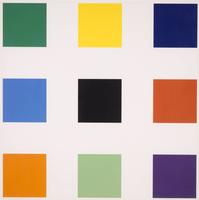
Nine Squares
Ellsworth Kelly
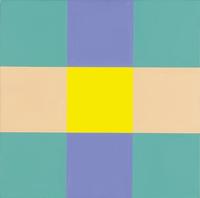
Drei Horizontal Gruppen mit gelben Zentrum Variation E
Richard Paul Lohse
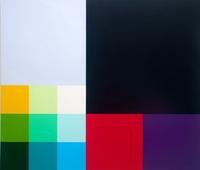
Untitled, 6 x 7-05
Robert Swain
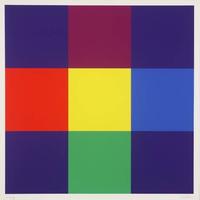
Untitled
Richard Paul Lohse
Sechs vertikale systematische Farbreihen mit orangem Quadrat rechts oben
Richard Paul Lohse
Wisteria
Anne Appleby