Expertenanalyse zu Richard Paul Lohses Kunstmappe Schweizerische Mobiliar
Stil: Concretism · Genre: abstract
Expert Analysis: Richard Paul Lohse's "Kunstmappe Schweizerische Mobiliar"
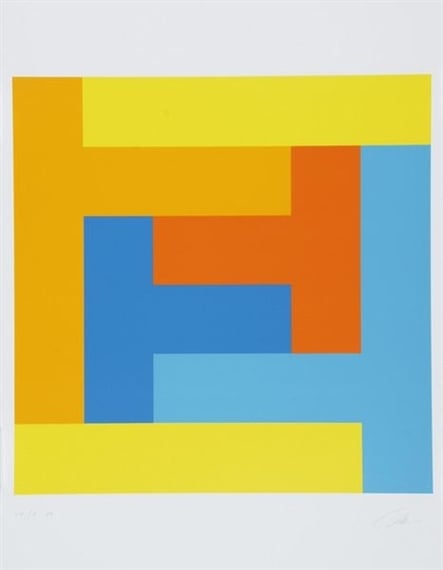
Richard Paul Lohse’s Kunstmappe Schweizerische Mobiliar stands as a paradigm of Concretism, the mid-20th-century movement that sought to purge art of all naturalistic reference and subjective emotion, embracing instead pure, mathematical abstraction. This work is significant not only for its strict adherence to Concretist principles but also for its pioneering fusion of avant-garde art with corporate identity and applied design.
Systematic Structure and Visual Logic
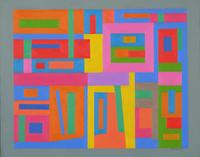
Lohse was a master of modular, grid-based composition. In this portfolio—created for the Swiss insurance company Mobiliar—he employs his signature method of color series and permutation. The artwork is built from repeating geometric modules (likely squares or rectangles) arranged in a strict, non-hierarchical grid. Each unit is assigned a hue from a limited, carefully calibrated palette. The colors follow a predetermined sequence, shifting in value or saturation across the grid, creating a sense of rhythmic progression without any central focal point. This eliminates all illusionistic depth or narrative, forcing the viewer to engage with the work as an objective, self-contained system.
Significance Within Concretism
Lohse’s approach epitomizes the Concretist ideal articulated by Theo van Doesburg: "The work of art must be entirely conceived and formed by the mind before its execution." There is no gestural spontaneity; every color and shape is determined by a logical, almost algorithmic rule. The abstract genre is here pushed to its purest extreme—the artwork is not a representation of anything external, but rather a visually realized idea of order, balance, and seriality. Lohse’s work directly influenced later developments in Op Art and systemic abstraction.
Functional Art and Corporate Design
What makes Kunstmappe Schweizerische Mobiliar especially remarkable is its dual identity. It is both a fine art portfolio and a commercial commission. By applying Concretist principles to a corporate setting, Lohse demonstrated that abstract visual logic could serve a communicative, institutional purpose. The grid and color progression evoke clarity, reliability, and systematic efficiency—qualities aligned with Mobiliar’s identity as an insurance provider. This integration of avant-garde aesthetics into functional design anticipated the Swiss Style of graphic design that would dominate the mid-20th century, where grids, sans-serif typography, and objective composition became hallmarks.
Conclusion
In summary, Kunstmappe Schweizerische Mobiliar is significant because it synthesizes rigorous Concretist theory with applied art, proving that pure abstraction can operate as a meaningful system beyond the gallery. It stands as a landmark in Lohse’s career, showcasing his lifelong dedication to serial, permutational order and his belief that art and design could merge in a rational, democratic visual language. The work remains a key reference point for understanding how geometric abstraction transcends decoration to become a tool of structured thought and institutional communication.
Visuell ähnlich
20 Werke mit ähnlicher Komposition und Farbpalette
Untitled
Richard Paul Lohse
Progression von Sechs Gleichen Gruppen von 1-11
Richard Paul Lohse
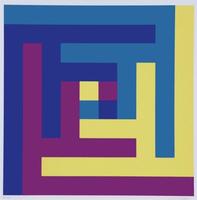
Vier verbundene Gruppen
Richard Paul Lohse
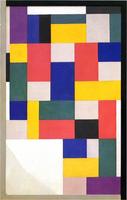
Pure Painting
Theo van Doesburg
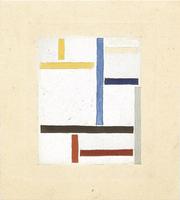
Study for Composition XXV
Theo van Doesburg
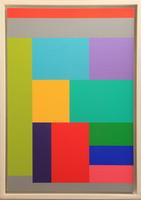
Q2
Jean-Francois Dubreuil
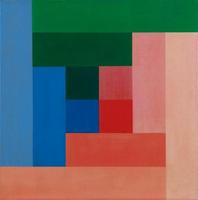
Progression of Four Graded Colours
Richard Paul Lohse
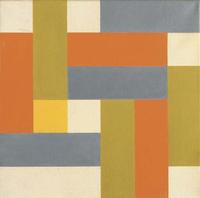
Farbenergien in vier Richtungen
Richard Paul Lohse
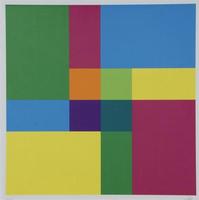
Zentrum aus vier Quadranten als Ergebnis der vier Kreuzflächen
Richard Paul Lohse
Q3
Jean-Francois Dubreuil
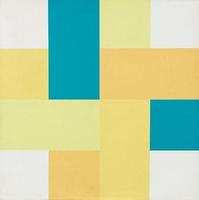
Vier verschränkte Farbgruppen mit blau grünen Akzenten
Richard Paul Lohse
Q1
Jean-Francois Dubreuil
Q4
Jean-Francois Dubreuil
Untitled
Camille Graeser
Study for Variant
Josef Albers
Mural
Fernand Leger
Saphan
Omar Rayo
EC19-i3
Thiago Boecan
Untitled
Ad Reinhardt
Relational Painting
Fritz Glarner