Analisi esperta di Vier verbundene Gruppen di Richard Paul Lohse
Stile: Concretism · Genere: abstract
Expert Analysis: "Vier verbundene Gruppen" by Richard Paul Lohse
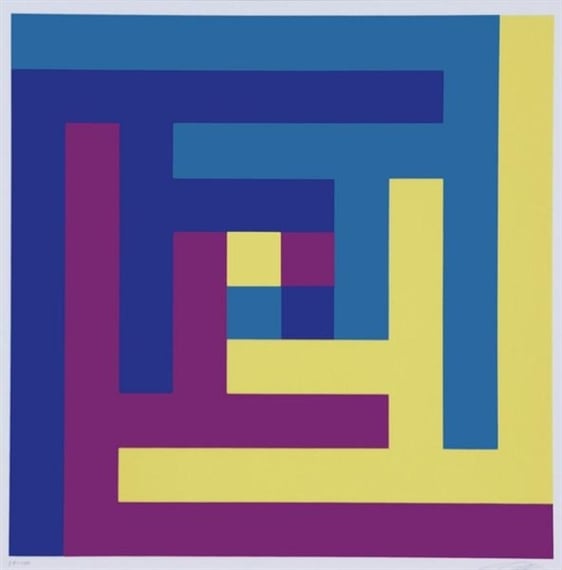
Richard Paul Lohse’s “Vier verbundene Gruppen” (English: Four Connected Groups) stands as a paradigmatic work of Concretism, a movement that sought to strip art of all references to the natural world and instead build images from pure, self-sufficient geometric forms and colors. As an abstract composition, this painting is not a depiction of anything external—it is an object in its own right, a structure governed by internal logic and systematic order.
What makes this artwork significant:
-
Systematic Permutation and Seriality
Lohse was a pioneer of what he called “modular” or “serial” composition. In “Vier verbundene Gruppen,” he arranges four distinct clusters of colored squares or rectangles within a grid. Each group is likely a permutation of the same set of colors (often primary hues, black, and white) but rotated, reversed, or shifted—creating visual connections across the canvas. This systematic approach anticipates both Minimalism and Conceptual Art, emphasizing process and rule-based creation over gesture or expression. -
The Principle of “Verbundene” (Connected) Groups
The title explicitly highlights connection. Unlike many concrete works that isolate geometric units, Lohse insists on relationships between the groups. The viewer’s eye is drawn from one cluster to the next via shared edges, color echoes, or rhythmic intervals. This transforms the painting into a visual “sentence” of sorts—a grammar of form and color where meaning arises from structure rather than narrative. -
Embodiment of Concretist Ideals
Lohse was a key figure in the Swiss Concrete Art movement, along with artists like Max Bill and Camille Graeser. “Vier verbundene Gruppen” epitomizes the movement’s credo: “Concrete art is the expression of the human spirit, based on its own principles and laws.” The work is entirely self-referential—its significance lies in its internal harmonies, not in any metaphor or symbolic content. -
Optimal Clarity and Rational Beauty
The painting achieves a delicate balance between order and vitality. The grid provides a rigorous framework, yet the variations in grouping and color create subtle optical rhythms—a dynamic equilibrium. Lohse believed that such rational structures could convey a universal, democratic beauty, free from subjective emotion. This makes his work a cornerstone of the Constructivist-Concrete tradition and a precursor to later generative and computer-based art.
In context:
Within the history of 20th-century abstraction, “Vier verbundene Gruppen” is significant for demonstrating how a limited set of formal elements—color, shape, and position—can yield infinite complexity through systematic variation. It is a testament to artistic freedom found within constraints and remains a key reference for anyone studying seriality, modularity, and the aesthetics of pure form.
Visivamente simili
20 opere con composizione e palette affini
Progression von Sechs Gleichen Gruppen von 1-11
Richard Paul Lohse
Kunstmappe Schweizerische Mobiliar
Richard Paul Lohse
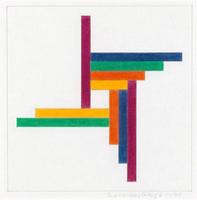
Composition
Verena Loewensberg
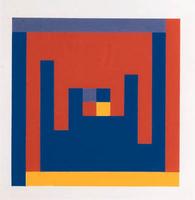
Untitled
Richard Paul Lohse
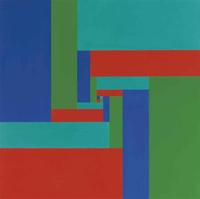
Bewegung von 4 kontrastierenden Gruppen aus einem Zentrum
Richard Paul Lohse
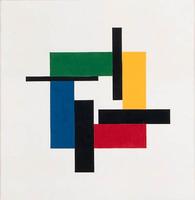
Untitled
Verena Loewensberg
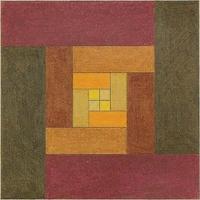
Etudes Bauhaus D
Victor Vasarely
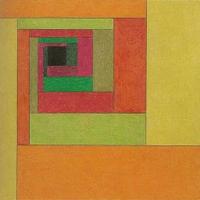
Etudes Bauhaus C
Victor Vasarely
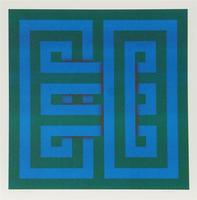
Saphan
Omar Rayo
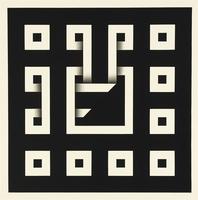
Clandestine Game XI
Omar Rayo
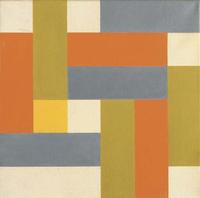
Farbenergien in vier Richtungen
Richard Paul Lohse
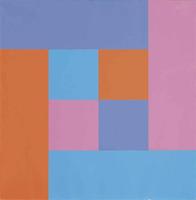
Progression vier gleicher Gruppen von 1-4
Richard Paul Lohse
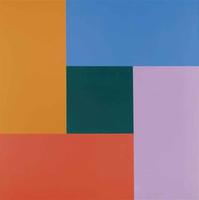
Bewegung von dunkelgelb über rot, violett, blau zu grünem Zentrum
Richard Paul Lohse
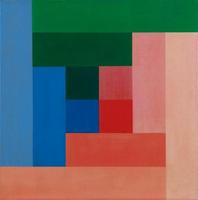
Progression of Four Graded Colours
Richard Paul Lohse
Mur-Mur
Omar Rayo
Composition
Theo van Doesburg
Espiral Laranja
Rubem Ludolf
O.V.N.I.
Omar Rayo
Tanglewood Tales
Virginia Frances Sterrett
Riu-Kiu-C
Victor Vasarely