Analisi esperta di Rhythmische Teilung di Richard Paul Lohse
Stile: Concretism · Genere: abstract
Expert Analysis: "Rhythmische Teilung" by Richard Paul Lohse
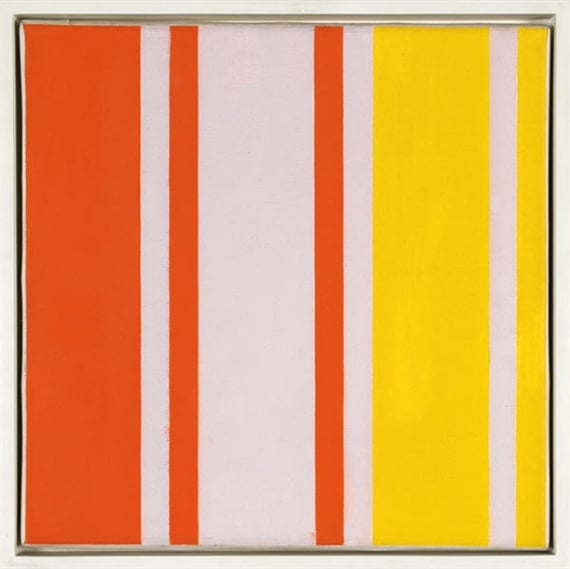
Richard Paul Lohse’s “Rhythmische Teilung” (Rhythmic Division) stands as a landmark of Concrete Art, a movement that sought to strip painting of all illusionistic or symbolic references, focusing instead on pure visual language—color, form, and systematic structure. Created during Lohse’s mature period, this work exemplifies his lifelong commitment to serial, modular composition and the logical arrangement of color.
Significance within Concretism:
-
Systematic Grid and Seriality: Lohse was a pioneer of systematic art, predating and influencing later Minimalism and Op Art. In Rhythmische Teilung, he employs a strict grid of horizontal and vertical divisions, but avoids static repetition. Instead, he introduces rhythmic variation through the careful distribution of color bands. The “division” is not random; it follows a pre-determined numerical or geometric sequence, creating a dynamic equilibrium between order and movement.
-
Color as Structure: Unlike Abstract Expressionists who used color emotionally, Lohse treats color as a material element that defines spatial relationships. Here, hues are arranged in graduated or alternating patterns, generating an optical vibration. This approach makes the painting self-referential: its meaning lies entirely in the interaction of its own parts.
-
Rejection of Composition: Traditional composition implies a focal point or hierarchy. Lohse’s modular grid eliminates any center, allowing the eye to roam freely. The work is all-over and infinitely extendable in theory, reflecting the Concrete Art principle that art should be a constructed object, like a building or a machine.
-
Historical Context: As a member of the Zurich school of Concrete Art (alongside Max Bill and Camille Graeser), Lohse argued that art must be rational and socially responsible. Rhythmische Teilung embodies this ethos: it is legible, reproducible, and free of subjective emotion, aligning with postwar European desires for clarity and reconstruction.
This painting is significant not only for its rigorous beauty but for its role in redefining abstraction as a logical, generative system—a direct precursor to generative and computer art.
Visivamente simili
20 opere con composizione e palette affini
V.S.
Karl Benjamin
Untitled
Michel Carrade
Untitled
Michel Carrade
Untitled
Michel Carrade
Untitled
Michel Carrade
Untitled
Michel Carrade
Untitled
Michel Carrade
Untitled
Michel Carrade
Mutation rythmique bi-jaune
Guido Molinari
Orange-Blue Space
Guido Molinari
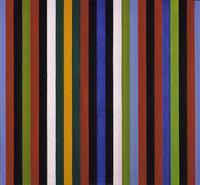
Hot Beat
Gene Davis
Sweet Carburetor
Gene Davis
Powwow
Gene Davis
Sour Ball Beat
Gene Davis
Sevastipol
Doug Ohlson
Diffusion of Two Groups of Colour
Richard Paul Lohse
GMPC
Yui Yaegashi
Untitled
Michel Carrade
Orange Twitter
Gene Davis
Zebra
Gene Davis