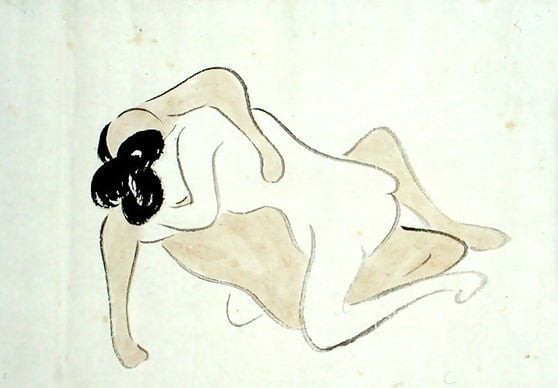
A Shunga
Expert analysis of Ike no Taiga’s A Shunga
Style: Nanga (Bunjinga) · Genre: nude painting (nu)
Expert Analysis of "A Shunga" by Ike no Taiga
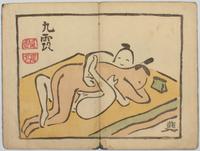
Ike no Taiga (1723–1776) was a leading master of the Nanga (or Bunjinga) school, the Japanese literati painting tradition inspired by Chinese scholar-artists. In the context of Nanga—a style prized for its amateur ideal, calligraphic brushwork, and themes of landscape, flowers, and classical Chinese subjects—Taiga’s A Shunga represents a striking and significant departure.
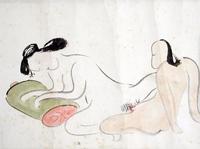
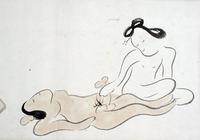
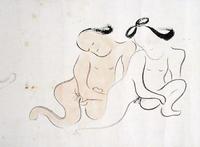
The work is classified as a nude painting (nu) and is explicitly a shunga (erotic art). This alone creates a powerful tension with Nanga conventions. Traditionally, Nanga painters avoided explicit eroticism, which was more commonly associated with ukiyo-e prints. Taiga’s choice to bring shunga into the literati sphere elevates the genre: he applies the distinctive Nanga stylistic vocabulary—loose, expressive brushstrokes, asymmetrical composition, and a poetic economy of line—to the human figure and intimate subject matter.
What makes A Shunga significant is its transgression of genre boundaries. By rendering the nude with the same spontaneity and refined brushwork he used for misty mountains or bamboo, Taiga asserts that even the erotic could be treated as a subject for high art, worthy of a scholar-painter’s attention. This fusion challenges the hierarchy of Japanese painting genres, demonstrating the flexibility and intellectual ambition of the Bunjinga movement. Furthermore, the "nude" as a pure subject was rare in pre-modern Japanese art (shunga typically showed figures in elaborate robes); Taiga’s focus on unadorned bodies may reflect the literati ideal of direct, honest expression, stripped of decorative excess.
In summary, A Shunga is a bold, genre-defying work that merges the refined aesthetics of Nanga with the intimate, often taboo realm of erotic art. It proves that Taiga’s art was not confined to orthodox literati themes but could embrace human sensuality through the same disciplined, evocative brushwork that defined his era’s most cultivated painting style.
Visually similar
20 works with related composition and palette
A Shunga
Ike no Taiga
A Shunga
Ike no Taiga
A Shunga
Ike no Taiga
A Shunga
Ike no Taiga
Two Female Nudes, One Reclining, One Kneeling
Egon Schiele
A Shunga
Ike no Taiga
Panama
Roberto Matta
Lovers
Ernst Ludwig Kirchner
Dance
Ossip Zadkine
Fantasy or Love
Alfred Freddy Krupa
Daito keigo (4)
Ike no Taiga
Two Friends
Egon Schiele
Untitled
Auguste Rodin
Untitled
Pablo Picasso
Nude
Nikos Nikolaou
Untitled (Lovers)
M.F. Husain
Cain and Abel
Marc Chagall
Embrace
Vasiliy Ryabchenko
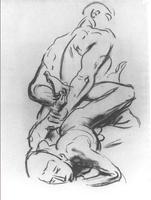
Study for a devil and victim in Judgement
John Singer Sargent
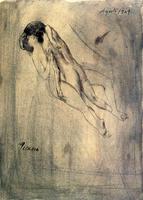
Lovers
Pablo Picasso