Analisi esperta di Landscape with Pavilion, Hanging Scroll di Ike no Taiga
Stile: Nanga (Bunjinga) · Genere: landscape
Expert Analysis: "Landscape with Pavilion, Hanging Scroll" by Ike no Taiga
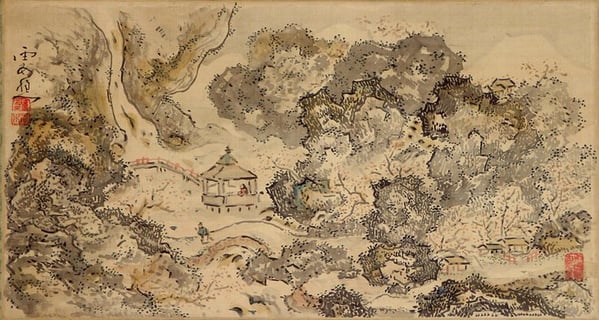
Ike no Taiga (1723–1776) is celebrated as one of the founding masters of the Nanga (Bunjinga) or "Southern School" of Japanese painting—a style deeply inspired by Chinese literati traditions but infused with a distinctly Japanese sensibility. This hanging scroll, Landscape with Pavilion, exemplifies the core values of Nanga: the fusion of scholarly idealization with spontaneous, expressive brushwork.
Significance within the Nanga Style:
-
Synthesis of Chinese and Japanese Aesthetics: Taiga was instrumental in translating the Chinese amateur scholar-painter ethos—where painting was a vehicle for personal cultivation and poetic sentiment—into a Japanese context. Here, the pavilion (a classic symbol of retreat and contemplation) is not merely a structural element but a metaphor for the scholar’s isolated mind, harmonizing with the surrounding natural forms. The composition echoes Chinese Song and Yuan dynasty landscape conventions (e.g., layered mountains, winding paths, and atmospheric mist), yet Taiga’s handling is looser, more calligraphic, and infused with a playful, lyrical quality that marks the Japanese adaptation.
-
Innovative Brushwork and Ink Economy: Taiga was renowned for his experimental use of ink—often employing “hatching” strokes, dry brush, and pooling ink to create texture and depth without rigid outline. In this scroll, the mountains are built from swift, rhythmic ink washes and dot-like stippling, conveying both mass and airiness. The pavilion is rendered with minimal, deliberate lines, anchoring the scene without dominating it. This economy of means, typical of Nanga, invites the viewer to complete the landscape through imagination—a key literati ideal.
-
Integration of Poetry and Calligraphy: Like many Nanga works, Taiga’s scrolls often included poetic inscriptions (though not specified here, the format implies space for such). Even without text, the painting itself functions as a “visual poem,” with the pavilion serving as a focal point for quiet observation—a stand-in for the scholar-painter himself. The hanging scroll format reinforces this intimate, meditative experience, meant for a private studio rather than public display.
-
Role in Defining Japanese Literati Art: Taiga, along with his contemporary Yosa Buson, helped establish Nanga as a major school in Japan. Landscape with Pavilion embodies the movement’s departure from the rigid, decorative styles of the Kano and Tosa schools, embracing instead a personal, untutored elegance. Taiga’s ability to fuse Chinese compositional principles with Native Japanese landscape motifs—such as softer, more organic rock formations—marks this work as a bridge between two traditions.
In summary, the significance of this scroll lies in its masterful embodiment of the Nanga spirit: a harmonious balance of intellect and emotion, tradition and innovation, where a single pavilion becomes a doorway into the vast, reflective landscape of the mind.
Visivamente simili
20 opere con composizione e palette affini
Earthly paradise and sacred mountains
Tomioka Tessai
Fishing in Springtime
Ike no Taiga
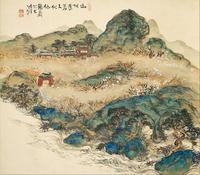
Mountain of Immortals
Tomioka Tessai
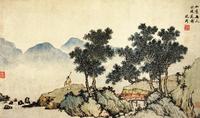
Falling Flowers
Shen Zhou
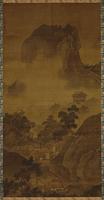
Landscape of Four Seasons: Fall
Sesshu Toyo
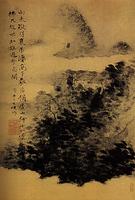
Between mountain and river, not far from Mount Huang
Shitao
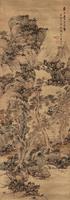
Autumn Mountains after Wang Meng
Lan Ying
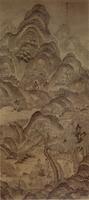
Landscape of Pine Valley
Chen Hongshou
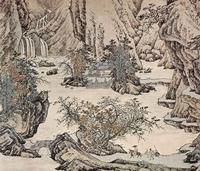
Landscape
Qiu Ying
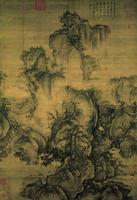
Early Spring
Guo Xi
Landscape
Tomioka Tessai
A Solitary Temple Amid Clearing Peaks
Li Cheng
Snowscape
Tang Yin
Watching Waterfall
Lan Ying
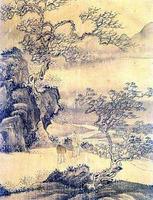
The picture of a man in the landscape
Owon
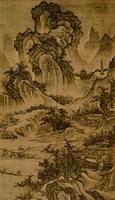
Untitled
Guo Xi
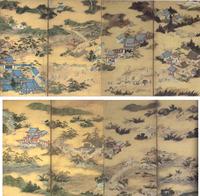
Famous Views of Sagano (top) and Famous Views of Uji (bottom)
Kanō Eitoku
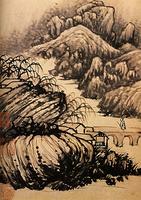
Hiking in the area of the Temple of the Dragon
Shitao
Untitled (a cave halfway up the mountain)
Ike no Taiga
Trees
Guo Xi