Analyse experte de Under the Lamp de Marie Bracquemond
Style : Impressionism · Genre : genre painting
Expert Analysis: "Under the Lamp" by Marie Bracquemond
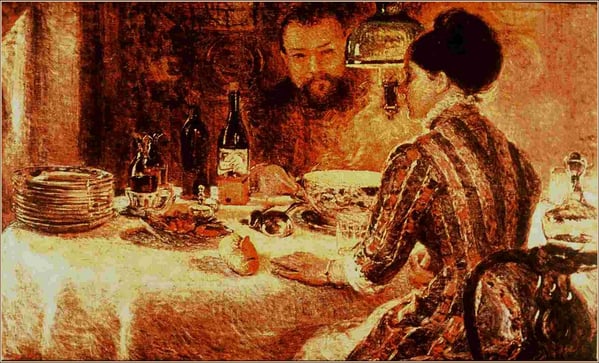
Marie Bracquemond, one of the few prominent female figures in the Impressionist movement, often turned her lens to the quiet, luminous interiors of domestic life—a subject both personal and revolutionary for its time. Under the Lamp exemplifies her mastery of capturing the interplay of artificial light in a private, everyday moment.
Why This Work Matters:
-
Innovative Treatment of Artificial Light: While Impressionists famously focused on natural daylight (Monet’s haystacks, Renoir’s dappled gardens), Bracquemond deliberately centers the scene around the warm, intimate glow of a lamp. This challenges the notion that Impressionism is solely about plein-air effects. Here, the lamp’s yellow-orange radiance shapes the figures and objects, creating soft halos and dramatic shadows—a sophisticated study of nocturnal interior illumination that rivals Degas’s cafe scenes or Cassatt’s theater boxes.
-
The Feminine Gaze on Domestic Modernity: Like her contemporary Berthe Morisot, Bracquemond elevates the private sphere of women—reading, sewing, or conversing under lamplight. But Under the Lamp goes further: it presents this space not as passive or sentimental, but as a site of quiet agency. The figures (likely her husband, the etcher Félix Bracquemond, and perhaps a friend) are absorbed in their own activities, unified by the light yet psychologically separate. This subtle narrative of middle-class intimacy was a radical departure from the overtly moralizing or theatrical genre scenes of the Salon tradition.
-
Brushwork with a Purpose: Bracquemond’s technique here reveals a delicate balance between Impressionist sketch-like freedom and precise draftsmanship. The highlights on skin and fabric are built with short, separate strokes of warm white and pale yellow, while the darkened periphery dissolves into deep blues and browns. This not only conveys the physical effect of lamplight but also mirrors the way our eyes adjust to low light—a proto-psychological realism that anticipates artists like Vuillard.
-
Overcoming Institutional Marginalization: Bracquemond was largely excluded from major Impressionist exhibitions after 1886 due to her husband’s disapproval. Under the Lamp thus stands as a testament to her persistence, produced during a period when she was pushed out of the public avant-garde. Its intimate scale and theme reflect not a retreat, but a deliberate choice to find radical innovation in the overlooked corners of the home—a place where female artists could claim authority.
Significance within Impressionism:
While not as widely known as Morisot or Cassatt, Bracquemond’s Under the Lamp expands the movement’s technical and thematic range. It demonstrates that Impressionism was never only about sunlight and leisure; it was equally a tool for exploring the tender, flickering moments of modern life, even in the shadow of a single lamp. For art historians, this work is a crucial reminder of the diverse voices that shaped the movement, and of how domestic light became a vehicle for personal expression and quiet defiance.
Visuellement similaire
20 œuvres à la composition et à la palette proches
The Dinner Party
Jules-Alexandre Grun
The Luncheon
Claude Monet
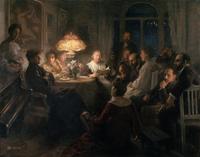
The Friends of Ellen Key
Hanna Hirsch-Pauli
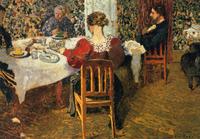
The End of Breakfast at Madam Vuillard
Edouard Vuillard
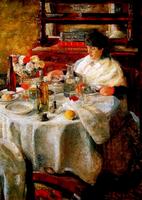
The Oyster Eater
James Ensor
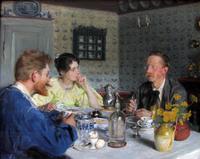
Lunch with Otto Benzon
Peder Severin Kroyer
Luncheon at Antino
Peder Severin Kroyer
Abendgesellschaft
Adolph Menzel
The Luncheon
Pierre-Auguste Renoir
The Birthday Party
John Singer Sargent
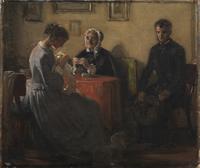
The suitor's visit
Wilhelm Marstrand
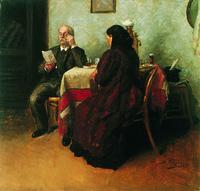
A letter
Vladimir Makovsky
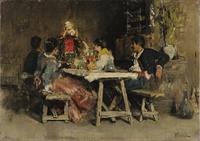
Wedding dinner
Vincenzo Caprile
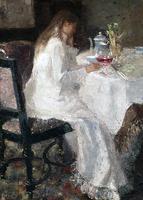
Lady in White
Jan Toorop
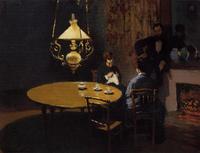
The Dinner
Claude Monet
Yeats at Petitpas
John French Sloan
Mother and Child
Umberto Boccioni
The Breakfast Table
John Singer Sargent
Waiting for Bridal Couple's Return from a Church in Novgorod Province
Andrei Ryabushkin
Lamp Effect
Edouard Cortes