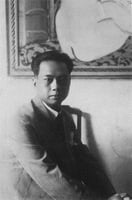
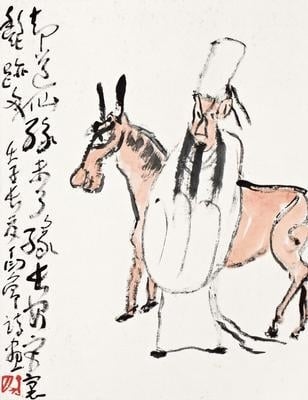
Expert analysis of Ding Yanyong’s Character
Style: Expressionism, Ink and wash painting · Genre: portrait
Expert Analysis of "Character" by Ding Yanyong
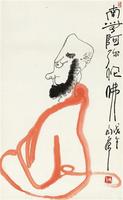
Ding Yanyong’s “Character” stands as a landmark work in the synthesis of Eastern and Western pictorial traditions, uniquely marrying the emotional intensity of Expressionism with the disciplined spontaneity of classical Chinese ink and wash painting. As a portrait, it transcends mere likeness to become a psychological study, where the artist’s dynamic brushwork and bold ink modulations capture not a face but a state of being.
Significance within its Style and Period:
-
Fusion of Traditions: Ding Yanyong was a pioneer in modernizing Chinese painting. “Character” exemplifies his ability to adapt the gestural freedom of Expressionist portraiture—emphasizing distorted features, exaggerated expressions, and stark contrasts—to the medium of ink on paper, traditionally used for its lyrical and calligraphic qualities. This cross-cultural dialogue challenged both the literati painting conventions of China and the purely formal concerns of Western Expressionism.
-
Ink as an Emotional Vehicle: The work is significant for treating ink not just as a descriptive medium but as an expressive force. Heavy, saturated washes and dry, ragged strokes create a sense of raw, inner turmoil, while areas of unpainted paper introduce tension and breath. This technique prefigures later modernist experiments in Chinese painting, where emotion overrides harmonious elegance.
-
Portraiture of the Inner Self: Unlike traditional Chinese portraiture, which idealized sitters or focused on social status, Ding’s “Character” presents a psychological portrait. The distorted facial features and stark chiaroscuro-like ink effects reflect the artist’s engagement with contemporary existential concerns, aligning with European Expressionists like Kokoschka or Soutine, yet rooted in the fluid, abstract tradition of Chinese brush art.
In summary, “Character” is significant for its bold cross-cultural synthesis, demonstrating that Expressionist emotion can be channeled through the most delicate of Chinese ink techniques, thereby expanding the vocabulary of both movements. It invites viewers to consider how identity and inner life can be rendered with nothing more than brush, ink, and an unflinching honesty.
Visually similar
20 works with related composition and palette
Riding on a Donkey
Xu Beihong
Back home after a night of drunkenness
Shitao
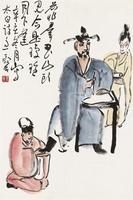
Li Bai's Drunken Calligraphy
Ding Yanyong
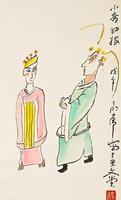
The Younger Qiao, a New Bride
Ding Yanyong
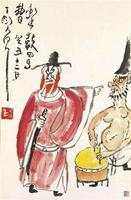
Denouncement of Cao Cao
Ding Yanyong
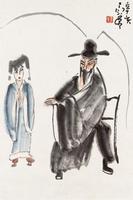
Opera Figures
Ding Yanyong
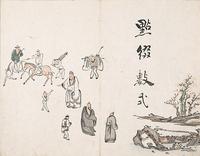
Untitled (Figures)
Ike no Taiga
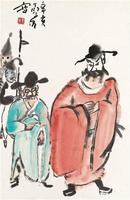
Opera Figures
Ding Yanyong
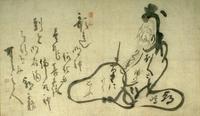
Hitomaro
Hakuin Ekaku
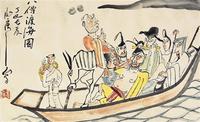
Eight Immortals
Ding Yanyong
Reclining Daruma
Joshu Shunso
Untitled
Sengai
Ox-herding Zen
Sengai
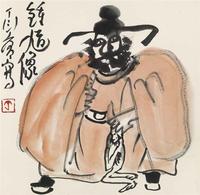
Zhong Kui
Ding Yanyong
Figure
Ding Yanyong
Portrait of 'Night-Shining White', a favorite steed of Emperor Xuanzong
Han Gan
Drinking Tea
Huang Yongyu
Lovers under the moon
Shin Yoon-bok
Drenching
Sengai
Horse
Kasumi Bunsho