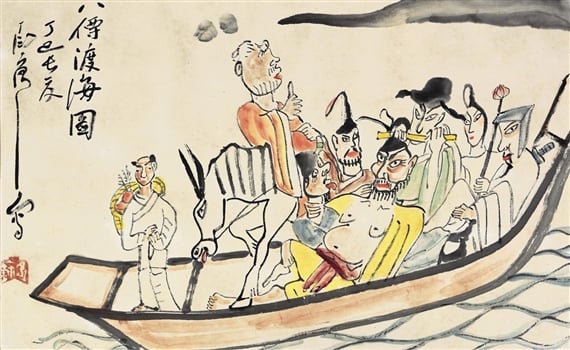
Ding Yanyong の Eight Immortals の専門的な分析
スタイル:Expressionism, Ink and wash painting · ジャンル:mythological painting
Analysis of "Eight Immortals" by Ding Yanyong
Ding Yanyong’s Eight Immortals stands as a landmark work that redefines mythological painting by fusing Chinese ink-wash tradition with Western Expressionist dynamism. Painted during a period when many Chinese artists sought to modernize their national heritage, Ding rejected both academic realism and rigid literati convention, instead forging a personal, emotionally charged style.
Significance within Expressionism and Ink Painting:
- Synthesis of mediums: Ding employs the spontaneous, wet-on-wet textures of ink wash—central to Chinese brushwork—but amplifies them with bold, often arbitrary colors and distorted forms borrowed from Fauvist and Expressionist vocabulary. The Eight Immortals are not rendered with careful linear elegance; instead, they emerge through slashing, energetic strokes, with exaggerated proportions and vividly unnatural hues (e.g., crimson robes, emerald hats) that convey vitality and spiritual energy rather than anatomical accuracy.
- Emotional immediacy: True to Expressionist principles, Ding prioritizes inner feeling over outer description. The immortals—Daoist symbols of longevity and freedom—are depicted in a state of ecstatic movement, their postures bent and faces slightly grotesque, suggesting that transcendence is a wild, untamed force rather than a serene ideal. This psychological intensity is rare in classical Chinese painting of this subject, which typically emphasizes harmony and balance.
- Cultural recontextualization: By applying Western modernist brushwork to a canonical Chinese motif, Ding subverts the long-standing tradition of "wenrenhua" (literati painting), which valued restraint and calligraphic discipline. His loose, almost violent handling challenges the viewer to see the immortals not as fixed icons but as living, flawed beings—a radical, humanizing stance for its time.
Period Context: Created amidst the early 20th-century Chinese art reform movement, Eight Immortals exemplifies the "xihua yundong" (Western painting movement) as reshaped by artists like Ding, who studied in Japan and France. It rejects both the conservatism of the Shanghai School and the complete Westernization advocated by others. Ding’s work instead proposes a hybrid modernism: one that retains ink’s fluidity and symbolic weight while adopting Expressionism’s raw emotionalism. This work thus occupies a crucial bridge position, influencing later generations of Chinese avant-garde artists who continue to reimagine traditional motifs through a contemporary lens.
In sum, Eight Immortals is significant for its fearless cross-cultural synthesis—a mythological painting that simultaneously honors its Chinese roots and declares the universal language of Expressionist passion.
視覚的に類似
構図やパレットが近い作品 20 件
Zhong Kui Marrying off His Sister
Ding Yanyong
Taoist Immortals Celebrating Longevity
Tomioka Tessai
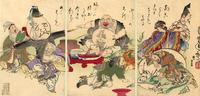
The Seven Lucky Gods
Tsukioka Yoshitoshi
Street scenes newly pubished
Katsushika Hokusai
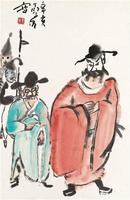
Opera Figures
Ding Yanyong
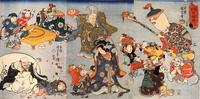
The seven gods of good fortune
Utagawa Kuniyoshi
Manga
Katsushika Hokusai
Shrine Attendants Smoking
Toyota Hokkei
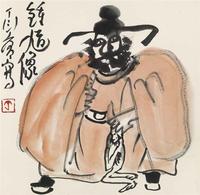
Zhong Kui
Ding Yanyong
Untitled (Figures)
Ike no Taiga
Denouncement of Cao Cao
Ding Yanyong
Chobenzu
Ike no Taiga
The Fever
Tsukioka Yoshitoshi
A scene of Journey to the West
Tsukioka Yoshitoshi
Untitled (Figures)
Ike no Taiga
Yang Guifei Mounting a Horse
Qian Xuan
Persona
Ding Yanyong
鬼趣图
Qian Xuan
Otsu-e Paintings Coming Alive Triptych
Utagawa Kuniyoshi
The ghost of Taira Tomomori
Utagawa Kuniyoshi