Analisi esperta di Persimmons and Flowers di Ding Yanyong
Stile: Expressionism · Genere: still life
Expert Analysis: "Persimmons and Flowers" by Ding Yanyong
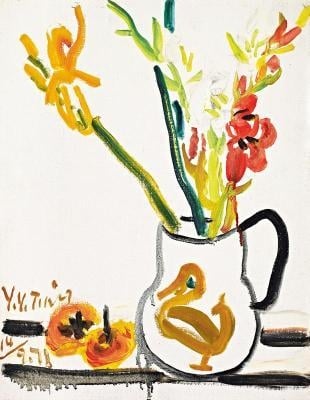
Ding Yanyong’s “Persimmons and Flowers” is a striking example of how Expressionist still life became a vehicle for cultural synthesis in early 20th-century Chinese modernism. The work’s significance lies in its bold bridging of Western Expressionist techniques with Chinese aesthetic traditions—a hallmark of Ding’s practice as a pioneer of modern art in East Asia.
Form and Emotion:
True to Expressionism, the composition prioritizes emotional intensity over naturalistic representation. The persimmons and flowers are likely rendered with flattened perspective, exaggerated contours, and vibrant, non-naturalistic colors—possibly saturated oranges, deep reds, and stark blacks. Ding’s brushwork is characteristically free and calligraphic, applying thick, gestural strokes that preserve the energy of the painter’s hand. The result is a still life that feels alive, almost turbulent, as if the fruit and blossoms pulse with inner feeling rather than sit passively on a table.
Cultural Fusion:
What makes this work significant within its period is Ding’s unique ability to merge two distinct lexicons. The subject matter—persimmons and flowers—is deeply rooted in traditional Chinese literati painting, where such objects symbolize auspiciousness, transience, or scholarly virtue. Yet Ding strips away the meticulous ink wash and restrained tones of classical Chinese bird-and-flower painting, replacing them with the raw chromaticism and subjective distortion of European Expressionism. This was a radical departure in the 1930s–1940s, when many Chinese artists were still debating how to reconcile tradition with modernity.
Historical Impact:
Ding Yanyong studied in Paris (1920s) and later taught at Hangzhou and Taiwan. “Persimmons and Flowers” embodies the cross-cultural dialogue he championed: it neither mimics Western Expressionism nor retreats into convention, but creates a wholly new visual language. The work’s significance is thus twofold—it is both a personal, emotionally charged still life and a landmark in the global evolution of Expressionism, demonstrating that the style could transcend its European origins to articulate a distinctly Chinese sense of vitality and harmony.
Visivamente simili
20 opere con composizione e palette affini
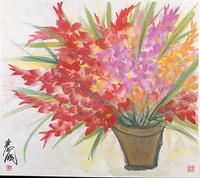
Gladioli
Lin Fengmian
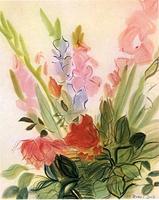
Gladioli
Raoul Dufy
Gladioli
Chaim Soutine
Gladíolos (palmas de Santa Rita)
Anita Malfatti
Sword-Lillies
Gheorghe Petrascu
Untitled
Dilek Demirci
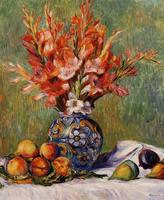
Flowers and Fruit
Pierre-Auguste Renoir
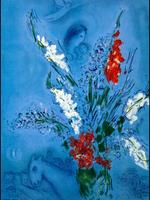
The Gladiolas
Marc Chagall
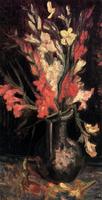
Vase with Red Gladioli
Vincent van Gogh
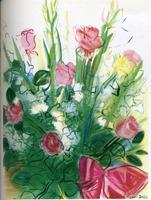
Bouquet of roses
Raoul Dufy
Imperial Gladiolus
Octav Bancila
Gladiolus
Claude Monet
Still Life Flowers and Fruit
Pierre-Auguste Renoir
Vase with Red Gladioli
Vincent van Gogh
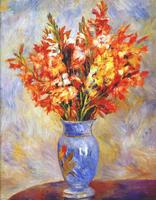
Gladioli
Pierre-Auguste Renoir
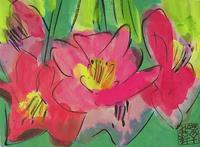
The Pinkest Flowers
Walasse Ting
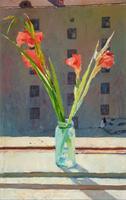
Gladiolus
Tahir Salahov
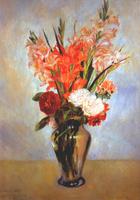
Gladioli
Pierre-Auguste Renoir
Gladiolen
Ivan Generalic
Still Life with Gladioli
Felix Vallotton