High Up on the Mountain
Expertenanalyse zu Huang Yongyus High Up on the Mountain
Stil: Abstract Expressionism, Ink and wash painting · Genre: landscape
Expert Analysis: "High Up on the Mountain" by Huang Yongyu
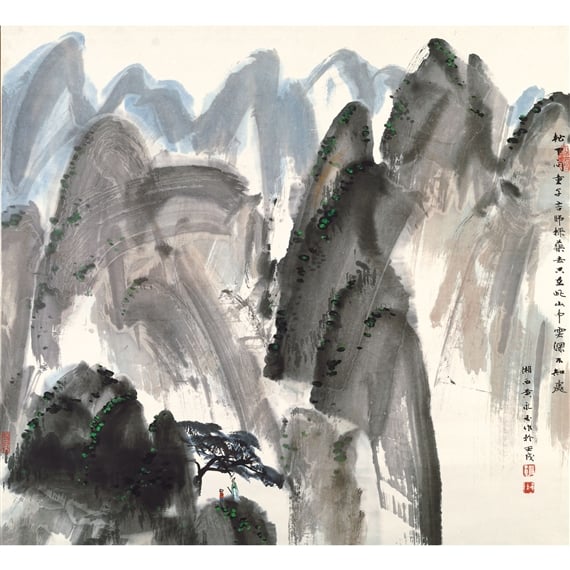
Huang Yongyu’s "High Up on the Mountain" is a landmark work that bridges two monumental artistic traditions: the spontaneous, gestural energy of Western Abstract Expressionism and the meditative, lyrical fluidity of traditional Chinese ink and wash painting. This fusion establishes the painting as a significant contribution to 20th-century East-West dialogue in art.
Stylistic Synthesis The work retains the landscape genre central to Chinese literati painting, yet it dissolves topographical description into abstract fields of ink—sweeping washes, dripping lines, and bold, impulsive brushstrokes. Huang adopts the Abstract Expressionist emphasis on process and the artist’s physical gesture, particularly echoing the “drip” technique of Jackson Pollock. However, his material is sumi ink on paper, not oil on canvas, and his mark-making is rooted in xieyi (freehand sketch) calligraphic principles. The result is not mere imitation but a genuine hybrid: the mountain becomes a volatile, almost seismic trace of energy, its “height” expressed through vertical thrusts of ink rather than perspective.
Innovation in Ink and Wash Huang revitalizes the millennia-old medium by pushing ink beyond its traditional role of defining form. In “High Up on the Mountain,” ink is used both as a descriptive element (suggesting rock, mist, vegetation) and as an autonomous, expressive substance. He allows ink to bleed and pool, creating accidental textures that evoke the “spirit” (qiyun) of the mountain while also asserting the materiality of the medium itself. This aligns with the Abstract Expressionist goal of direct, unmediated expression, yet remains anchored in Chinese aesthetic values of spontaneity and resonance.
Cultural and Historical Significance Painted during the late 20th century, the work exemplifies the global reach of Abstract Expressionism while affirming a distinct Chinese voice. Huang Yongyu resists pure non-objectivity; the mountain remains a recognizable subject, yet it is deconstructed into raw sensation. This tension—between representation and abstraction, Eastern meditative control and Western existential release—makes the painting a pivotal example of cross-cultural modernism. It argues that traditional ink painting can absorb and transform radical Western styles without losing its own identity, opening a path for subsequent generations of artists experimenting with hybrid forms.
Visual and Emotional Impact The composition is both majestic and intimate. Light ink washes create atmospheric distance, while darker, jagged strokes push the mountain forward, as if it is alive and breathing. The absence of color strips the scene to its elemental essence—water, ink, paper, motion. The viewer is not shown a specific peak but is instead invited into the very process of the mountain’s coming into being, a concept deeply rooted in Daoist spontaneity and echoed in Abstract Expressionist action painting.
In sum, “High Up on the Mountain” is significant because it successfully melds two traditionally distinct philosophies of mark-making, achieving a new, transcendent visual language. It stands as a testament to Huang Yongyu’s boldness in fusing the energetic freedom of Abstract Expressionism with the disciplined poetry of Chinese ink painting, creating a landscape that is both of its time and timeless.
Visuell ähnlich
20 Werke mit ähnlicher Komposition und Farbpalette
Dancing and Singing (Peasants Returning from Work)
Ma Yuan
Sound of Pines on a Mountain Path
Tang Yin
Geumgang jeondo
Jeong Seon
Light of dawn on the monastery
Shitao
Pavilions in the Mountains of the Immortals
Qiu Ying
Landscape of Mt. Lushan
Xu Beihong
Dancing and Singing (Peasants Returning from Work) (detail 1)
Ma Yuan
Homes
Qi Baishi
The Hermitage at the foot of the mountains
Shitao
Poet on a Mountaintop
Shen Zhou
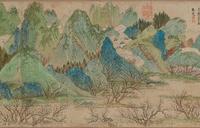
Peach Blossom Spring (detail)
Qiu Ying
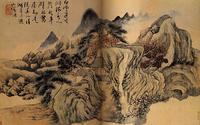
Autumn the mountain
Shitao
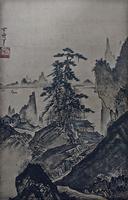
Landscape
Sesshu Toyo
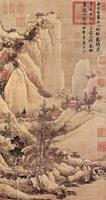
Clearing after Snow on a Mountain Pass
Tang Yin
Luxuriant Forest among Distant Peaks
Li Cheng
Untitled (Mountains)
Ike no Taiga
Terrace of Cinnabar
Shitao
Untitled (Mountain)
Ike no Taiga
Untitled (Mountains)
Ike no Taiga
Xiling Gorge
Fu Baoshi