Analisi esperta di An Allegory of Peace and the Arts under the English Crown di Artemisia Gentileschi
Stile: Baroque · Genere: quadratura, trompe-l'œil
Expert Analysis: An Allegory of Peace and the Arts under the English Crown by Artemisia Gentileschi
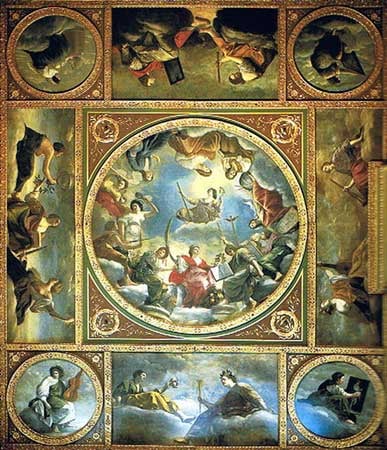
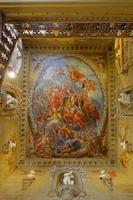
This work stands as a remarkable testament to Artemisia Gentileschi’s mastery of Baroque illusionism and her ability to fuse political allegory with the technical bravura of quadratura and trompe-l’œil. Painted during her brief yet consequential stay in London (1638–1640) at the court of Charles I, the piece is a ceiling decoration that transforms architecture into a staged, celestial drama—a hallmark of Baroque quadratura, where painted perspectives merge seamlessly with real space. Gentileschi employs trompe-l’œil to make the allegorical figures appear to float above the viewer, breaking the plane of the ceiling with convincing foreshortening and dramatic chiaroscuro.
What makes this work significant is how Gentileschi, as one of the few women of her era to command large-scale public commissions, subverts the male-dominated tradition of allegorical ceilings. Here, she personifies Peace and the Arts under the English Crown, likely glorifying the Stuart monarchy’s patronage. The female figures are not passive objects but active agents—Peace holds an olive branch while the Arts (Painting, Sculpture, Music, etc.) gather around her, echoing Gentileschi’s own identity as a woman artist. The trompe-l’œil elements, such as simulated architectural frames and seemingly three-dimensional putti, showcase her rigorous training in perspective under her father Orazio and her own study of Caravaggio’s naturalism.
Within the Baroque context, this piece exemplifies the period’s obsession with inganno (deception) and meraviglia (wonder). Gentileschi’s handling of drapery and light creates a palpable sense of movement, while her allegory asserts the idea that peace fosters cultural flourishing—a message both political and personal, as she herself thrived in the competitive English court. The work remains a rare example of a female artist commanding the grand manner of Baroque illusionistic ceiling painting, typically reserved for men like Pietro da Cortona or Andrea Pozzo.
Genere
Stile
Visivamente simili
20 opere con composizione e palette affini
Justizia
Domenico Beccafumi
France victorious at Bouvines
Merry Joseph Blondel
La Nuit Ou Diane
Charles Le Brun
Clement VII crowns Charles V
Giorgio Vasari
Scenes from the Life of David
Raphael
Clement VII returns from France to Rome
Giorgio Vasari
Pope Clement VII (1478-1534) marrying Catherine de Medici (1519-1589) and Henri II of France (1519-59) 28th October 1533, from the 'Sala di Clemente VII'
Giorgio Vasari
Le Soir Ou Morphée
Charles Le Brun
Capitole Toulouse. Toulouse coopérant à la défense nationale
Jean-André Rixens
Triumph of Venice
Tintoretto
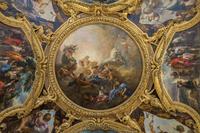
The Chariot of Apollo
Charles de La Fosse
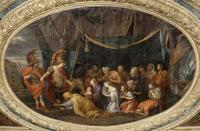
Antichambre de la reine - La famille de Darius au pied d'Alexandre
Charles Le Brun
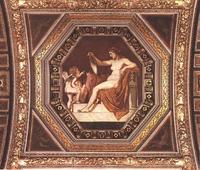
Allegorical Figure of Reality
Károly Lotz
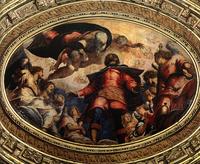
The Apotheosis of St Roch
Tintoretto
Chapel with the Lord in glory
Giorgio Vasari
The triumph of art
Leon Bonnat
Apollo Slays Python
Eugene Delacroix

Ceiling paintings
Paolo Veronese
Concordia
Domenico Beccafumi
Great Staircase, Triumph of Semele, Ceiling
Antonio Verrio