Analyse experte de Madonna Enthroned and Ten Saints de Rosso Fiorentino
Style : Mannerism (Late Renaissance) · Genre : religious painting
Artwork: Madonna Enthroned and Ten Saints by Rosso Fiorentino
Style: Mannerism (Late Renaissance)
Genre: Religious painting
Analysis: Significance within Mannerism
Rosso Fiorentino’s Madonna Enthroned and Ten Saints stands as a defining example of Mannerist religious painting, a style that deliberately broke from the balanced naturalism of the High Renaissance. Created in the early 16th century, this work encapsulates the Mannerist fascination with intellectual complexity, emotional tension, and formal artifice—all hallmarks that mark a conscious departure from the harmonious ideals of Leonardo, Raphael, and Michelangelo.
1. Departure from High Renaissance clarity
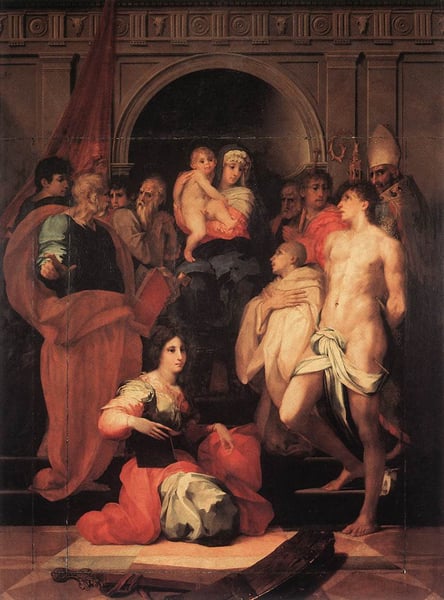
Unlike the serene, centralized compositions of the preceding era, Rosso’s arrangement of the Madonna and ten saints is deliberately crowded and ambiguous. The sheer number of figures—ten saints surrounding the Virgin—creates a compressed, almost claustrophobic space. This reflects the Mannerist preference for overlapping, restless forms that challenge the viewer’s ability to easily read the scene. The spatial logic is destabilized: figures seem to press forward or recede unnaturally, denying the clear recession of perspective that defined earlier altarpieces.
2. Stylized elegance and expressive distortion
Rosso was a master of the Mannerist “figura serpentinata”—the serpentine, elongated pose that gives figures a sinuous, artificial grace. Even in a devotional context, the saints likely display exaggerated proportions, refined gestures, and contorted postures that prioritize visual drama over naturalistic plausibility. This aesthetic choice was not merely decorative; it served to heighten the spiritual intensity, pulling the viewer into a realm of heightened emotion and mystical fervor.
3. Acidic color palette and tonal dissonance
Rosso is famous for his striking, sometimes shrill color combinations—lime greens, sharp oranges, and cold blues—that create a sense of unease and dislocation. In a religious painting, such dissonant hues would have felt deliberately unsettling to contemporary viewers, emphasizing the profound mystery and otherworldliness of the sacred subject rather than comforting familiarity.
4. Iconographic density
The inclusion of ten saints is itself significant. The number suggests a complex theological or local program, possibly referencing the patron saints of a specific church or confraternity. Mannerist artists often embraced learned, allusive iconography as a way to demonstrate their intellectual sophistication. Rather than simplifying the narrative for clarity, Rosso layers multiple holy figures in a compressed format, inviting the educated viewer to decipher each saint’s attributes and identity.
5. Historical context: The crisis of the Renaissance
Painted during a period of political and religious turmoil—the Sack of Rome (1527) occurred shortly after Rosso’s active years—this work reflects the growing spiritual anxiety of the late Renaissance. Mannerism emerged as a response to the perceived perfection of earlier art: where High Renaissance artists sought order and beauty, Mannerists like Rosso embraced irresolution, elongation, and emotional charge to convey a world in flux. Madonna Enthroned and Ten Saints thus stands as a pivotal monument in the transition from Renaissance harmony to the more subjective, expressive currents that would lead towards Baroque art.
Conclusion
Rosso Fiorentino’s Madonna Enthroned and Ten Saints is significant not for its adherence to classical ideals but for its deliberate subversion of them. It exemplifies Mannerism’s core ambition: to transform religious painting into a vehicle for artificial elegance, emotional intensity, and intellectual complexity. In this work, the sacred is made strange—and thereby more compelling.
Visuellement similaire
20 œuvres à la composition et à la palette proches
Presentation Of The Virgin In The Temple
Francisco Herrera
Dido Receiveng Aeneas and Cupid Disguised as Ascanius
Francesco Solimena
Discord Expels Art and Science
Theodoor van Thulden
The Four Evangelists
Peter Paul Rubens
The Martyrdom and Last Communion of Saint Lucy
Paolo Veronese
Scipio Africanus
Theodoor van Thulden
Marriage of the Virgin
Rosso Fiorentino
Allegory of Sensuality
Pompeo Batoni
Study for Antiochus and Stratonice
Pompeo Batoni
Holy Women at Christ' s Tomb
Annibale Carracci
Christ Blessing the Little Children
Adam van Noort
The Mystic Marriage of St. Catherine
Adam Elsheimer
Coronation of the Virgin with St. Catherine of Alexandria, St. John the Evangelist, St. John the Baptist
Guido Reni
Ecstasy of St. Margaret of Cortona
Giuseppe Maria Crespi
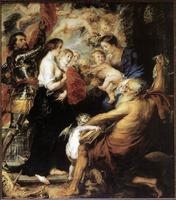
Our Lady with the Saints
Peter Paul Rubens
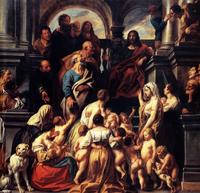
Suffer the Little Children
Jacob Jordaens
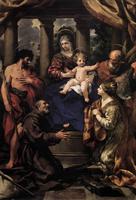
Virgin and Child with Saints
Pietro da Cortona
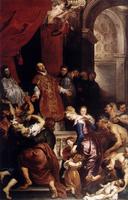
Miracles of St. Ignatius
Peter Paul Rubens
DIE RÜCKKEHR DES VERLORENEN SOHNES
Ludovico Carracci
The Gathering of the Manna
Guido Reni