Analisi esperta di Chess Players III di Willi Baumeister
Stile: Abstract Art, Cubism · Genere: figurative
Expert Analysis: Chess Players III by Willi Baumeister
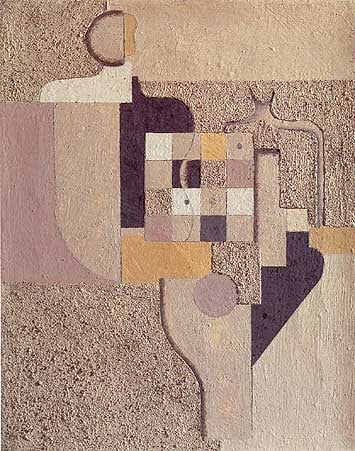
Willi Baumeister’s Chess Players III stands as a compelling synthesis of Cubist structure and abstract figuration, marking a pivotal moment in early 20th-century European modernism. Executed during a period when Baumeister was deeply engaged with the formal language of Cubism—yet pushing toward a more autonomous abstraction—this work exemplifies his ability to distill a recognizable subject into a dynamic interplay of fragmented planes, rhythmic lines, and muted, earthy tones.
What makes it significant:
-
Bridging Cubism and Abstract Art – Baumeister’s approach here is not merely derivative of Picasso or Braque. He retains a figurative core (the chess players) but treats it as a point of departure for an almost geometric symphony. The chessboard, figures, and table dissolve into overlapping, angular shapes that maintain a tense equilibrium between representation and pure form. This places the work at the threshold where Cubism’s analytical deconstruction gives way to the non-representational impulses of abstract art.
-
Thematic Resonance – The chess motif is itself significant. For Baumeister and his contemporaries, chess symbolized intellectual strategy, order, and the tension between chance and control. In Chess Players III, the visual complexity mirrors the mental intensity of the game: each shape engages with its neighbor as if in a strategic dialogue, while the confined pictorial space evokes the board’s bounded yet infinite possibilities.
-
Contribution to German Modernism – Baumeister was a central figure in the German avant-garde before his work was suppressed by the Nazi regime. Chess Players III represents his refined, studio-driven exploration of form—distinct from Expressionism’s emotionalism and closer to the cool, architectonic investigations of the Bauhaus and De Stijl. Its balanced asymmetry and restrained palette (gray, ochre, black, white) reveal a commitment to universal, timeless composition over individual psychology.
-
Precursor to Later Abstract Works – This painting foreshadows Baumeister’s mature style of the 1940s and 1950s, where figurative allusions become even more enigmatic. Chess Players III retains enough legibility to ground the viewer, yet its bold simplification of anatomy and space anticipates the reductive, ideogram-like forms that would define his post-war output.
In summary, Chess Players III is significant as a masterful integration of Cubist method and abstract ambition—a work that does not abandon the figure, but reimagines it through a lens of structural purity and intellectual play. It is a testament to Baumeister’s role as a synthesizer and innovator within the German modernist tradition.
Visivamente simili
20 opere con composizione e palette affini
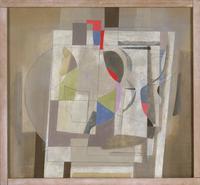
Feb 2-54
Ben Nicholson
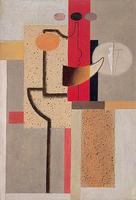
The Sculptor
Willi Baumeister
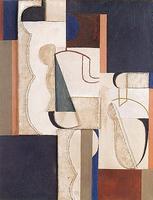
Three Stepped Figures
Willi Baumeister
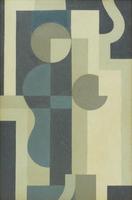
Bach fuga i grått
Otto Gustav Carlsund
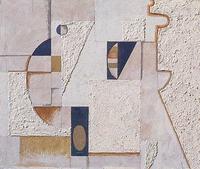
Wall Picture with Segments
Willi Baumeister
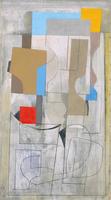
Feb 28-53 (vertical seconds)
Ben Nicholson
Composition
Albert Gleizes
Wall Picture with Metals
Willi Baumeister
Strolling
Will Barnet
Untitled
Sandu Darie
Hockey
Willi Baumeister
Head and two boxers
Victor Brauner
Intervista con la materia
Enrico Prampolini
Hommage à Delaunay et Gleizes
Adolf Fleischmann
Machine with Red Square
Willi Baumeister
El Náhuatl
Carlos Merida
Mechanical Elements on red background
Fernand Leger
Untitled
Maurice Esteve
Untitled
Maurice Esteve
Composition abstraite
Serge Poliakoff