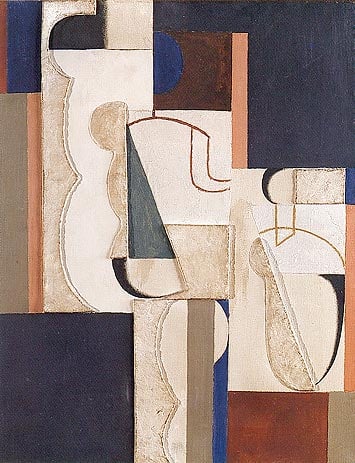
Expert analysis of Willi Baumeister’s Three Stepped Figures
Style: Abstract Art · Genre: abstract
This analysis is based solely on the provided facts: artist Willi Baumeister, the title Three Stepped Figures, and the classification as Abstract Art (abstract genre).
Expert Analysis of Three Stepped Figures
Willi Baumeister’s Three Stepped Figures is a significant work within the trajectory of mid-20th-century European abstraction. Created by a key figure in post-war German art, this piece exemplifies Baumeister’s signature synthesis of archaic, totemic forms with modern, geometric abstraction. The title hints at a structure of vertical, tiered humanoid shapes—likely simplified into stepped blocks or ladder-like contours—that simultaneously evoke primitive sculpture and architectural order.
Significance within Abstract Art:
-
Archetypal Reduction: Baumeister was deeply influenced by cave painting and ancient Mediterranean art, yet he translated those organic, ritualistic forms into a strictly abstract vocabulary. Three Stepped Figures likely reduces the human body to its most elemental, rhythmic volumes, stripping away narrative in favor of universal, symbolic presence. This aligns with Baumeister’s search for a “primordial” abstract language, a pursuit that set him apart from purely geometric abstractionists like the Bauhaus or De Stijl.
-
Tension Between Flatness and Depth: The “stepped” motif suggests a play between shallow relief and two-dimensional painting. Baumeister often used layered, textured surfaces (e.g., sand mixed with paint) to create archaeological strata on the canvas. The figure-as-step becomes a threshold between figure and ground, past and present—a core innovation in his abstract figure-ground relationship.
-
Legacy in Post-War Abstraction: As a professor at the Stuttgart Academy, Baumeister mentored a generation of artists who would later define German Informel. Three Stepped Figures stands as a bridge between the expressive figuration of the early 20th century and the radical non-objectivity that followed. Its significance lies in proving that abstraction could retain a corporeal, almost tribal memory without resorting to representation—an idea that influenced both European Art Informel and American Abstract Expressionist notions of the “sign.”
In summary, this artwork is significant for how it distills the human form into a universal, stepped code—an architectural rhythm that speaks to Baumeister’s belief in abstraction as a timeless, essential language.
Genre
Style
Visually similar
20 works with related composition and palette
Feb 28-53 (vertical seconds)
Ben Nicholson
Feb 2-54
Ben Nicholson
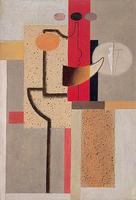
The Sculptor
Willi Baumeister
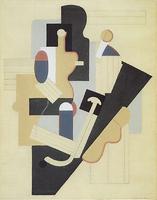
Hockey
Willi Baumeister
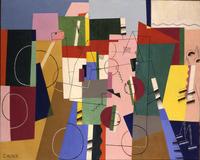
Landscape
Georges Valmier
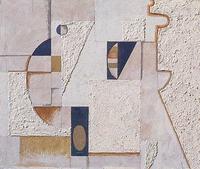
Wall Picture with Segments
Willi Baumeister
1934-6 (painting - still life)
Ben Nicholson
Summer Studio #2
Perle Fine
Cubist Composition
Georges Valmier
Folk Motives (variation)
Lajos Kassak
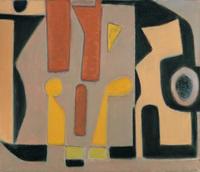
Strolling
Will Barnet
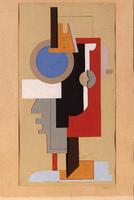
Abstrakte Komposition
Willi Baumeister
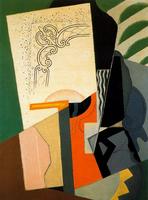
Composición Cubista
Maria Blanchard
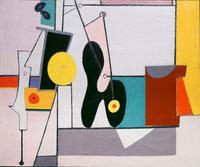
Organization
Arshile Gorky
Cirkus
Toyen
Cubist Composition
Georges Valmier
Head and two boxers
Victor Brauner
Interior
Robert Blackburn
Head
Auguste Herbin
Mechanical Elements on red background
Fernand Leger