Anthony Caro sanatçısının Black Cover Flat eseri hakkında uzman analizi
Tarz: Abstract Art · Tür: sculpture
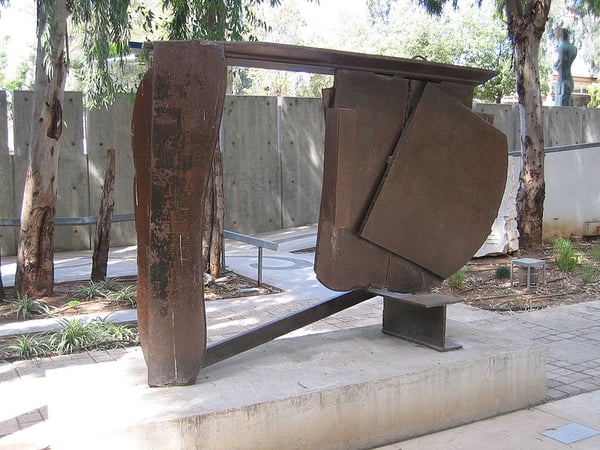
Expert Analysis: "Black Cover Flat" by Anthony Caro
"Black Cover Flat" exemplifies a pivotal moment in late 20th‑century sculpture, where Anthony Caro redefined the medium by breaking free from traditional pedestal‑based, figural conventions. As an Abstract Art sculpture, Caro’s work is significant for its radical materiality, its engagement with ground‑plane composition, and its rejection of illusionistic space in favor of direct, physical presence.
Key Significance within Abstract Sculpture:
-
Material and Surface: Caro’s use of industrial steel—often painted in monochrome colors—was groundbreaking. For “Black Cover Flat,” the black paint is not merely a decorative finish but an essential component that unifies the fabricated metal elements. The matte black surface suppresses light reflections, forcing the viewer to concentrate on the sculpture’s silhouette, volume, and the relationship between its parts. This approach aligns with Caro’s broader practice of treating color as a structural, rather than representational, tool.
-
Horizontal, Ground‑Hugging Composition: Unlike traditional sculpture that rises vertically on a base, Caro’s compositions are often low and spread across the floor. “Black Cover Flat” likely emphasizes this horizontality, inviting the viewer to encounter the piece at eye level and walk around it. This breaks the barrier between artwork and spectator, making the sculpture part of the viewer’s physical space. Caro was influenced by the “drawing in space” of David Smith and by the directness of American Abstract Expressionist painting, but he pushed further by eliminating the pedestal entirely.
-
Formal Abstraction and Negative Space: The title “Black Cover Flat” suggests a deliberate flatness or covering action, possibly using planar elements that hover, project, or intersect in ambiguous ways. Caro’s sculptures are built from welded steel beams, sheets, and tubes, arranged in abstract, non‑representational configurations. The significance lies in how the work negotiates solidity and void: the black surfaces define and activate the surrounding empty space, making negative space as integral as the metal itself. This interplay reflects Caro’s debt to Constructivism and his own modernist quest for pure, self‑referential form.
-
Influence on Post‑Minimalism and Site‑Specificity: By the time Caro created works like “Black Cover Flat,” he had already shifted the course of British and international sculpture. His insistence on low, sprawling, non‑hierarchical forms influenced later movements such as Land Art and Process Art. The work’s refusal to represent anything beyond its own materials and structure aligns with the core tenets of Abstract Art, where meaning emerges from direct perceptual experience rather than narrative symbolism.
In sum, “Black Cover Flat” is significant as a mature example of Caro’s ability to transform industrial metal into a lyrical, spatial composition that redefines how sculpture inhabits the world. It stands as a testament to the artist’s role in liberating abstract sculpture from both figurative tradition and the constraints of the base, opening new possibilities for the medium in the modern era.
Görsel olarak benzer
İlişkili kompozisyon ve renk paletine sahip 20 eser
Transparent Horizon
Louise Nevelson
Lagoon
Anthony Caro
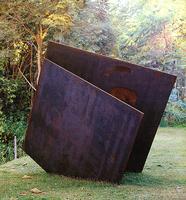
Untitled
Amilcar de Castro
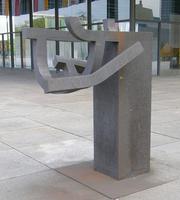
Gudari
Eduardo Chillida
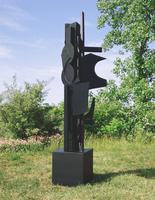
Night Tree
Louise Nevelson
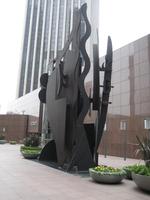
Night Sail
Louise Nevelson
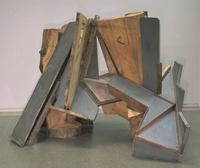
Within
Phillip King
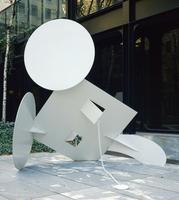
Geometric Mouse, Scale A
Claes Oldenburg
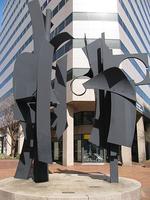
Sky Landscape
Louise Nevelson
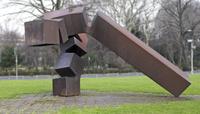
Monumento
Eduardo Chillida
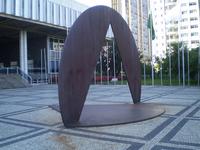
Escultura no Hall das Bandeiras da Assembleia Legislativa de Minas Gerais
Amilcar de Castro
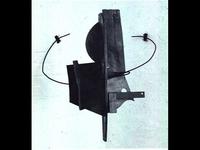
Tatlin Relief 2
Vladimir Tatlin
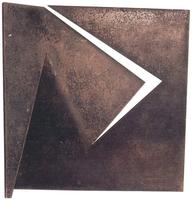
Untitled
Amilcar de Castro
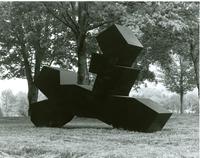
Caephae-Aekyad #2
Douglas Abdell
Host of the Ellipse (Garden)
Ronald Bladen
Sky Hook (Maquette)
Louise Nevelson
Ferro
Mark di Suvero
Two Forms (Divided Circle) (BH 477)
Barbara Hepworth
Black Lightining (Garden)
Ronald Bladen
Sister Lu
Mark di Suvero