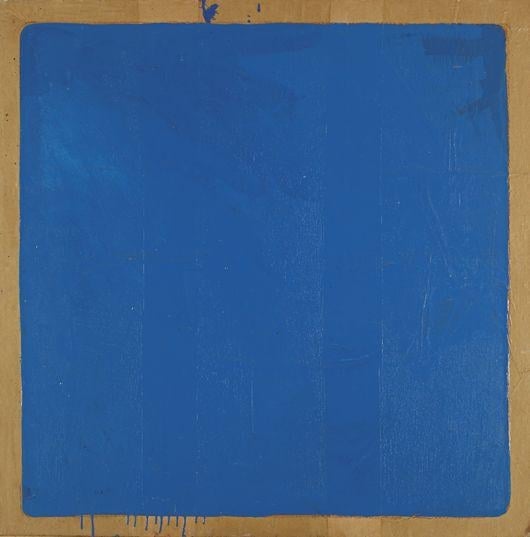
Expert analysis of Mario Schifano’s Monocromo blu
Style: Nouveau Réalisme · Genre: abstract
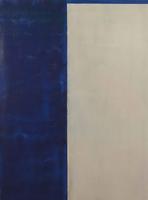
Expert Analysis: "Monocromo blu" (Blue Monochrome) by Mario Schifano
Although presented here as an abstract work, Mario Schifano’s Monocromo blu gains its true significance within the context of Nouveau Réalisme—the French movement founded in 1960 that sought to “appropriate fragments of reality” (real objects, industrial materials, urban debris) rather than represent them through illusion. Schifano, an Italian painter closely aligned with the movement, used this monochrome to collapse the boundary between painting and the everyday environment.
Key aspects of its significance:
-
Industrial Materiality: Schifano often applied standard commercial house paint—not fine art pigment—onto canvas or even metal supports. In Monocromo blu, the flat, uniform blue surface rejects the expressive brushwork of Abstract Expressionism. Instead, it mirrors the mass-produced, anonymous color of factory goods, bureaucratic forms, or billboard signage. This aligns with Nouveau Réalisme’s insistence on presenting “the real” in its raw, unmediated state.
-
Challenging the “Painting as Window”: By eliminating composition, gesture, and depth, the monochrome becomes an object—a thing in itself—rather than a representation. Schifano’s blue is not a mood or a symbol (unlike Yves Klein’s spiritual IKB); it is a literal, industrial color swatch. The work functions as a “ready-made” painting, echoing Marcel Duchamp’s influence on Nouveau Réalisme.
-
Contextual Dialogue with Italian Pop and Monochrome Traditions: While Nouveau Réalisme was primarily French, Schifano’s monochromes occupy a unique position between Pop Art (the slick, mediated surface) and Arte Povera (the use of humble materials). Monocromo blu’s aggressive flatness and lack of illusion prefigures the Italian art movement’s later fascination with industrial and found surfaces.
-
Significance within the Style: In Nouveau Réalisme, the monochrome is not a retreat into pure abstraction but an act of appropriation. Schifano takes “blue” from the realm of synthetic color—the kind used on factory walls, road signs, or plastic products—and presents it as a literal fragment of modern urban reality. The work thus embodies the movement’s central paradox: a painting that is abstract yet utterly real, because its color and material are borrowed directly from the contemporary world.
In sum, Monocromo blu is significant not for what it depicts (nothing), but for what it is: an industrial artifact disguised as a painting, challenging the viewer to reconsider the nature of artistic media, the role of mass culture, and the very definition of realism in the postwar era.
Visually similar
20 works with related composition and palette
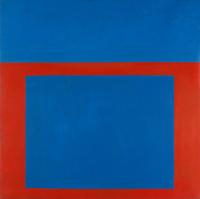
"Cool" Series No. 7 (Square Shooter)
Perle Fine
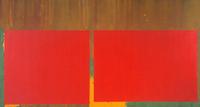
17. 3. 69
John Hoyland
Untitled (blue)
Gunther Forg
4.5.68
John Hoyland
Classic Yellow Sun-Box
Theodoros Stamos
Untitled
Gerwald Rockenschaub
Untitled Green Monochrome
Yves Klein
Untitled
Gunther Forg
"Cool" Series (Dark Pink over Brown)
Perle Fine
Infinity Field, Nemea Series #4
Theodoros Stamos
The Third
Barnett Newman
Untitled
Mario Schifano
Untitled Mural for End Wall
Mark Rothko
"Cool" Series No. 46 (Spanking Fresh)
Perle Fine
Untitled No. 5
Michael Heizer
Irregular Form
Sol LeWitt
Vermilion II
Frederic Matys Thursz
Bad Honnef Multiple
Gunther Forg
Inval
Raoul De Keyser
Ligne rouge II n°19
Genevieve Asse