Expertenanalyse zu Alighiero Boettis Ma cosa fai? Ma cosa dici?
Stil: Minimalism · Genre: abstract
Expert Analysis: "Ma cosa fai? Ma cosa dici?" by Alighiero Boetti
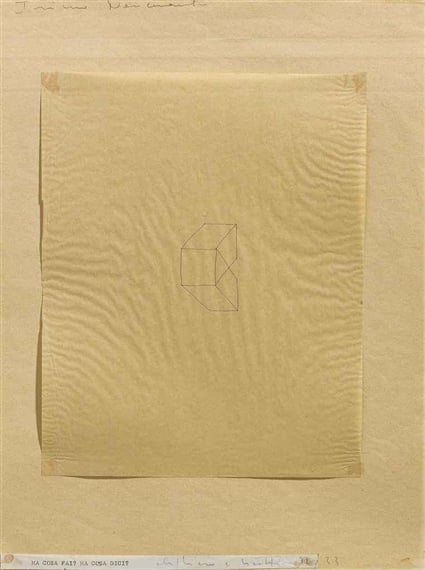
Alighiero Boetti’s "Ma cosa fai? Ma cosa dici?" (English: "But what are you doing? But what are you saying?") stands as a compelling intersection of Minimalist discipline and conceptual wordplay. While Boetti is often associated with Arte Povera and Conceptual art, this work exemplifies a Minimalist vocabulary through its stark, repetitive structure and reduction to fundamental elements. Created as part of his series of embroidered texts or inscribed surfaces, the piece presents a tautological linguistic loop: the Italian phrase is itself the subject and the object, the question and the answer.
Significance within Minimalism and Abstract Genre:
The work’s significance lies in how it pushes Minimalism beyond pure geometric abstraction into semantic abstraction. Rather than reducing form to shape and color, Boetti reduces language to its barest communicative function—repetition. The phrase “Ma cosa fai? Ma cosa dici?” is repeated or presented in a grid-like composition, echoing Minimalist principles of seriality, uniformity, and the denial of expressive hierarchy. By using text as an abstract pattern, Boetti transforms everyday speech into a visual field where meaning oscillates between literal reading and formal contemplation.
Conceptual Depth:
The title’s dual questioning—what are you doing? and what are you saying?—creates a reflexive commentary on the act of making and interpreting art. In the context of Minimalism, which often sought to eliminate narrative, Boetti reintroduces language as a material that simultaneously reveals and obscures its own meaning. The work invites viewers to question whether they are engaging with a simple phrase or a meditative mantra, a conceptual puzzle or a decorative pattern. This ambiguity is the work’s core achievement: it bridges the austerity of Minimalist aesthetics with the playful, self-referential logic of conceptual art.
Artistic Legacy:
"Ma cosa fai? Ma cosa dici?" is significant for demonstrating that Minimalism need not be purely non-referential. Boetti’s inclusion of language as a formal element expands the movement’s boundaries, anticipating later developments in text-based art and post-minimalist conceptualism. The work remains a key example of how artists in the 1960s–70s challenged the strictures of Minimalist dogma while honoring its commitment to simplicity, repetition, and the primacy of the object.
Genre
Stil
Visuell ähnlich
20 Werke mit ähnlicher Komposition und Farbpalette
Untitled
Christopher Wilmarth
Untitled
Marc Vaux
Untitled
Marc Vaux
Time and Space Series 2
Kazuo Nakamura
Déka 27
John Cage
Grün / Orange 3:1
Camille Graeser
Untitled from Seven Aquatints
Robert Mangold
UNHL BLEU II, 4 -70
Jean Degottex
Radiation of Purple
Max Bill
Untitled
Fred Sandback
Study for White Sculpture
Ellsworth Kelly
Lago d'Orta
Antonio Calderara
Untitled
Max Bill
Untitled
Gotthard Graubner
Pictorial Architecture
Lajos Kassak
Pier-Piet
Alighiero Boetti
Depli bleu (II)
Jean Degottex
Dialogue 10
Vasile Dobrian
Composition 4
Stefan Sevastre
Zerstrahlung aus Rotem Kern
Max Bill