Sengai sanatçısının Kanzan and Jittoku eseri hakkında uzman analizi
Tarz: Ink and wash painting · Tür: religious painting
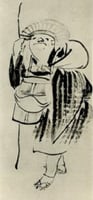
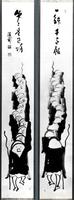
Sengai’s Kanzan and Jittoku is a masterwork of ink and wash painting executed within the religious painting genre, and its significance lies in how the medium and subject are fused to embody the very essence of Zen Buddhism.
The ink and wash style—characterized by swift, minimalist brushstrokes and a deliberate economy of ink—is not merely a technical choice but a spiritual one. In this work, Sengai uses the brush’s spontaneity to capture the unguarded, playful nature of the two legendary Zen eccentrics Kanzan and Jittoku. Their gestures are reduced to essential lines, suggesting a state of enlightened simplicity: the ink itself becomes a metaphor for the sudden, direct transmission of insight that Zen prizes.
As a religious painting, the piece transcends mere portraiture. Instead of illustrating a strict doctrinal scene, it presents the two figures in a moment of joyful, unbounded freedom—an embodiment of the Zen ideal of awakening in everyday life. Sengai’s composition leaves ample blank space (the “empty” or yohaku in Japanese aesthetics), which is not emptiness but a charged void representing the formless nature of ultimate reality.
What makes this work significant is its radical reduction: it achieves profound religious meaning not through detail or narrative, but through the concentrated power of a few brushstrokes. In his hands, the ink and wash style becomes a form of meditation, and the religious painting genre is reinvented as a direct, unmediated expression of Zen mind.
Görsel olarak benzer
İlişkili kompozisyon ve renk paletine sahip 20 eser
Untitled
Sengai
Traveling Monk and kyoku
Sengai
Begging Monks
Deiryu
Ôtaka Gengo Tadao
Utagawa Kuniyoshi
Yazama Kihei Mitsunobu
Utagawa Kuniyoshi
Untitled
Sengai
Hitomaro
Hakuin Ekaku
Drenching
Sengai
Opera Figures: Farewell my Concubine
Ding Yanyong
Yoshida Chûzaemon Kanesuke
Utagawa Kuniyoshi
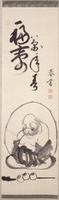
Hotei
Joshu Shunso
All the World's a Stage
Ding Yanyong
Cherry blossom viewing during the Genroku period
Toyota Hokkei
Page from Shotōzan Tenarai Hōjō in Which a Picture by Sharaku Appears on a Kite
Tōshūsai Sharaku
Dipicting the characters from the Chushingura
Utagawa Kuniyoshi
Sumino Jûheiji Tsugufusa
Utagawa Kuniyoshi
Actors
Utagawa Kuniyoshi
Front-Facing Daruma
Soen Kogaku
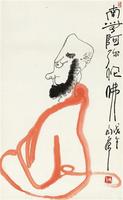
Figure
Ding Yanyong
The man with the comb
Qi Baishi