Analisi esperta di Traveling Monk and kyoku di Sengai
Stile: Ink and wash painting · Genere: portrait
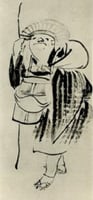
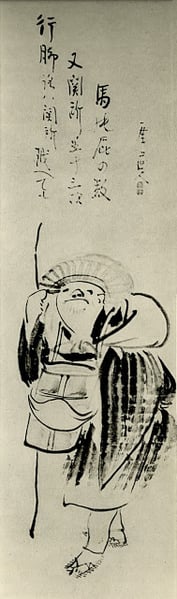
This ink-wash portrait by Sengai, a Zen monk of the Edo period, exemplifies the radical economy of means central to Zen ink painting. The work’s significance lies in its deliberate departure from realistic depiction toward a pure, expressive essence.
-
Style as Philosophy: Sengai’s brushwork is not merely a technique but a direct channel for Zen insight. Each stroke is swift, confident, and seemingly spontaneous—a visual koan. The minimal ink and water application on the “Traveling Monk” captures the subject’s itinerant, detached nature in just a few gestures, embodying the Zen ideals of simplicity (wabi) and impermanence (mono no aware).
-
Genre Reinterpretation: This is a portrait of a type, not an individual. The monk is defined by his attribute—a kyoku (likely a walking staff or flute) and his humble posture. Sengai subverts traditional portraiture by focusing on the universal, archetypal condition of the wandering monk, inviting the viewer to contemplate the emptiness of self.
-
Period Significance: Within the ink-wash tradition, Sengai occupies a unique place between the formal literati style and the later, more playful ukiyo-e. His work distills centuries of Chinese and Japanese ink painting into a direct, humorous, and deeply spiritual statement. Here, the “kyoku” might symbolize the monk’s sole earthly companion—a tool for begging or music—further emphasizing the theme of transient existence.
Ultimately, the artwork’s power arises from what is left unsaid. The viewer is asked to complete the picture in their own mind, mirroring the act of Zen meditation. Sengai’s “Traveling Monk and kyoku” is less a portrait and more a philosophical prompt, making it a masterwork of Zen visual culture.
Genere
Visivamente simili
20 opere con composizione e palette affini
Hitomaro
Hakuin Ekaku
Untitled
Sengai
Drinking Tea
Huang Yongyu
Untitled
Sengai
Gale to Asajigahara
Katsushika Hokusai
Drenching
Sengai
Untitled
Sengai
One hand clapping
Hakuin Ekaku
A fisherman with a fishing rod
Qi Baishi
Daruma
Joshu Shunso
Self-portrait
Hakuin Ekaku
Reclining Daruma
Joshu Shunso
The man with the comb
Qi Baishi
Kanzan and Jittoku
Sengai
Daruma
Soen Kogaku
Fisherman and Fisherwoman
Huang Shen
Hotei
Utagawa Kuniyoshi
Shotoku Taishi
Kogan Gengei
The Seven Lucky Gods
Tsukioka Yoshitoshi
Denouncement of Cao Cao
Ding Yanyong