The Goldfish Pool at Chartwell
Analisi esperta di The Goldfish Pool at Chartwell di Winston Churchill
Stile: Impressionism · Genere: landscape
Expert Art Historical Analysis: "The Goldfish Pool at Chartwell" by Winston Churchill
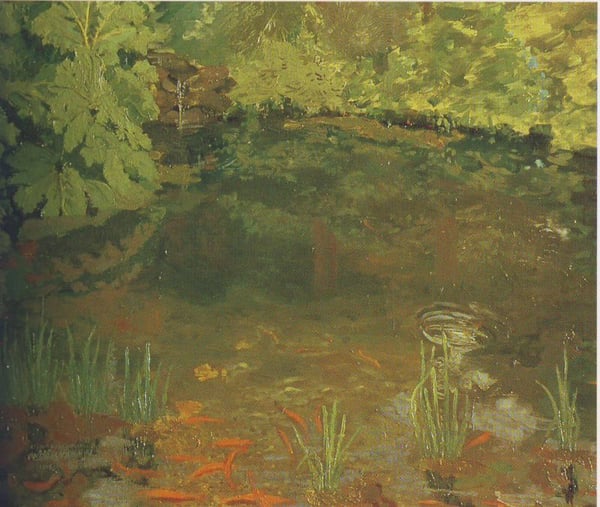
As an Impressionist landscape, "The Goldfish Pool at Chartwell" captures a fleeting moment of light and atmosphere at Churchill’s beloved country home. The painting exemplifies the core tenets of Impressionism—rapid, visible brushwork, a focus on natural light, and a vibrant, often unblended palette—transforming a simple garden feature into a shimmering study of reflection and color. The goldfish pool itself becomes a prismatic lens: dappled sunlight dances on the water’s surface, while the surrounding foliage is rendered in broken strokes of green, blue, and gold, suggesting movement and the transient quality of the scene.
Significance within Impressionism and Churchill’s Oeuvre
-
Churchill’s Dual Legacy: This work is significant because it represents the private, contemplative side of a towering public figure. For Churchill, painting was a respite from political pressures, and his adoption of Impressionism allowed him to express emotion through color and texture rather than rigid detail. The piece stands as a testament to the therapeutic power of art—Churchill often called painting his “muse” and a necessary counterbalance to leadership.
-
Impressionist Devotion: While not a revolutionary Impressionist, Churchill absorbed the movement’s core lessons from artists like Sir John Lavery and Paul Maze. In The Goldfish Pool at Chartwell, he applies those lessons with sincerity: the water reflects the sky and trees in broken patches, and the goldfish themselves are suggested by small dabs of orange and red, dissolving form into light. This aligns with the Impressionist goal of recording a sensory impression rather than a precise topographical map.
-
Place as Personal Symbol: Chartwell was Churchill’s sanctuary, and the goldfish pool—a modest, man-made feature—is elevated to an iconic landscape subject. The painting’s significance lies in how it transforms a personal domestic space into a universal Impressionist motif: the interplay of water, light, and nature. It shows Churchill not as a “gentleman amateur” but as a committed practitioner who understood that Impressionism’s true subject is always light in motion.
In sum, The Goldfish Pool at Chartwell matters because it bridges statesmanship and artistry, offering a rare window into the inner life of a historical giant while faithfully serving the Impressionist love affair with natural light and ephemeral beauty.
Genere
Stile
Visivamente simili
20 opere con composizione e palette affini
Lake at Blenheim
Winston Churchill
Yerres, on the Pond, Water Lilies
Gustave Caillebotte
Overgrown Pond
Konstantin Somov
The Etang des Soeurs at Osny
Paul Cezanne

Park in Olshanka
Vasily Polenov
Clearing After Rain, Maganatawan River, Ontario
J. E. H. MacDonald
At the park
Isaac Levitan
Brook in Woods
T. C. Steele

San Antonio River
Robert Julian Onderdonk
Water Lily Pond at Giverny
Claude Monet
The Pond at Montgeron
Claude Monet
Coltsfoot
Ivan Shishkin
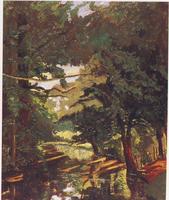
Wooded Water near Blenheim
Winston Churchill
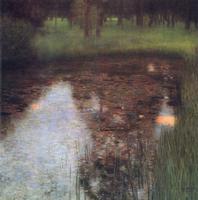
The Swamp
Gustav Klimt
Ivan Trush Little Pond
Trush Ivan Ivanovych
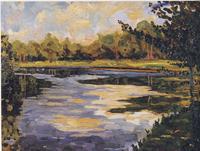
Lake near Breccles in Autumn
Winston Churchill

Pond
Konstantin Korovin
Brumes a Villeneuve l'Elang
Henri Biva

Landscape
Ivan Shishkin
Spring Landscape
Emil Carlsen