
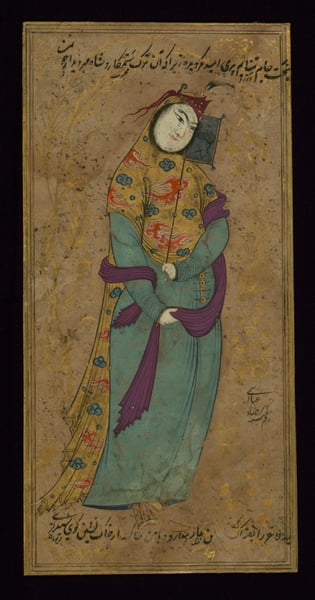
A Lady with a Fan
Analyse experte de A Lady with a Fan de Reza Abbasi
Style : Safavid Period · Genre : miniature
Based solely on the structured facts provided—that the artwork is A Lady with a Fan by Reza Abbasi, belonging to the Safavid Period style and the miniature genre—its significance can be analyzed as follows:
Significance within the Safavid Period:
- The Safavid period (16th–18th centuries) represents the golden age of Persian miniature painting, characterized by exquisite detail, rich color palettes, and a synthesis of Persian, Chinese, and European influences. Reza Abbasi was the leading artist of the Isfahan school under Shah Abbas I, and his work marks a pivotal shift in the genre.
- Unlike earlier Safavid miniatures that focused on manuscript illustration (epics, histories), Abbasi pioneered the single-figure portrait in album leaves, elevating the miniature from narrative decoration to an independent art form. A Lady with a Fan exemplifies this innovation: the subject is isolated from a narrative context, allowing the viewer to focus on refinement, elegance, and individual character.
Significance within the Miniature Genre:
- Abbasi’s miniatures are celebrated for their naturalistic yet stylized treatment of figures. In A Lady with a Fan, the fine linework, flowing fabrics, and subtle modeling of the face (soft shading, arched eyebrows, almond eyes) demonstrate a departure from the more rigid, idealized formulas of earlier Persian painting.
- The fan itself is a symbol of status and grace, a recurring motif in Abbasi’s courtly scenes. The composition’s balance between delicate ornamentation (the patterned fabric, the fan’s ribs) and lifelike poise highlights the artist’s mastery of line and silhouette, central to the miniature genre.
Artistic Legacy:
- This work is significant as an archetype of Safavid courtly elegance, capturing the sophisticated aesthetic of the Isfahan court. Reza Abbasi’s focus on the individual—often a beautiful youth or a noblewoman—influenced later Persian and Mughal painting. A Lady with a Fan stands as a testament to his role in transforming the miniature into a vehicle for intimate, worldly beauty rather than purely sacred or heroic themes.
In summary, the artwork’s significance lies in its representation of a turning point in Safavid miniature painting: the shift toward secular portraiture, refined naturalism, and the celebration of delicate, personal detail within a traditionally narrative genre.
Genre
Style
Visuellement similaire
20 œuvres à la composition et à la palette proches
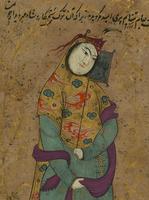
A Lady with a Fan (detail)
Reza Abbasi
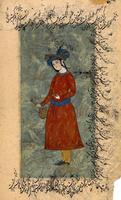
Young man with a bottle and a wine-cup
Reza Abbasi
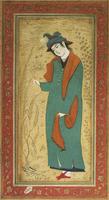
Cup-bearer
Reza Abbasi
Two Lovers
Reza Abbasi
Youth reading
Reza Abbasi
Young woman in a white wrap
Reza Abbasi
Girl
Reza Abbasi
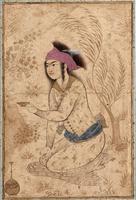
Youth kneeling and holding out a wine-cup
Reza Abbasi
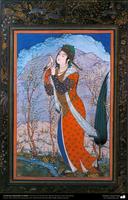
Prince and hawk
Hossein Behzad
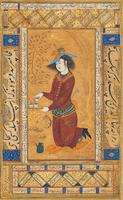
Saki
Reza Abbasi
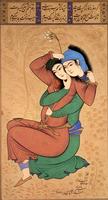
A Miniature, After Reza Abbasi
Aydin Aghdashloo
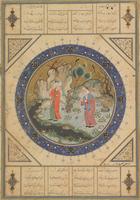
The Old Man and the Youth
Kamal ud-Din Behzad
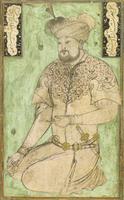
Portrait of Sultan Husayn Mirza Bayqara at the Age of About 50 Years.
Kamal ud-Din Behzad
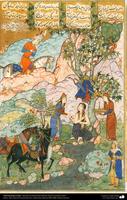
Bathing Shirin
Hossein Behzad

Princely Youth and Dervish (attributed)
Reza Abbasi
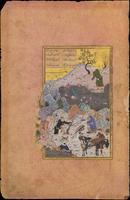
The Anecdote of the Man Who Fell into the Water
Kamal ud-Din Behzad
Allegory of Drunkenness
Sultan Muhammad
Celebration of Seven Domes
Hossein Behzad

Portrait of the Poet Hatifi
Kamal ud-Din Behzad
Untitled
Mirza Agha Emami