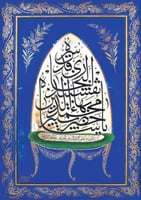
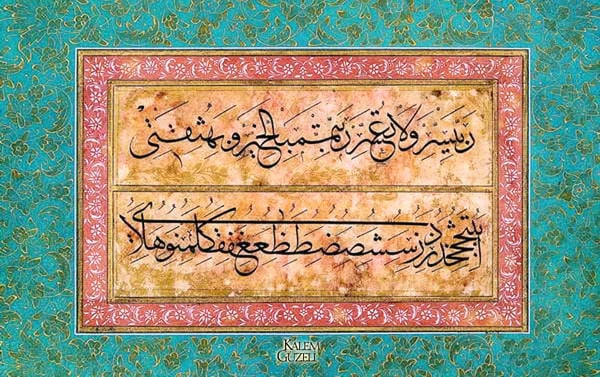
Muttasıl Müfredat
Analisi esperta di Muttasıl Müfredat di Mustafa Rakim
Stile: Ottoman Period · Genere: calligraphy
Analysis of "Muttasıl Müfredat" by Mustafa Rakim
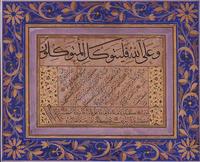
Mustafa Rakim (1757–1826) is revered as one of the supreme masters of Ottoman calligraphy, and Muttasıl Müfredat (literally "Connected Isolated Letters") is a landmark work that exemplifies his revolutionary approach to the sülüs (thuluth) and nesih scripts.
Significance within the Ottoman Calligraphic Tradition:
- Synthesis of Composition: The title itself points to the work’s pedagogical and artistic genius: Rakim presents the Arabic letters in both their isolated (müfredat) and connected (muttasıl) forms within a single, harmonious layout. This was not merely a technical exercise but a demonstration of how individual letter shapes could flow seamlessly into words, embodying the core principle of Islamic calligraphy—that the written word is a living, rhythmic organism.
- Proportional Perfection: Rakim refined the proportional system established by the earlier master Hâfız Osman (1642–1698), but he added a new level of geometric precision and fluidity. In Muttasıl Müfredat, the spacing between letters, the curvature of strokes, and the balance of thick and thin lines achieve an almost musical equilibrium. His use of the “nokta” (dot) as a unit of measurement governs every curve, making the script appear both mathematically flawless and spontaneously graceful.
- Innovation in Script Style: Rakim is particularly celebrated for his sülüs letterforms, which he made more upright and elongated while retaining their classic elegance. This work showcases his signature “Rakim style” (often called Rakimî), where the alif stands straight as a reed, the sin curls with a controlled tension, and the final ye descends in a subtle, weighted arc. He also introduced a distinctive way of connecting certain letters (e.g., the he and lam-alif) that became a model for later generations.
- Historical Context: Created during the late Ottoman period—a golden age of calligraphy—Muttasıl Müfredat served as both a teaching tool and a masterpiece of sacred aesthetic. Rakim’s work influenced the next great calligrapher, his own student Mustafa İzzet (1801–1876), and through him shaped the standard Ottoman school of calligraphy that persisted into the 20th century.
Artistic Impact:
Beyond its technical brilliance, Muttasıl Müfredat is significant because it transforms a functional alphabet into a visual prayer. The letters are not merely written but composed as an abstract, rhythmic pattern—dark ink on cream paper, the strokes breathing with controlled energy. It exemplifies the Ottoman ideal of hüsn-i hat (beautiful writing) as a spiritual discipline, where each letter is a vessel for divine meaning.
In summary, this work represents the apex of Mustafa Rakim’s career: a perfect marriage of tradition and innovation, where the isolated letters of the Arabic alphabet become a unified, flowing symphony of line and space.
Visivamente simili
20 opere con composizione e palette affini
Muttasıl Müfredat
Mustafa Rakim
Untitled
Ahmed Karahisari
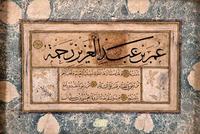
Kıta
Sheikh Hamdullah
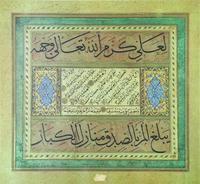
Kıta
Sheikh Hamdullah
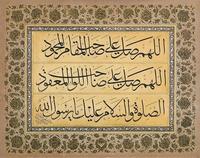
Celi Sülüs
Mustafa Rakim
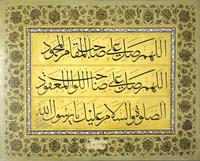
Levha
Mustafa Rakim
Untitled
Sheikh Hamdullah
Murakka (calligraphic album)
Hafiz Osman
Untitled
Ahmed Karahisari
Untitled
Sheikh Hamdullah
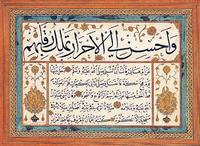
Untitled
Hafiz Osman
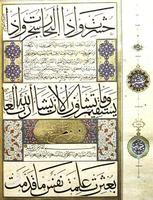
A large size mushaf
Ahmed Karahisari
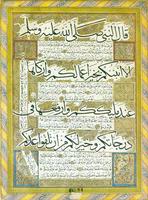
Levha - Hadis-i Şerîf
Sheikh Hamdullah
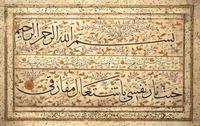
Kıta-
Sheikh Hamdullah
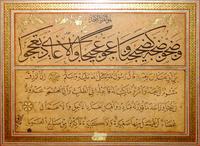
Kıta - Hadis-i Şerîf
Mustafa Rakim
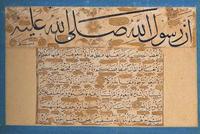
Hadith
Sheikh Hamdullah
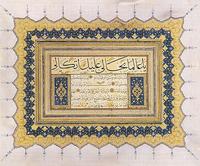
Sülüs Nesih Kıt`a
Hafiz Osman
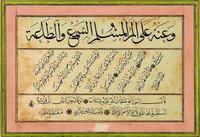
Kıta - Hadis-i Şerîfler
Mustafa Rakim
Calligraphic Writing in Sulus and Nesih scripts
Hafiz Osman
Untitled
Hafiz Osman