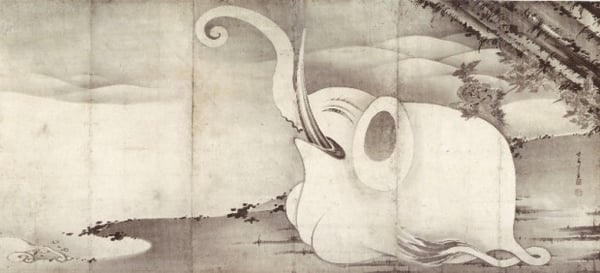
Elephant and Whale (diptych)
Analisi esperta di Elephant and Whale (diptych) di Ito Jakuchu
Stile: Ukiyo-e · Genere: animal painting
"Elephant and Whale (diptych)" by Itō Jakuchū presents a striking and unusual pairing within the ukiyo-e tradition—a genre better known for kabuki actors and scenic views than for monumental animal studies. Jakuchū, an eccentric 18th-century painter active in Kyoto, did not work in the woodblock print medium typical of later ukiyo-e but rather in meticulous brush-and-ink on silk, often with vibrant mineral pigments. His animal paintings fuse acute naturalistic observation with a decorative, almost surreal sense of pattern.
The diptych’s significance lies in its subject matter and composition. An elephant and a whale—exotic, colossal creatures rarely seen in Japan—are rendered with Jakuchū’s trademark precision. The elephant’s wrinkled hide and the whale’s spouting blowhole are depicted in exacting detail, yet the animals float in an empty, dimensionless space, divorced from any landscape or sea. This stylistic choice heightens their symbolic and otherworldly presence. In Buddhist context, elephants evoke strength and wisdom (and are associated with bodhisattvas), while whales symbolize the vast, unknowable depths of the ocean—together they suggest a cosmic or auspicious duality.
Jakuchū’s work stands apart from conventional ukiyo-e animal prints (e.g., Hokusai’s or Hiroshige’s) by its monumental stillness and decorative intensity. The diptych format itself implies a dialogue: land versus sea, mass versus fluidity, the tangible versus the sublime. By isolating these magnificent animals against a neutral ground, Jakuchū elevates them beyond mere zoological curiosity to objects of contemplative wonder. This piece exemplifies his lifelong project of capturing the “colorful realm of living beings” (Dōshoku Sai-e), where each creature is a microcosm of vitality and spiritual significance.
Genere
Stile
Visivamente simili
20 opere con composizione e palette affini
Thaishun with elephants
Utagawa Kuniyoshi
Hermits and a Fairy (Left Side)
Kanō Eitoku
琴棋書画図屏風
Kanō Motonobu
Painting on Zen Enlightenment (Sanping baring his chest and Shigong stretching his bow)
Kanō Motonobu
Right Screen
Kanō Motonobu
Birds and flowers in spring and autumn
Tosa Mitsuoki
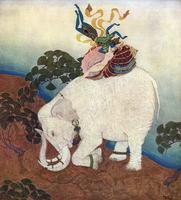
The Pearl of the Elephant, from The Kingdom of the Pearl
Edmund Dulac
Left Screen
Kanō Motonobu
In anticipation of spring
Shitao
Four Accomplishments
Kanō Motonobu
Snow Mountain
Guo Xi
Monkeys and Horses
Han Gan
Views Inside and Outside the Capital, Kyoto (Right half)
Kanō Eitoku
Hermits and a Fairy (Right side)
Kanō Eitoku
Scene on the Wang Ch‘uan
Wang Wei
Cherry trees
Tosa Mitsuoki
Cypress Trees
Kanō Eitoku
Huike Offering His Arm to Bodhidharma
Sesshu Toyo
Chowon jirok
Owon
Flowers and Birds of the Four Seasons
Kanō Motonobu