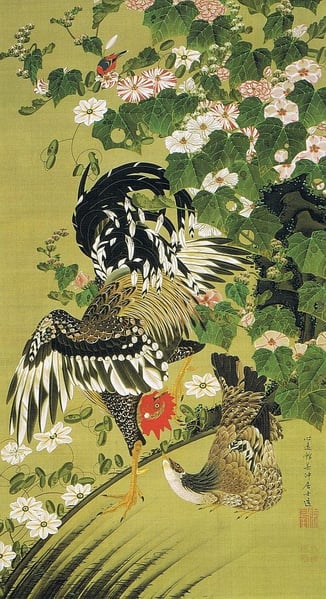
Fuyo soukeizu
Analisi esperta di Fuyo soukeizu di Ito Jakuchu
Stile: Ukiyo-e · Genere: animal painting
Ito Jakuchu’s "Fuyo soukeizu" (often translated as Hibiscus and Chickens) stands as a singular achievement within the ukiyo-e tradition, despite the artist’s approach pushing the boundaries of the style. While ukiyo-e is most commonly associated with woodblock prints of courtesans, actors, and landscapes, Jakuchu’s animal painting here demonstrates how the genre could absorb a meticulous, almost scientific naturalism while retaining the decorative flatness and bold color contrasts typical of the period.
Significance within ukiyo-e and animal painting:
- Unprecedented realism in ukiyo-e: Unlike the stylized, idealized forms of most ukiyo-e birds-and-flowers (kachō-e), Jakuchu rendered the chickens’ feathers with obsessive detail—individual barbs, subtle gradations of white and black, and the glossy texture of the comb and wattle. This hyper-realism was informed by his direct observation of living animals in his own garden.
- Compositional tension between nature and decoration: The hibiscus blossoms and leaves are treated with the same precision but arranged in a rhythmic, almost abstract pattern against a neutral background. This juxtaposition creates a dynamic interplay between the spontaneous vitality of the birds and the studied artifice of the composition—a hallmark of Jakuchu’s mature style.
- Technical virtuosity: Painted in mineral pigments and ink on silk, the work achieves a luminosity that mimics the effect of ukiyo-e woodblock printing while retaining the subtlety of a handscroll. The underpainting and layered washes give the plumage a three-dimensional volume rarely seen in contemporary ukiyo-e works.
- Conceptual innovation: Jakuchu’s focus on common barnyard chickens—rather than exotic or poetic birds—was a deliberate departure. By elevating a mundane subject to the level of high art, he challenged the hierarchical conventions of both Chinese-derived painting and ukiyo-e, anticipating later developments in Japanese realism.
In short, "Fuyo soukeizu" is significant because it reimagines ukiyo-e’s decorative vocabulary as a vehicle for penetrating naturalism, creating a work that is at once a masterpiece of observation and a bold statement of artistic independence within the ukiyo-e tradition.
Genere
Stile
Visivamente simili
20 opere con composizione e palette affini
Rooster and Hen with Hydrangeas
Ito Jakuchu
Roosters and Chicks
Xu Beihong
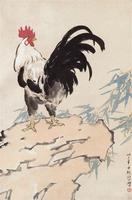
Rooster
Xu Beihong
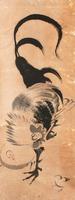
Chickens
Ito Jakuchu
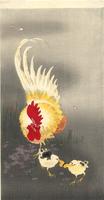
Rooster and chicks
Ohara Koson
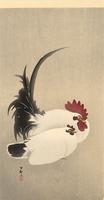
Rooster and Hen
Ohara Koson
Chicken
Shin Yoon-bok
Roosters
Ito Jakuchu
Rooster and Hen at Sunrise
Ohara Koson
Rooster
Owon
Cactus and Roosters
Ito Jakuchu
Rooster and Taro Leaves
Xu Beihong
Two roosters
Pablo Picasso
Fowl In A Damson Tree
Charles Tunnicliffe
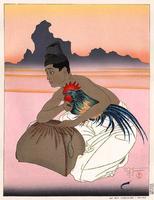
The Two Opponents (Right). Coree
Paul Jacoulet
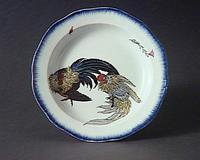
Round dish with scalloped edge
Katsushika Hokusai
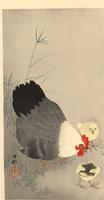
Hen and two chicks in grass
Ohara Koson
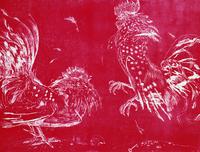
Cock Fight III.
Rudolf Láng
My Mona Lisa
Ivan Generalic
The rooster
Ivan Generalic